Environment

Nearly all unagi products found in S'pore come from threatened eel species: Study
At risk from our appetites.
April 02, 2025, 03:24 PM
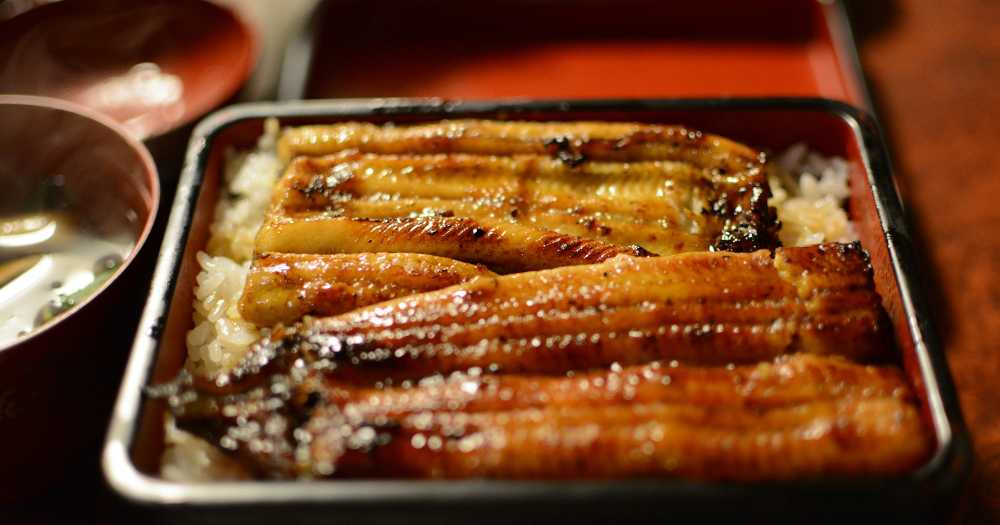


Do you like eating unagi?
You might be unwittingly contributing to eel exploitation, as almost all unagi products sold in Singapore were found to be from endangered eel species, according to a recent research study.
The study by researchers from Yale-NUS College was published in the journal "Conservation Science and Practice" on Jan. 9, 2025.
Nearly all S'pore unagi from threatened species
In July 2023, the team analysed 314 eel meat products sold by retailers in Singapore, including restaurants, supermarkets, wholesalers and online shops shipping to Singapore.
256 of the 257 products sold as "unagi" (99.6 per cent) were identified via DNA extraction to be from endangered or critically endangered eel species under the International Union for Conservation of Nature (IUCN).
The other sample, which was bought from a supermarket, was the pink cusk-eel mislabelled as unagi.
Unagi, or anguillids, consist of 19 species of freshwater eel.
In Singapore, three species are typically consumed, the European eel (A. anguilla), American eel (A. rostrata) and Japanese eel (A. japonica).
However, the European eel is a critically endangered species under the IUCN and has been banned for export outside the European Union, while the latter two are listed as endangered species.
The study found that of the 257 unagi products which could be identified, 217 contained the American eel (84.4 per cent).
The Japanese eel was found in 36 products (14 per cent) and there were three samples containing the European eel (1.1 per cent).
American eels, once substitutes, now at risk
In February 2013, Japan's Ministry of the Environment designated the Japanese eel as an endangered species after its population saw a sharp decline.
The European eel was subsequently used as a substitute until it too became critically endangered.
The team said their results supported suggestions that the trade in unagi has shifted to the American eel after a decline in the population of the European eel.
Yale-NUS alumnus Joshua Choo, who pursued the project under the supervision of assistant professor Benjamin Wainwright, presented the research at the 2024 International Eel Science Symposium in Liverpool.
Choo said, according to a Yale-NUS release,
“It was sad to connect Singaporean unagi with the history of anguillid eel exploitation – where a crash in one anguillid’s stock repeatedly leads to another’s overexploitation and crash."
Nevertheless, Choo said he was heartened at the conference to see many researchers and indigenous groups across the world invested in the recovery of anguillid populations, adding that "there's room for Southeast Asian perspectives" in the field.
Wainwright remarked that the eel trade has been described as "the greatest wildlife crime on Earth".
Wainwright noted that vast criminal networks illegally traffic juvenile eels in the hundreds of millions to Asia each year, some of which are deliberately mislabelled.
"If the American eel is to avoid a similar fate to that suffered by the European eels, it will be important to closely monitor the American eel trade and introduce rules and regulations designed to prevent overexploitation,” he added.
Alternatives?
Amidst the risk of extinction posed to freshwater eels by our appetites, steps have been taken around the world to find alternatives.
In January 2023, lab-grown unagi fish cakes were produced via a collaboration between Nanyang Polytechnic (NYP) and Singapore food-tech start-up Umami Meats, a world first.
In January 2024, the first lab-grown freshwater eel meat was produced by an Israeli tech startup using embryonic cells of an eel, The Guardian reported.
The company said it aimed to scale up operations and put the cultivated eel on sale by 2026.
Top image from Canva