




News

'No such thing': Migrant workers say laws on rest for lorry drivers, secured equipment 'often not enforced'
"Lorry transport is dangerous, and it cannot be made safe, neither through helmets, safety belts, and definitely not by criminalising drivers."
March 20, 2025, 10:27 AM


Laws on mandatory rest for lorry drivers ferrying migrant workers, as well as those requiring equipment to be "properly secured" to avoid injuries to the passengers, are "often not enforced", said migrant workers.
The workers' experiences were published in a Mar. 19 report by the Humanitarian Organisation for Migration Economics (HOME), covering the dangers of lorry transport for migrant workers.
Collected through three focus groups with 34 migrant workers, including designated lorry drivers, the anecdotes shed light on the real-life implications of these laws.
This comes on the back of requirements and amendments to the Road Traffic Act, meant to improve the safety of lorry transport for migrant workers.
Goods and people
Under the law, any loads being transported alongside passengers must be "properly secured, including lashing to prevent side lateral movement or when vehicle is braking, and should not pose any danger to the workers in the rear deck or other road users".
But this isn't always the case, said workers interviewed by HOME.
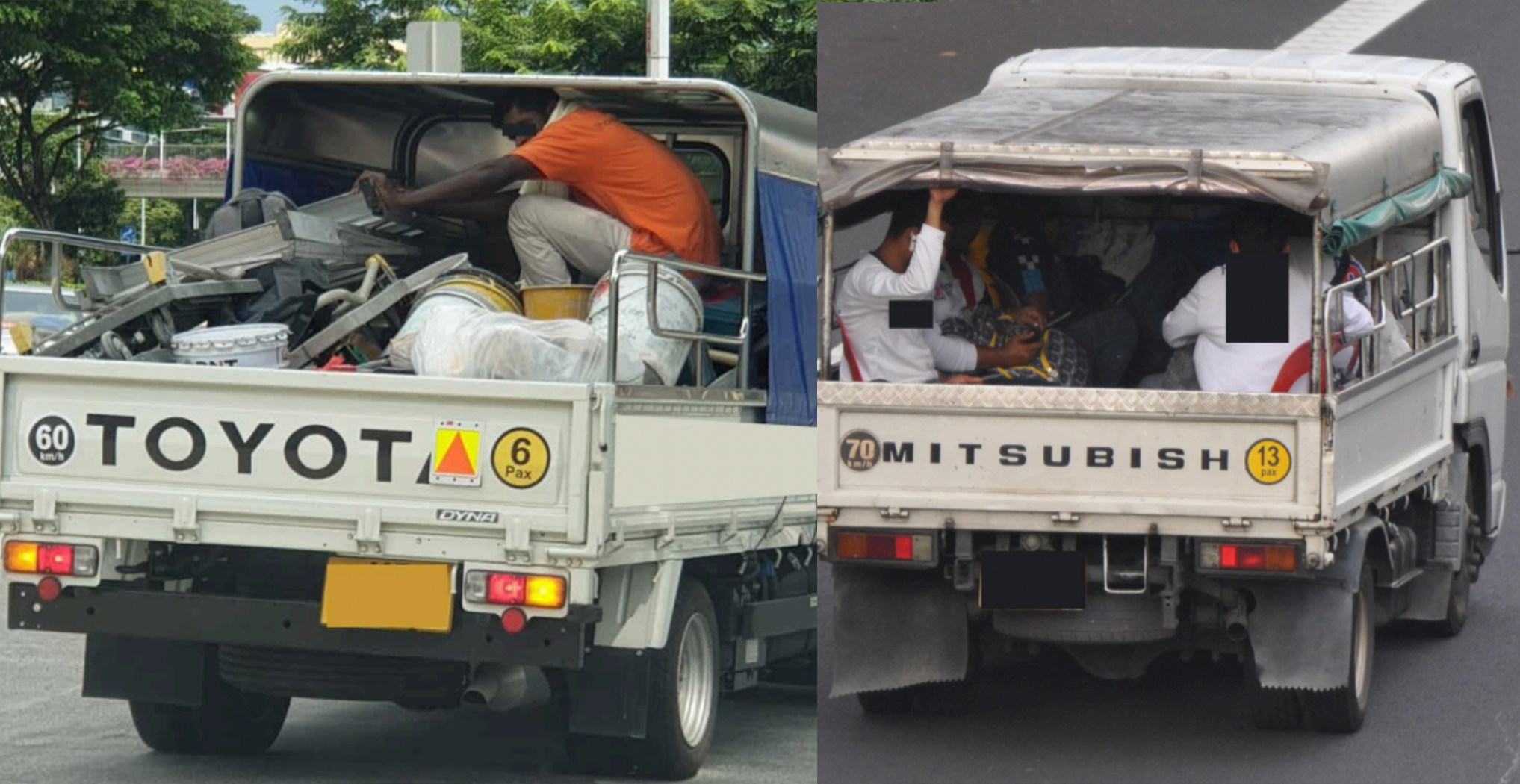
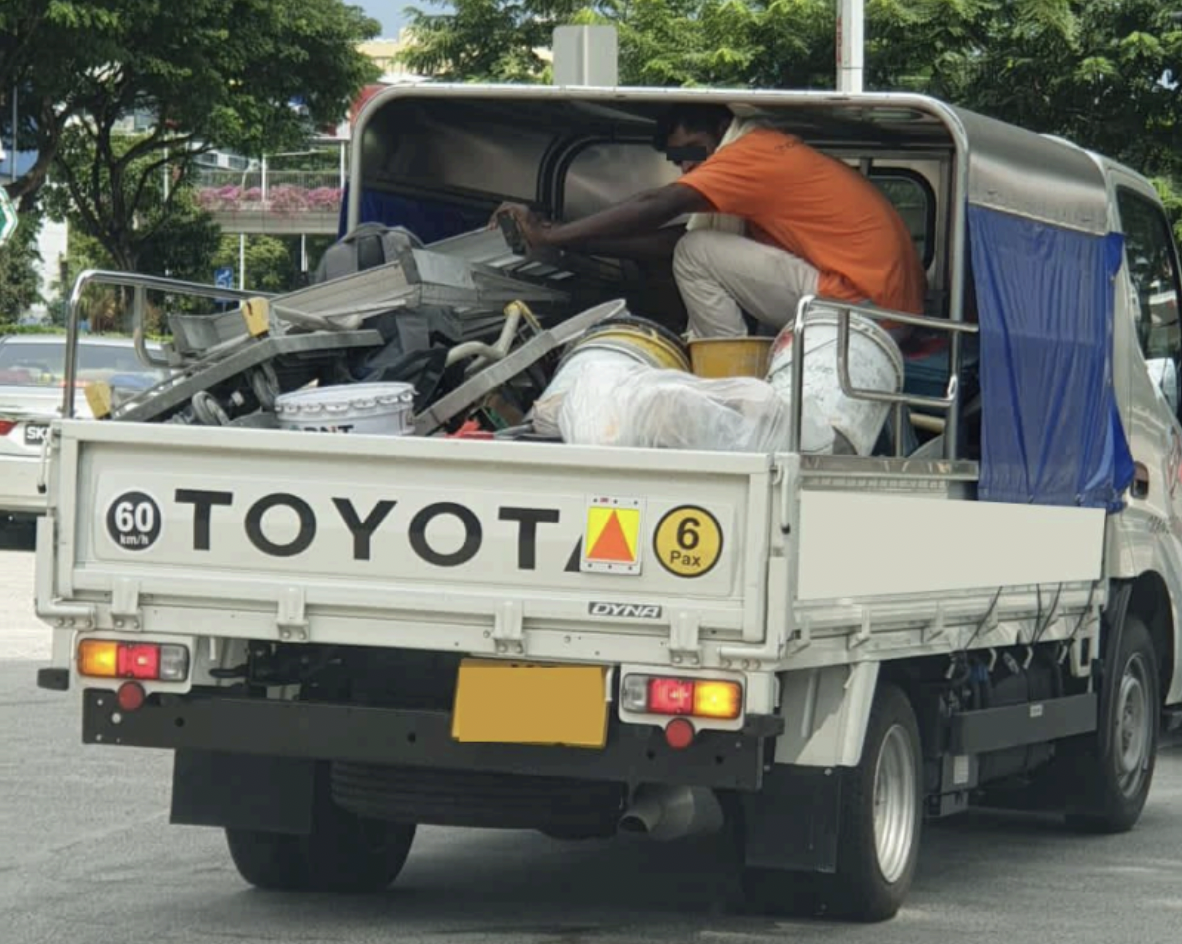 Worker ferried on back of lorry in 2022. Photo from HOME
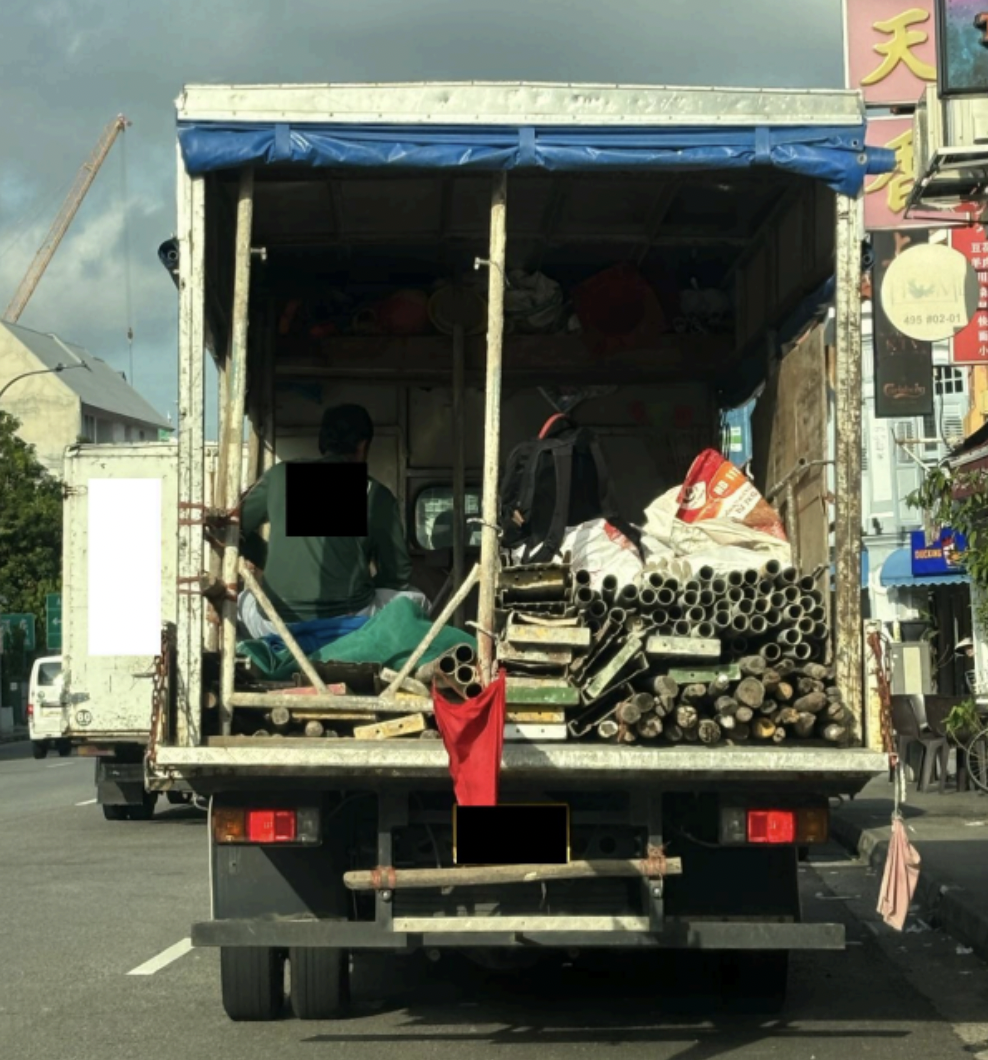 Worker ferried alongside equipment in 2024. Photo from HOME
The law is not always enforced, which means that workers often remain at risk of equipment-related injuries.
"When there is a sudden brake, the material falls on us," one worker said.
One doctor, interviewed by HOME in December 2024 for the report, recalled having treated a migrant worker who was injured due to a heavy object sliding forward and crashing into him.
The patient suffered severe injuries to his lungs and spine, and may not be able to work a manual labour job again.
Another worker riding in the same lorry was also fatally injured after being hit by cargo when the lorry braked to a stop, the doctor said.
"The fact that cargo [may not be] secured properly puts migrant workers at very high risk for accidents," the doctor added.
No breaks
The amended law also calls for lorry drivers who have worked for at least six hours prior, to be given a minimum of a 30-minute rest break before taking the wheel.
But this, too, is not always implemented.
"No such thing," one migrant worker said.
"[The drivers] have to work constantly."
Workers also told HOME that in addition to drivers not being given this mandatory rest period, they are also pressured to drive "in a rush" to get the workers to their destinations on time.
To achieve these time constraints, they may be forced to drive "rashly", they said.
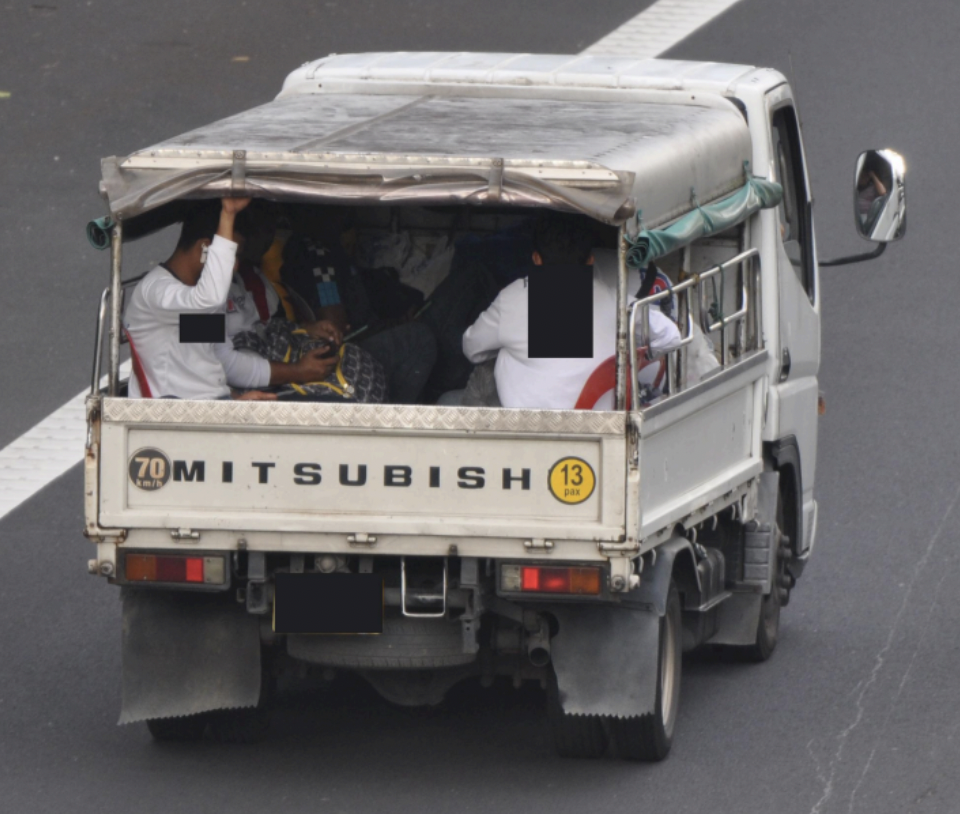 Photo from HOME
"This is actually not drivers' fault, it is company's management and system...the driver has to transport workers to the four sites before 8am, so the driver does not care if he driving at 70-80 (km/h) speed."
Lorry drivers, on their end, shared in the focus groups their own unrelenting work schedules; some reported working up to 14 hours a day.
"After 10, 12 hours of driving, my eye very pain, my whole body also very pain because we have to use force to shift the gear and do the driving.
The whole time, have to focus and look on the road. Very difficult."
Call for ban
HOME reiterated its call for a ban on lorry transport for migrant workers.
In Singapore, lorry transport is generally banned under the Road Traffic Act.
But an exemption allows passengers to be transported in lorries, if their employer owns or hires the lorry.
As dorm operators and dormitories are required to provide migrant workers with transport to their workplaces under the Foreign Employee Dormitories Act (FEDA), lorry transport "disproportionately impacts migrant workers compared to other groups of commuters", the non-governmental organisation said.
In her closing remarks at the report's launch event, executive director Stephanie Chok said: "Lorry transport is dangerous, and it cannot be made safe, neither through helmets, safety belts, and definitely not by criminalising drivers."
"Costs, not enough bus drivers, not enough buses, possible road congestion...these are feasibility concerns that need to be worked out. I don't deny that, but this is definitely not adequate justification for compromising on lives, safety, dignity."
Jaya Anil Kumar, senior manager of research and advocacy, added a call for the government to announce, and set out a timeline, for this ban.
She said that the ban, if implemented in a "reasonable and measured way", can be effective.
"We say 18 months for larger firms, and 36 months for smaller firms, to reflect both the urgency of the issue, and to acknowledge that there are other factors that need to be taken into consideration," she proposed.
Related story
Top image from HOME