News

Trump national security officials mistakenly add journalist to group chat discussing military strikes in Yemen
The White House has confirmed the incident, but defense secretary Pete Hegseth denied that war plans were shared.
March 25, 2025, 11:41 PM

 Senior members of the United States President Donald Trump's administration erroneously added a journalist to a chat group where they discussed in some detail the administration's plans to attack targets in Yemen.
Signal lost
Jeffrey Goldberg found himself in a curious situation when he found out on Mar. 11 that he had been added to a group chat populated with accounts that seemed to be named after senior Trump administration officials.
Like anyone added to an unsolicited group text by people he did not know, Goldberg was sceptical.
Not just because he had been added without being informed ahead of time but because he and the media outlet that he was editor-in-chief of, The Atlantic, were not on good terms with the Trump Administration.
According to The Washington Post, Trump would later say that he was "not a big fan of the Atlantic".
Goldberg wrote about his experience for The Atlantic, describing his initial reaction to being added as a contact on the commercially-available Signal App, which he describes as an "open-source encrypted message service popular with journalists and others who seek more privacy" than other similar apps provided.
High degree of verisimilitude
Goldberg recounted how he was initially very sceptical about being added to a chat group called the "Houthi PC small group", which he identified as a "principals committee".
A principals committee is a group for senior national security officials.
Goldberg initially thought that he had been caught up in an elaborate hoax meant to entrap a senior journalist, but noted that initial messages in the group had a "high degree of verisimilitude".
In other words, if it was a hoax, it was a very realistic one.
But as things progressed, he came to believe that the group chat and its members were real, something that was confirmed by the White House on Mar. 24.
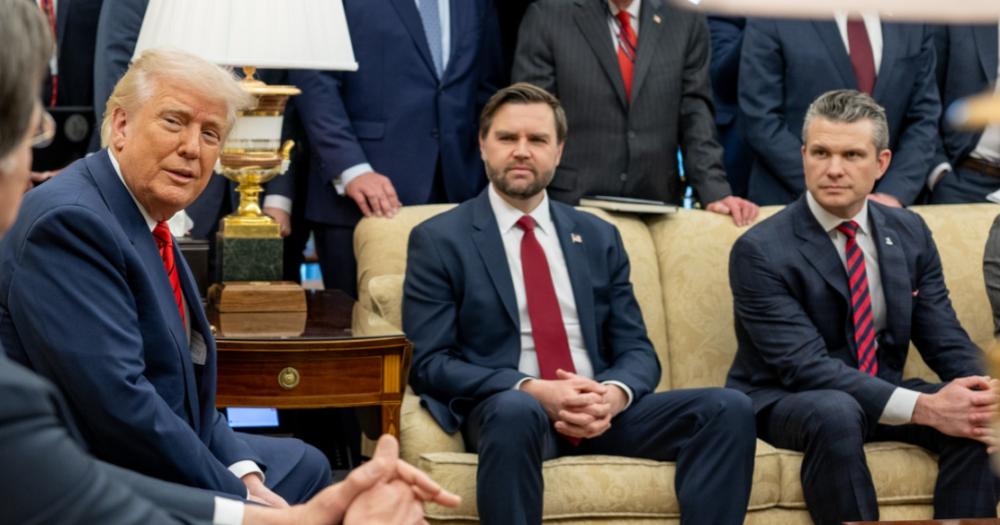
Goldberg was added to the chat by Michael Waltz, Trump's National Security Advisor, and was joined by vice-president JD Vance, defence secretary Pete Hegseth, and secretary of state Marco Rubio, amongst several others.
The chat initially discussed a potential attack on Houthi forces in Yemen, as well as Vance's reservations regarding such an action, Vance and Hegseth's disdain for Europe regarding its lack of initiative on security, its potential economic impact, and ultimately, the results of the attacks, which took place on Mar. 15.
The attacks targeted Iran backed Houthi forces in Yemen, who have attacked shipping in the Red Sea and Gulf of Aden, a major artery of global shipping.
U.S. attacks against the Houthi were initiated by former president Joe Biden, but Trump has criticised them as being insufficient.
Archival law
It was only after this that Goldberg believed the chat was real, leaving it soon after, without ever posting a message.
Soon after he informed Waltz via email and Signal, as well as Hegseth and other officials, asking them if they had known he was part of the group, and whether they regularly used the messaging app for "sensitive discussions".
The incident has raised several concerns, such as how a journalist was added to a sensitive discussion about national security, how he was able to remain in the chat for so long, and why such a discussion was taking place via a commercially available app in the first place.
Goldberg also noted that such discussions about National Security were subjected to records-keeping laws and that the messages he had seen on Signal were scheduled for deletion between a week and a month after being sent.
The Washington Post reported that a spokesperson for the White House National Security Council confirmed that the message thread Goldberg revealed "appears to be authentic".
He added that administration officials would review how an "inadvertent number was added to the chain".
The Post reports that defence secretary Hegseth forcefully denied any wrongdoing, and was quoted as saying "Nobody was texting war plans".
Goldberg, in his initial article, had said that detailed messages had been sent by an account purporting to be Hegseth with "operational details of forthcoming strikes on Yemen, including information about targets, weapons the U.S. would be deploying, and attack sequencing".
Goldberg said that he declined to quote the discussions, saying that the information could "conceivably have been used to harm American military and intelligence personnel".
In his article, Goldberg had shared screenshots of other parts of the discussion.
Scorn and agreement
U.S. press have also picked up on Vance disagreeing with Trump, although the disagreement was not in Trump's presence, and Vance saying in the chats that his concern was regarding timing.
Both he and Hegseth also poured scorn on European allies' naval capabilities, with Vance saying that he hated "bailing Europe out again".
Hegseth replied by saying, "I fully share your loathing of European free-loading. It's PATHETIC." (emphasis in original)
The areas in which Houthi forces operate mainly affects ships bound to and originating from Europe, but attacks greatly impact energy prices across the world.
Vance's communications director told Politico that Vance "unequivocally supports" the Trump administration's foreign policy and that Vance's "first priority" was ensuring that Trump was adequately briefed on his advisor's discussion.
Vance and Trump, he added, "had subsequent conversations about this matter and are in complete agreement."
Top image via White House/Facebook