Court


Woman wins appeal to keep 99% share of S$1.9 million condo bought with ex-boyfriend who paid more
The High Court had previously ruled partly in the man’s favour.
May 21, 2026, 12:24 PM
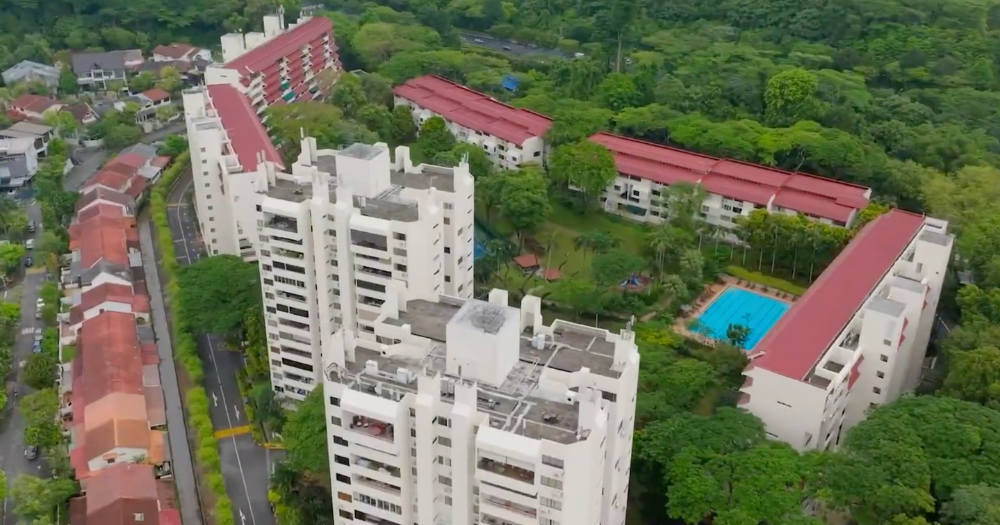
Top image via Huttonsgroup/YouTube


A woman who bought a S$1.865 million Bukit Timah condominium unit with her then-boyfriend has won her appeal to keep her 99 per cent share of the property, despite him having contributed more money towards its purchase.
The Court of Appeal ruled in favour of Wong Mei Lee Millie on May 20, 2026, according to court documents seen by Mothership, allowing her appeal against an earlier High Court decision which had found that she held part of her registered interest in the property on trust for her ex-boyfriend, Jake Ngor Shing Rong.
Arcadia condo unit
The case centred on a condominium unit at Hillcrest Arcadia, which the couple purchased in December 2019 while they were still in a romantic relationship.
Although Ngor contributed S$359,949.42 towards the purchase price, compared with Wong’s S$159,678, the property was registered in a 99:1 ratio in Wong’s favour.
The remainder of the purchase was financed with a mortgage loan, which was serviced mainly using both parties’ CPF monies and rental proceeds from the unit.
The couple broke up in November 2020, and a dispute later arose over who truly owned what share of the property.
Ngor subsequently sought a declaration that he held 71 per cent of the beneficial interest in the condominium, while Wong maintained that her 99 per cent registered share reflected both her legal and beneficial ownership.
High Court had earlier ruled partly in man’s favour
The High Court had previously found in Ngor’s favour in 2025.
At the time, the High Court judge found that Wong held 54.22 per cent of the property on trust for Ngor, after considering the parties’ respective financial contributions.
The judge also found that Ngor did not intend to immediately and unconditionally benefit Wong with his contributions, but only if he cheated on her.
The couple had rented out the property throughout their relationship, and continued to communicate relatively amicably about administrative matters relating to the condo and its tenants even after they broke up.
Ngor began suggesting the sale of the unit in 2022, before Wong later asserted that she owned the entirety of her 99 per cent legal share.
Parties intended 99:1 split to reflect ownership
On appeal, however, the Court of Appeal found that the evidence showed Wong and Ngor had intended the 99:1 ratio to reflect both their legal and beneficial ownership of the property.
Delivering the judgment, Justice Hri Kumar Nair said the court disagreed with the High Court judge’s evaluation of the evidence:
“It follows that Jake did intend to benefit Millie with his financial contributions, and a resulting trust did not arise over the Property.”
In simple terms, the court found that Ngor could not rely on his larger financial contributions to claim a bigger beneficial share of the property, because the evidence showed that both parties had intended Wong to own 99 per cent of it.
The court noted that neither party knew nor understood the distinction between legal and beneficial ownership when they bought the property.
This supported Wong’s case, as the couple could not have intended to own the property in a way that was different from the 99:1 ratio stated in the documents they signed, the court found.
Man’s “cheating condition” argument rejected
A key part of Ngor’s case was that Wong would only be entitled to the 99 per cent share if he cheated on her.
He argued that he had agreed to the 99:1 arrangement as a form of assurance to Wong, who was insecure about the possibility of him being unfaithful.
The Court of Appeal rejected this argument.
It found that Ngor’s explanation of this alleged “cheating condition” was inconsistent, illogical and not borne out by the evidence.
The court documents noted that if Wong’s 99 per cent registered interest was only nominal, she would have had "no meaningful assurance and security" at all, as Ngor could demand his share back at any time, and it would then be for Wong to prove that he had cheated on her.
By contrast, Wong’s case was more logical, the court said.
Her position was that she wanted the both of them to remain in a relationship, and that having 99 per cent ownership of the property was a demonstration of Ngor’s commitment to her.
Furthermore, the text messages between the both of them from Jul.19, 2018, seen in the court documents by Mothership, further showed that Ngor did not indicate her ownership would merely be nominal or conditional on him cheating on her:
Millie: But u do so many things
…
Millie: Ltr u v rich I worried
Jake: Baobei ah
Millie: Ltr by 40 u rich n free
A lot of girls come
Jake: We joint account everything
…
Millie: I hope this won’t break us
Jake: We must settle the houses
2 houses at least
Millie: U
Cannot
Be too rich k
I scared ltr lose u to other ppl
Jake: Wont
We joint everything baobeo
Baobei
Millie: Joint still can take as and when
Jake: You can monitor
…
Jake: 2 house
2 houseeee
Hahahq
Millie: 2 is u one I one ah
Hahahaha
Jake: Yes
Millie: If the hse isn’t mine I won’t bother
So put under my name at least I will bother
Tho
Jake: Hugs ni
In the exchange, Wong asked if the arrangement would be “u one I one”, to which Ngor replied: “Yes.”
Wong later said, “If the hse isn’t mine I won’t bother / So put under my name at least I will bother.”
The Court of Appeal said this showed that Wong’s ownership of one of the properties was important to her.
It added that there was nothing in this exchange, or in other messages, to suggest that her ownership would only be in name, or that it depended on Ngor cheating on her.
Court also addressed 99-1 arrangement and ABSD issue
The court also addressed the couple’s use of the 99:1 arrangement in the context of Additional Buyer’s Stamp Duty (ABSD).
According to the judgment, part of the arrangement involved Ngor later transferring his 1 per cent share to Wong, before buying a second property solely in his own name so that ABSD would not be payable.
Although the Court of Appeal did not need to decide the illegality issue after finding that no resulting trust had arisen, it went on to state that this would have been an independent reason to deny Ngor’s claim.
If a resulting trust had existed, according to the court documents, it would mean Ngor knew he had a larger beneficial interest in the property and intended to conceal it when buying a second property to avoid ABSD.
The court said:
“It follows that the illegality contemplated by Jake at the time the Property was acquired would have been tax evasion and not simply under-stamping.”
Ex-boyfriend ordered to pay $50,000 for appeal costs
It added that, given the serious nature of tax evasion and the importance of maintaining compliance with the ABSD regime, denying Ngor’s claim would not have been a disproportionate response.
Justice Hri Kumar Nair said:
“Therefore, even if we had not found that the parties’ common intention was for the 99:1 ratio to reflect their legal and beneficial ownership, the issue of illegality would have been an independent basis for denying Jake’s claim.”
The court also said that where the illegal purpose involved dishonesty, “it would be extremely rare that the financial consequences of denying a claim would outweigh the gravity of the illegality”.