News


S’pore hawker, 31, must sell 40 plates of nasi lemak daily to 'break even', works 11-hour days
When broken down by cost, S$2.70 of the S$6.90 nasi lemak berempah set went towards rental and conservancy fees.
May 11, 2026, 05:59 PM
Top photo from Melissa lovesicecream/Google Maps & Donald-Eric Lim/Google Maps


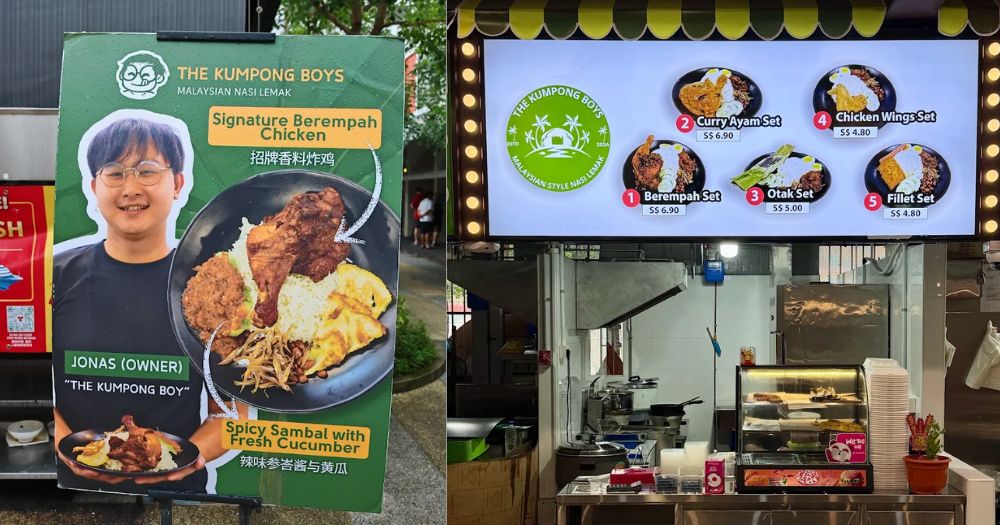
A Singapore hawker who sells nasi lemak for S$6.90 a plate says he needs to sell 40 plates a day to break even.
The owner of The Kumpong Boys, Jonas Koh, told CNA Insider's Money Mind that he works "11 hours a day, six days a week".
He earns about S$1.50 per plate, averaging to S$2,000 to S$2,500 each month.
Break even
Koh told CNA Insider: "When I say break even, it means that it covers my cost of ingredients, my overhead rent, my water bill, my gas bill but it doesn't cover my salary."
CNA Insider noted that on most weekdays, Koh sells 50 to 60 plates, and on weekends, he sells up to 100 plates a day.
Customers who are accustomed to S$4 to S$5 for a plate of nasi lemak in hawker centres and coffeeshops feel that his S$6.90 pricing is expensive.
But Koh says that his portions are bigger, with heavier marinated fried chicken.
"For ours, the berempah is about 300 grams, most nasi lemak stores were about 50 to 60 grams."
Costs
However, customers are still price sensitive and with narrow margins, selling more plates does not significantly increase his income.
CNA Insider broke down the cost of Koh's S$6.90 nasi lemak berempah set, of which S$2.70 went to rental and conservancy fees.
Figures were calculated based on the average number of such sets sold in a month at 910.
Singapore University of Social Sciences, Associate Professor (Economics), Walter Edgar Theseira said: "Singaporeans expect that food sold in hawker centres and coffee shops should be affordable to all Singaporeans."
Theseira said that if hawkers offer more premium products, their prices would be higher as well, however hawkers have difficulty raising prices for goods that Singaporeans consider mass market staples.
Competition & Supply Chain
Koh's stall is located in Ang Mo Kio, a mature estate which makes it difficult to charge more, especially with stiff competition.
Koh told CNA Insider that prices of ingredients are rising with one kilo of chilli padi being S$12, double of what it used to be.
Koh added that if he were to shift to the Central Business District (CBD), his rent will be about S$7,000 to S$8,000 a month and that he will have to hire more staff, as there is only one peak window to clock sales.
Koh said that as his salary is not fixed, monthly saving is difficult and buying a house is difficult.
Koh who has a degree in business management also does catering and delivery orders for extra income.
Theseira said that hawkers like Koh would have to put up with supply chain cost increases and are constrained by market norms.