Features


Comment: If you need a seat on the MRT, please just ask
Two-way street of communication and grace.
May 12, 2026, 10:47 AM
Image via Canva, jiaweing/Unsplash


MRT seats are a contentious issue in Singapore, especially the priority seats.
We’ve been talking about it for a while. At one point, someone suggested in a Straits Times forum letter that a S$5 fine be imposed on inappropriate usage of priority seats.
Fights have even broken out over it.
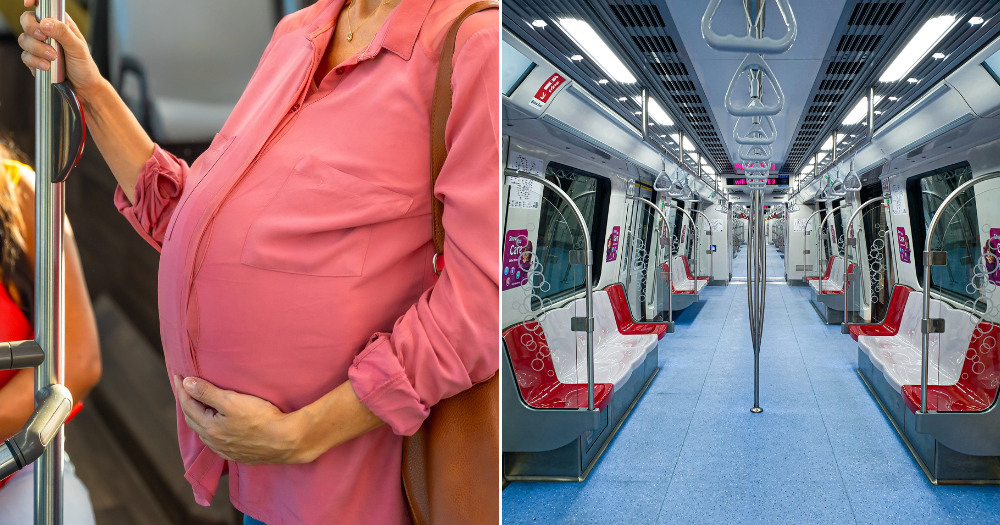
More recently, an expectant mother lamented to Stomp about not being offered seats on her public commute, despite being eight months into her pregnancy.
In the piece, she said she felt invisible, as she noted no one offered to give up a seat.
This sparked a bit of a debate online.
Some commenters characterised the mother as entitled. Others mentioned that she should have just taken a taxi.
I disagree that she was being entitled, but I do agree that our commuting culture can be better in some ways.
Stand-up Stacey says: “Show you care, offer this seat”.
That said, I think the virtue of graciousness needs to be complemented by another oft-overlooked characteristic, the virtue of asking.
Expecting the seat
Under Stacey’s watchful eyes, taking a seat on the MRT goes from a simple instinct to an ethical dilemma.
Is there a senior citizen, an injured person, or a pregnant woman in the cabin? Is there someone else who looks to be in more need than I?
Is this person old enough to be considered an elderly person, or just someone whom life has been unforgiving towards?
If I get up and offer my seat, and she turns out not to be pregnant, will she get offended?
Little things like being tired after a long day don't even make the list.
This complex web of social rules and etiquette has led to a kind of unspoken expectancy, in which we're left guessing.
It's exhausting and often counter-productive.
So other than graciousness, why don't we try something else: communication?
Stand-off over seats: An experience
Once on the NEL, I saw an older woman standing a few people away from me.
She didn't have a head full of white hair. But the freckles on her face hinted at her age.
For a while, she stood in front of a younger person, exuding an energy that subtly hinted that she ought to be the one sitting down.
After a few moments, a slightly older man seated beside the younger person stood up and offered her his seat.
She replied with something to the effect of: “It’s OK. We’ll let the younger people sit.”
For the next few stops, that seat was left empty. Too awkward for the man to sit back down, too tense for anyone else to take it up, and too pointed for the woman herself to take a rest.
But what if, instead of relying on that expectancy, she had just asked?
A two-way street
I’m not saying that we should do away with the basic courtesy of offering your seat to someone who needs it more.
If someone is obviously pregnant — i.e. in maternity clothes and with an obvious baby bump — people should offer their seats. It is only gracious to do so.
But love is a two-way street.
On one hand, people should have the social awareness and grace to offer. But on the other hand, a bit of communication would really help with mutual understanding.
Take, for instance, the “May I have a seat please?” initiative that was launched a few years ago.
The idea behind it was to recognise that some medical conditions are “invisible”. After all, we cannot assume an individual isn’t in some sort of discomfort just because they look healthy.
The pregnant woman was disappointed that no one offered her a seat. I think she has every right to be.
But we shouldn't assume that the other healthy-looking individuals seated in the cabin didn't need one either.
Normalise asking
Back in school, my teacher used to tell me: “When you assume, you make an ass out of you and me.”
The solution is simple: Stop assuming. Normalise asking.
Ask politely, share more about your need with others, and see if they too are in need.
It's far more productive than being passive-aggressive or suffering in silence.
It also has the added benefit of making it harder for others to ignore, which can be the case with the lanyard initiative, as a 2023 CNA report found.
Some people might counter that having the person in need ask is demeaning and creates a situation akin to begging.
But I am inclined to still believe in the good of people. I think if you ask politely, most people will happily oblige. Perhaps they might even feel better for helping someone out.
Ideally, there will be two sets of happy commuters going home that day.
Hand in hand
So here I am calling for two things: the politeness of asking, and the spirit of care and understanding. Both need to go hand in hand.
But it might be tough in a culture like ours. Asking for help might be seen by some as a bit embarrassing.
Perhaps a mascot might come in handy?
For sure, Stand-up Stacey still has a place among The Thoughtful Bunch.
But I think she could use a new companion.
I think I'll call him Just-ask Jason.