News


'We either sink or swim together': Chee Hong Tat on working with ASEAN for climate resilience
He emphasised that it is more important for Singapore to renew its sustainability commitment during this time of global uncertainty.
May 20, 2026, 11:53 AM
Photos by Mothership and Unsplash


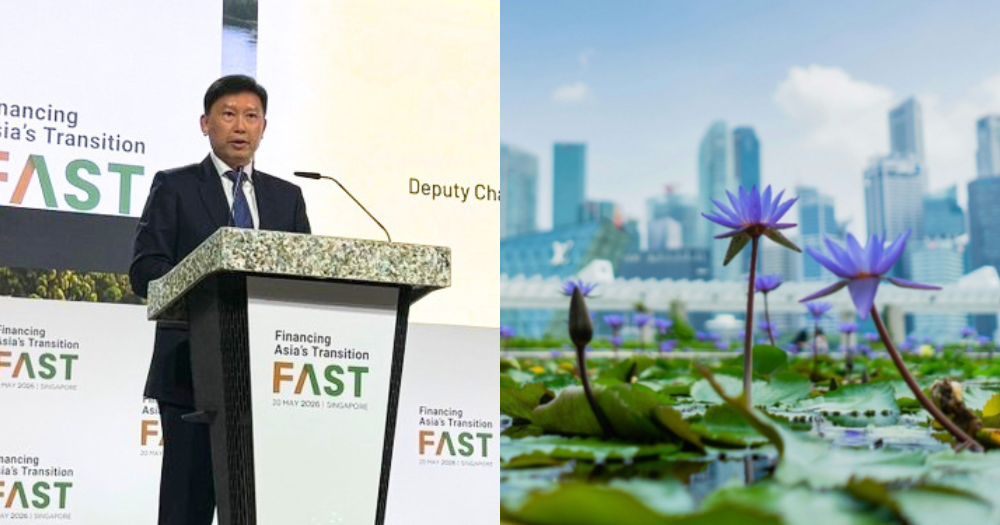
Singapore has been working closely with regional partners to strengthen climate adaptation and resilience across Southeast Asia, said Minister for National Development Chee Hong Tat.
He was speaking on May 20 on the third day of Ecosperity Week 2026, Temasek's annual sustainability conference.
Chee pointed out that Southeast Asia has recently been warming faster than the global average, and coastal cities are increasingly exposed to floods, heat, and water stress.
But climate resilience cannot be advanced by any single country alone.
"It's not something that individual countries can say, 'Well, I just do what is within my borders, and I don't pay attention to what is in the region outside of my country'...
Our fates are tied together, and it is best that we work together to try and tackle some of these common challenges... It is inherently a collective endeavour. We either swim or sink together."
Recent efforts
At the conference, Chee spotlighted some of Singapore's recent efforts in climate adaptation and resilience.
Many of these projects have been in collaboration with regional and global partners, he said.
Through the Financing Asia’s Transition Partnership (FAST‑P) initiative, launched in 2023, the Singapore government has pledged up to US$500 million (S$641 million) to match concessional capital from other parties.
The aim is to raise up to US$5 billion (S$6.4 billion) to support Asia's green transition.
Chee also shared that the Green Investments Partnership (GIP) under FAST-P has now achieved its second close, bringing total commitments to US$800 million (S$1.03 billion).
The GIP invests in green and sustainable infrastructure opportunities in Southeast and South Asia.
Looking ahead
Chee reiterated that Singapore's approach to sustainability has been "consistent and pragmatic", with a long-term perspective.
"We are neither climate sceptics nor climate zealots, we are climate realists. Recognising the realities of global warming while managing the practical trade-offs," he said.
Moving forward, the next frontier is to complement post-disaster recovery financing with greater investment in resilience-building measures.
This approach can help to reduce the impact of climate shocks when they occur.
"Annual [resilience] financing needs in Southeast Asia are estimated to be at US$17.5 billion (S$22.4 billion), or close to 90 per cent of total needs," Chee said.
He added that there is "scope" for Singapore's financial sector to contribute and bridge this gap.
Chee underscored that in the face of growing global uncertainty, it is more important for Singapore to renew its commitment to climate resilience.
"We are living in uncertain times, but uncertainty should not be a reason or an excuse for inaction.
We should instead strengthen our resolve to work together even more closely and to act early and prepare well, so that we turn today's risk into tomorrow's readiness."