News


Australian TV show about S'pore Changi Prison describes conditions as 'harsh', prison officer says it's 'spartan'
The show called the prison a massive concrete oven with the walls radiating the relentless Singapore heat.
May 15, 2026, 04:18 PM
Top images via DatelineSBS/Facebook


"Dateline", a long-running Australian current affairs programme, has resurfaced its 2025 feature on Singapore's Changi Prison.
The show posted a clip on Facebook on May 14, which was about the rare access given to take a look inside the place where prisoners are incarcerated in Singapore.
According to the Australian broadcaster SBS, the Changi Prison feature was part of the 2025 season premiere of "Dateline".
The feature was described as the first time an Australian TV crew had been given access inside Changi Prison.
The Facebook post by "Dateline" questioned whether the strict system and punishment actually led to change.
"A massive concrete oven"
In the episode, host Adam Liaw visited Changi Prison’s maximum-security wing that held inmates convicted of serious offences, including drug trafficking.
The prison’s conditions were described as basic and harsh, with inmates sleeping on thin straw mats in cells with no air-conditioning and little natural airflow.
 Image via DatelineSBS/Facebook
Liaw proceeded to describe the facility as follows:
“This place feels like a massive concrete oven, the walls radiating the relentless Singapore heat.”
One inmate, identified by SBS as Matthew, was sentenced to eight years’ jail for drug trafficking after being found with 93g of methamphetamine.
 Image via DatelineSBS/Facebook
Under Singapore law, those found in possession of 250g or more of methamphetamine may face the death penalty.
Matthew said: “Sometimes I reflect at night that I got eight years, which to me is pretty harsh for a first timer. But when I think about it, I'm like, okay, it's not the death penalty.”
"Spartan" conditions, not harsh
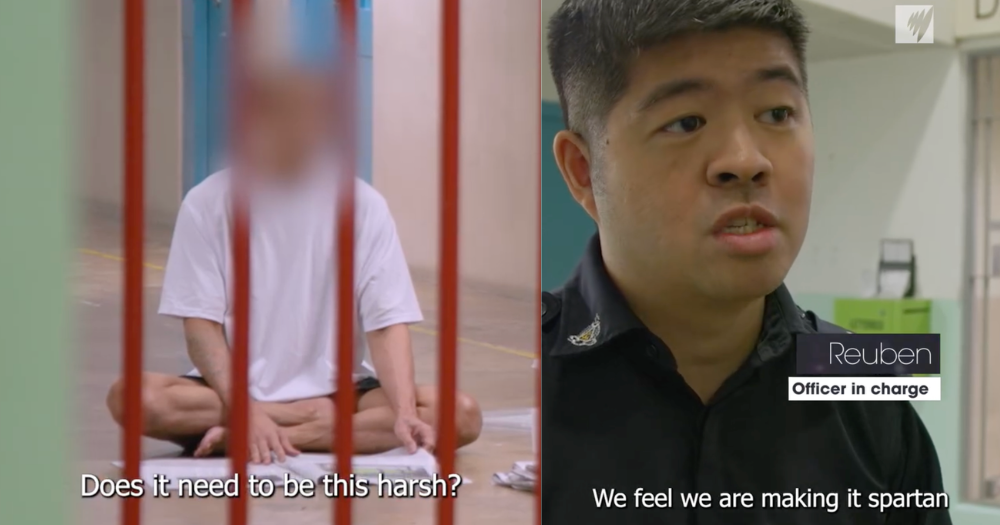
During the episode, Liaw also questioned a Changi Prison officer about whether the conditions needed to be so severe:
“I see one table and bench. That's one table and bench for 40 people. Most of the inmates are sitting on a hard concrete floor. Does it need to be this harsh?”
 Image via DatelineSBS/Facebook
Reuben, the officer in charge, replied: “It's not harsh, I think we use the term, 'spartan'. We feel we are making it spartan as a deterrent, so that we don't want inmates to come back in again.”
An article about the episode reported that a typical day in Changi begins with a muster check to count inmates, followed by breakfast of four slices of bread and a hot drink, served through a hatch at the bottom of the cell door.
Inmates may also get around one to two hours of yard time a day.
The episode also noted that inmates’ contact with family members is restricted to twice a month, either through face-to-face visits or tele-visits.
Captains of Lives
In Singapore, prison officers are referred to as “Captains of Lives”, and are positioned not just as enforcers, but as part of inmates’ rehabilitation.
Reuben told "Dateline": “Each one of them is a human being, so, we are in the business of change.”
 Image via DatelineSBS/Facebook
“You might not succeed on the first try, second try, but our hope is that, you know, they'll be successfully rehabilitated, reintegrated into society,” he added.
When Liaw asked if he genuinely felt he was in the “profession of change”, given that prison is also about punishment, Reuben said the two worked together.
He said: “So, while you punish them, we also try to rehabilitate them to show them, you know, this is the mistake you made. So when you go outside, you don't repeat the same mistake again.”
According to the Singapore Prison Service’s (SPS) 2025 annual statistics release, SPS said it “enforces the secure custody of offenders and rehabilitates them for a safer Singapore”, with its Captains of Lives working with offenders, their families, aftercare agencies, community partners and volunteers.
Kirsten Han, an activist from the Transformative Justice Collective, however, told "Dateline": “They call Singapore's prison officers 'Captains of Lives' but really, they are the ones that will send you to the gallows and to your death.”
Recidivism remains low
Singapore’s tough prison conditions are often framed by authorities as part of a wider deterrence and rehabilitation model.
SPS noted that the recidivism rate “remained low and stable”, and added that this continues to be one of the lowest two-year rates internationally.
Singapore’s 21.9 per cent rate held up against Hong Kong’s 21.8 per cent, Denmark’s 31 per cent and Australia’s 43 per cent.
The SBS feature also examined Singapore’s use of the death penalty, particularly for drug offences.
At the United Nations Human Rights Council’s Universal Periodic Review on May 12, 2026, several member states raised concerns over Singapore’s use of the death penalty and corporal punishment, with some urging Singapore to establish a moratorium on executions or abolish the death penalty.
Australia expressed concern that Singapore’s executions had reached their highest level in over 20 years in 2025.
The Singapore government has maintained that the death penalty is used only for the most serious crimes.
Over 80 per cent of people in the region also believe that the death penalty is an effective deterrent for serious crimes such as drug trafficking in Singapore, according to a Ministry of Home Affairs (MHA) survey.
Back in Changi Prison, Matthew said he was trying to remain positive despite the conditions:
“If I focus on the fact that it's a miserable living condition, then I will be very sad. But at the onset of my incarceration, I told myself that I'm not going to think like that, I'm going to see the good in everything.”