News


S'pore's progress on human rights noted at UN, some member states remain concerned about death penalty
UN member states gave recommendations based on a National Report on Singapore's current human rights situation the country submitted in January 2026.
May 13, 2026, 04:38 PM
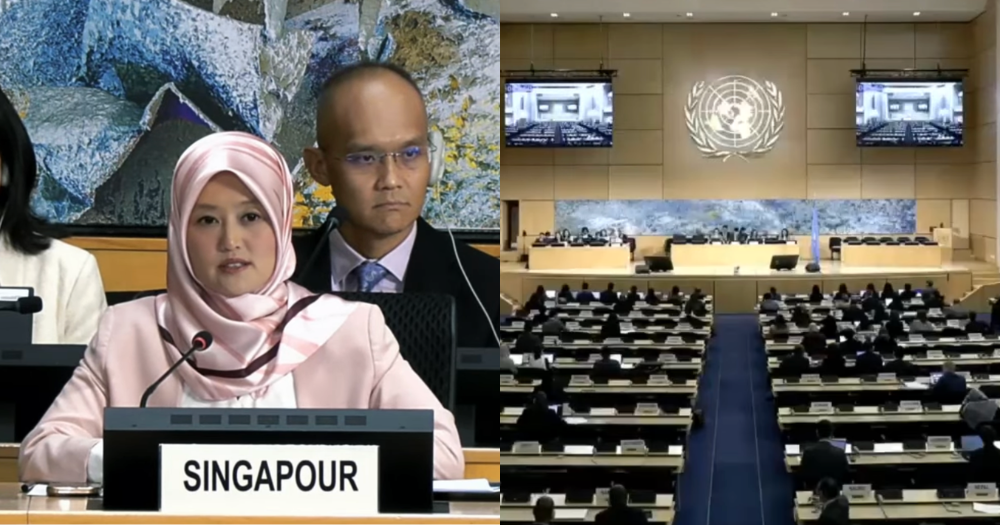
Images from UN Web TV


Singapore's human rights record was examined by 142 states at the United Nations (UN) Human Rights Council’s Universal Periodic Review (UPR) on May 12.
While they noted progress made, some member states urged Singapore to change some things, most notably to abolish the death penalty.
Review
The UPR is a process in which each UN member state gets the opportunity to review the human rights situation in other member states about once every five years.
It was the fourth time Singapore has participated in the UPR, the last one being in 2021.
Minister of State for Health and Digital Development and Information Rahayu Mahzam led the delegation of officials from eight government agencies to the review.
Many of the member states commended Singapore on the significant progress it has made in recent years, the Ministry of Foreign Affairs (MFA) said in a press release afterwards.
They welcomed Singapore's efforts such as the Workplace Fairness Act 2025, advancing the status of women, expanding support for vulnerable groups, maintaining racial and religious harmony, advancing sustainable development, and decriminalising gay sex by repealing Section 377A of the Penal Code.
The member states also gave recommendations, which included abolishing capital and corporal punishment, reviewing the Protection from Online Falsehoods and Manipulation Act (POFMA), and strengthening protection against discrimination for LGBT+ people.
A constant work in progress
In her opening remarks, Rahayu highlighted that there is no one single approach to the realisation of human rights.
"Each country has to approach it in ways that take into account its own national context and social realities," she said.
In addition to outlining Singapore's progress in protecting human rights, she noted that there is always more to do, and called the country a "constant work-in-progress".
"Even as we celebrate the progress we have made, we recognise that we must continue to advance equality and inclusion, reinforce protections, and provide more opportunities for at-risk groups in our society."
Member states' recommendations
On abolishing capital and corporal punishment
The most common recommendation for Singapore among the member states, especially those from the West, was the abolition of capital and corporal punishment.
Australia expressed concern that Singapore's executions reached their highest level in over 20 years in 2025.
Ireland said it was deeply concerned about the increased number of executions in Singapore, and the limited access to legal counsel for those facing the death penalty.
Many proposed that Singapore establish a moratorium on executions with a view to abolishing the death penalty, while some urged directly for a full abolition.
Sweden called for Singapore to ratify the UN Convention against Torture and Other Cruel, Inhuman or Degrading Treatment or Punishment (CAT), and abolish the use of corporal punishment such as caning.
Singapore's stance
From the Singapore delegation, director of the Ministry of Home Affairs' (MHA) international organisations and security directorate Gregory Foo responded to these recommendations.
"Singapore retains the right to determine the most appropriate penalties in accordance with our national circumstances and obligations under international law," he said. "This includes the use of capital punishment for the most serious crimes."
He emphasised that Singapore does not impose capital punishment lightly, but only when it is imperative to protect the society at large.
"Only crimes that inflict the most severe harm to the victims and to wider society in Singapore attract capital punishment," he added.
In March earlier this year, Home Affairs Minister K Shanmugam cited a survey that revealed a majority of respondents supported the mandatory death penalty for trafficking a "significant amount" of drugs.
Shanmugam criticised those who said that Singaporeans only support the policy because of "propaganda" and added that as well-informed, well-educated people, Singaporeans know what's in their best interest and can see the impact of drug trafficking in other countries.
On reviewing POFMA
Many states also brought up concerns about freedom of opinion and expression, with several highlighting Pofma.
Chile called for Singapore to review Pofma and the Public Order Act "to ensure that the struggle against disinformation does not unduly restrict the right to freedom of expression, peaceful assembly, and the work of human rights defenders".
The Netherlands named Pofma as a law "restricting freedom of expression and assembly that [contradicts] international standards", and proposed that it be repealed.
In response, the director of Ministry of Digital Development and Information (MDDI) Angela Tan shared clarifications on Pofma.
She said that the recipient of a Pofma correction direction is free to continue expressing his or her opinions, and to challenge the direction in court if they wish to do so.
"Pofma only applies to false statements of fact that affect public interest," she added. "It does not apply to opinions. It cannot be used just because the government disagrees with the statement."
On protecting LGBT+ people
While commending the repeal of Section 377A, many member states also called for stronger institutional protections for LGBT+ people.
The United Kingdom recommended that Singapore include protection against discrimination on the grounds of sexuality and gender identity in the Workplace Fairness Act, and ensure equal treatment in government policies for LGBT+ people.
States including Brazil and Iceland encouraged Singapore to formally recognise or legalise same-sex marriages.
From the Singapore delegation, Senior Adviser at the Ministry of Social and Family Development Ang Bee Lian said the country noted the concern raised by member states on protecting LGBT+ people.
Singapore firmly believes that LGBT+ persons are equal members of its society, she clarified.
"Like every Singaporean, LGBT+ persons in Singapore have access to opportunities, education, employment, health care, social services, and importantly, protections from harassment and violence."
However, Ang said that Parliament's definition of marriage between a man and a woman is a "socio-political issue" for Parliament to decide, not the courts.
The Constitution was amended as such, and laws and policies based on that definition can only be decided by Parliament.
In her closing address, Rahayu committed that the delegation will examine the recommendations received, and consider how they can be implemented to promote and protect human rights in Singapore.