Court


'When I read it, I immediately said this is defamatory': Shanmugam on Bloomberg article
He said, "It’s a sleight of hand going to direct dishonesty.”
April 09, 2026, 08:44 PM
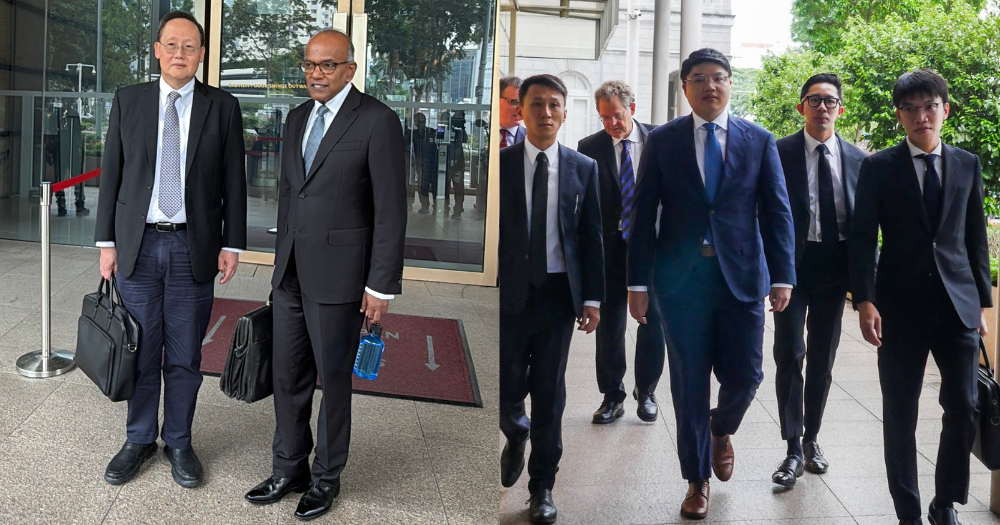


Bloomberg’s lawyer challenged Minister for Home Affairs K Shanmugam in court on Apr. 9 to identify where "falsehoods" appeared in the Bloomberg article at the centre of his defamation suit, with Shanmugam saying that the article had to be read as a whole because it created false impressions about secrecy, checks and ownership disclosure.
On the third day of the trial, Senior Counsel Sreenivasan Narayanan repeatedly took Shanmugam through passages of Bloomberg’s Dec. 12, 2024, article and asked where statements later identified in a government correction notice could be found in the published text.
Defence questions POFMA wording
Sreenivasan referred to statements identified in the Factually article accompanying Bloomberg’s Protection from Online Falsehoods and Manipulation Act (POFMA) correction direction, including claims that there are no publicly available government records of GCB transactions if caveats are not lodged, the government may not know the identity of the ultimate beneficial owner, and GCB transactions can occur without government checks.
He then asked Shanmugam where Bloomberg had actually made those statements.
At one stage, Sreenivasan pointed out that Bloomberg had not used those words directly.
Shanmugam disagreed, saying the issue was not verbatim wording but the impression created.
Caveat argument “utter nonsense”
A major part of his testimony focused on Bloomberg’s treatment of caveats as well.
Bloomberg wrote that buyers typically pay premiums for “off-radar transactions” and that many high-value GCB transactions did not include caveats.
Shanmugam rejected that argument, saying:
“This is utter nonsense.”
He explained that whether a caveat is filed is determined by the buyer, not the seller, and that high-value buyers paying fully in cash often do not need caveats because there is no mortgage lender whose interest needs protection.
He added that even without a caveat, ownership details still have to be submitted to the government.
“You need to go to the government and disclose the full identities of everyone, the government knows and there is a public record of the transfer.”
Article implied “falsehoods”
During re-examination by Senior Counsel Davinder Singh, Shanmugam and Tan See Leng's lawyer for the defamation suit, Shanmugam was asked why he rejected suggestions that the article did not imply criminal, illegal or improper conduct.
He said:
“I have said this article was full of falsehoods and it does suggest I was involved in a shady deal with the possibilities of money laundering.”
He said references to secrecy, trusts, caveats, price differences and unidentified beneficiaries together suggested wrongdoing.
Responding to the defence’s questions, Shanmugam said Bloomberg had omitted important details about Singapore’s anti-money laundering safeguards in property transactions.
He told the court:
“It’s crazy that this kind of article can be put up. This article is very carefully crafted to make all the false points as maliciously as possible.”
Bloomberg’s article had stated that “property agents and other service providers involved in the transactions are primarily responsible for verifying the identities and source of wealth of Singaporean mansion buyers”.
Shanmugam said the article created the false impression that property agents were primarily responsible for identity checks while leaving out the role of financial institutions, banks and government agencies involved in verifying transactions.
Internal Bloomberg emails raised in court
The court also heard internal Bloomberg emails exchanged before publication.
One March 2024 email from Low proposed:
“One possible way to get into this is to wrap it in a broader story of how rich people are using trust to buy property in Singapore...”
Another internal message described the transaction as a “hush hush affair”, which Shanmugam said was false because the sale had been formally recorded like any other transaction.
Shanmugam clarified:
“What is ‘hush hush’, it is an event like any other transaction.”
A separate email referred to the possibility that a story on Shanmugam selling his GCB would “strike a nerve”, particularly given the Ridout Road controversy at the time.
Shanmugam noted the emails reinforced his view that Bloomberg had been looking for a way to frame his sale as politically damaging.
Tan See Leng takes stand
In the afternoon, Manpower Minister Tan See Leng took the stand for the first time.
He said he was disturbed when he first read the article and reread it several times “because [he was] not a lawyer”and felt it portrayed him negatively.
Tan also said he did not understand why his non-caveated Brizay Park transaction had been described as “off the radar”, since such purchases would still appear in public records after some time.
“Thus I felt, why was it off the radar when it would appear eventually and the difference is just a matter of four to six, maybe 12 weeks.”
When asked by Bloomberg’s lawyer whether it was a sensitive issue for locals that Singapore had granted citizenship to wealthy migrants who were paying large sums for private properties, Tan initially said the question had to be understood in context.
He said different groups of Singaporeans might view the issue differently, adding that when he was younger and living in an HDB flat, luxury homes such as Good Class Bungalows were never something he personally thought much about.
“They were out of my reach to begin with. I was concerned more about getting the next BTO flat.”
However, Tan agreed that in recent years the issue had become more sensitive and said there was now greater public interest in it.
The trial before Justice Audrey Lim continues on Apr. 10.
Top image via Mothership