News


Reading fiction requires concentration & bandwidth, but rewards are significant: SM Lee
"No matter how busy you think you are, I hope you will devote some time, energy and bandwidth to make reading a habit, as I have."
April 09, 2026, 02:57 PM
Don't have time to pick up a book? Senior Minister Lee Hsien Loong gets it.
In a recent book published by World Scientific, "What We Read, and Why", the former prime minister of Singapore penned an essay on the importance of reading, and his own personal experience with making time for it.
The book also features essays by other eminent figures in Singapore society, including former Deputy Prime Minister Heng Swee Keat, Singapore's Ambassador-at-Large Tommy Koh, and renowned restaurateur Violet Oon.
It's available for purchase at major bookstores across Singapore, on Amazon, and via the World Scientific website.
An abridged version of SM Lee's essay can be found below.
By Lee Hsien Loong
Henry Kissinger wrote that “the convictions that leaders have formed before reaching high office are the intellectual capital they will consume as long as they continue in office. There is little time for leaders to reflect.”
I have experienced this first hand. And so all through my years in politics, I have tried to set aside time to read more broadly — to learn new things, refresh my intellectual capital, and keep myself and my ideas up to date.
This is not easy to do.
Most days, after dealing with the issues of the day — which already includes digesting voluminous papers — and catching up on the news (in three local languages), I find myself still browsing the latest current affairs commentaries, journals and periodicals.
The temptation is to reach for something related to work, bite-sized and digestible.
But in the endless battle between the urgent and the important, one has to make a conscious effort to step back from immediate preoccupations and reach for something else more distant and enduring.
Otherwise, we will gradually run down our intellectual reserves, and become stale and jaded.
Something else
For me, that “something else” usually comes in the form of biographies, histories, and popular explanations of what is happening in the math, computer science and technology worlds.
These give me a different perspective of the world, and engage a different part of my brain. Sometimes, they spark fresh ideas on how to tackle old problems.
I read mostly on Kindle. It is very convenient, especially when travelling. I can also adjust the font and layout, a mundane but important feature as I grow older.
Right now, I am reading Iran’s Grand Strategy by Vali Nasr, an Iranian American academic. It covers the political history of the Islamic Revolution, and how that has shaped present-day attitudes, ideologies and power structures in Iran.
After stepping down as prime minister in 2024, I started reading a few chapters of the Chinese historical classic Shiji (《史记》), Records of the Grand Historian by Sima Qian (司马迁).
As a schoolboy I studied a few extracts from Shiji, which left a deep impression on me. I am reading it in its original classical Chinese, or 文言文, but with a modern Chinese translation as a crib.
This takes some effort, but is less daunting than it sounds. It remains an ambitious long-term project.
But every once in a while, I come across good physical books, which hold their own charm.
Beside my bed right now I have Lee Huay Leng’s《思索的长度》(A Long Thought), a collection of significant interviews she did over a long career as a journalist.
I also have a set of five slim booklets published by Straits Times Press called Turbulent Times: Forgotten Stories of Singapore’s Early Years.
The human passions
What I find harder to do is to read novels.
With non-fiction, one can more readily graft the contents and the flow onto one’s frame of the world.
Fiction, however, requires one to suspend disbelief, to disconnect from reality if temporarily, and immerse oneself in a completely different world.
For me, that demands the most concentration and bandwidth. It also takes an extended uninterrupted span of time and attention, a luxury in today’s fast-paced world.
Yet, the rewards are significant.
Quite apart from the sheer joy of the language and story, novels can offer insights into human passions and concerns, make you understand and empathise with the different perspectives and mindsets of multiple characters, and so help you to better understand human nature.
A set of novels that I enjoyed is the Wolf Hall trilogy by Hilary Mantel. This historical fiction series is focused on Thomas Cromwell’s life and death during the reign of King Henry VIII.
I have read the first two volumes, and look forward to reading the final volume.
Making reading a habit
Kissinger observed that learning from books places a premium on conceptual thinking, on the capacity to reimagine a narrative.
Building and maintaining that capacity is perhaps the single most important thing we can do for ourselves all through our lives.
No matter how busy you think you are, I hope you will devote some time, energy and bandwidth to make reading a habit, as I have.
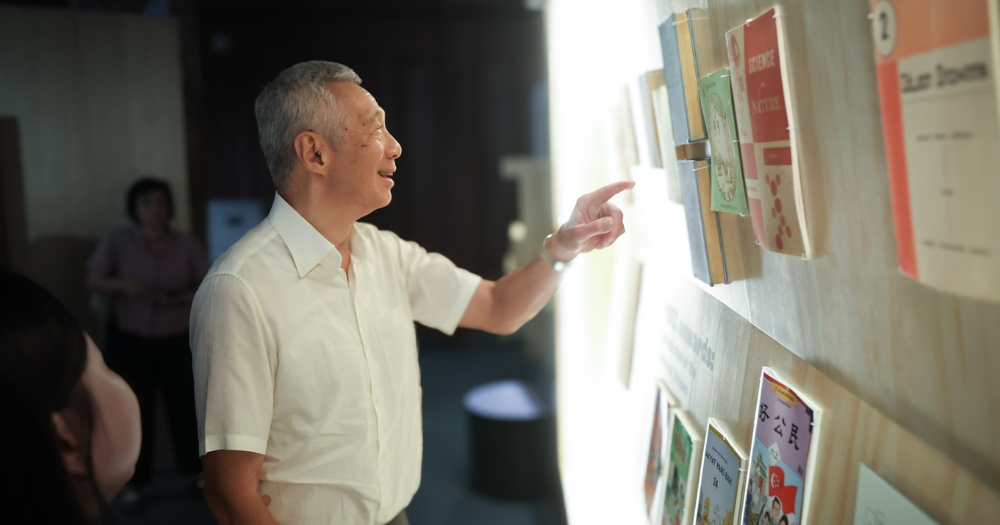
Top image from LHL/Facebook