News


Australian PM Albanese made a flying visit to S'pore, what can we learn from Australia's reaction?
Witness him.
April 20, 2026, 07:01 PM


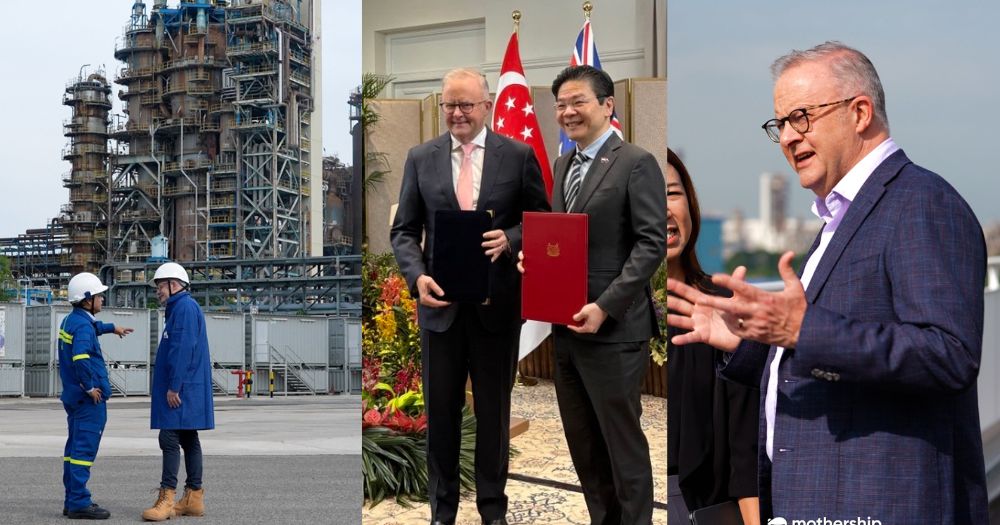
Australia Prime Minister Anthony Albanese paid Singapore a visit on Apr. 9-11, what was described by some as a flying visit, because despite the three-day itinerary, he really only spent one full day in the country.
That itinerary left little doubt about what he was here for.
Gastown
A morning visit to Jurong Island, and a lunchtime discussion with PM Lawrence Wong, yielded a joint statement on economic resilience and essential supply.
The visit was centred around one thing: Fuel.
It is abundantly clear, browsing through Australian media in the wake of Albanese's visit, that fuel availability is on the front of many people's minds, leading some to begin hoarding fuel in response, to the annoyance of others.
@mothershipsg An Australian social media figure, Willem Powerfish, filmed a man pumping containers of petrol amid a fuel crisis in Australia and posted the video on his Facebook page on Mar. 24. According to 7News, a fuel emergency plan had just been proposed to cap fuel purchases at A$40, allowing motorists to only buy about 16 litres at a time. However, according to news.com.au, Australia Energy Minister has ruled out implementing the fuel limit, saying the proposal is “a bit out of date”. #mothershipabroad #australia #tiktokaustralia #fyp ♬ original sound - Mothership
Those fears set the stage for the Australian PM's visit: on Mar. 22, as the Hormuz crisis began to really take shape, it was reported by the Guardian that six fuel ships bound for Australia had been cancelled or deferred (Australia generally expects 80 shipments a month).
The very next day, on Mar. 23, Albanese spoke to PM Wong about assuring fuel deliveries.
And Albanese ultimately got what he wanted from the visit.
A question coming from an Australian reporter posited a scenario where supply constraints forced Singapore to reduce exports to other countries: Would Singapore prioritise fuel exports to Australia?
It's often the case that definitive answers in foreign relations can be hard to get. Even in the joint statement between Singapore and Australia this week, as the Australian media noted, there were many assurances, but no explicit promises.
Not happening
But PM Wong was as definitive as it got.
Responding to a question about whether Singapore would prioritise Australia if it was forced to cut fuel exports, PM Wong was as definitive as he could be: It would not happen.
"We do not plan to restrict exports," he said. "We didn't have to do so even in the darkest days of Covid, and we will not do so during this energy crisis."
Albanese beamed. The PM was “as confident in public as he was in private”, capitalising on the moment to reinforce his diplomatic success for an Australian audience.
The press has its say:
But was that success real? How did Australia's media react and what does Australia's reaction tell us about Singapore’s own position in the most intense fuel crisis in decades?
Australian media broadly had two key reactions to the visit:
Firstly, Singapore was alternatively a steadfast friend in a time of need or saving Albanese's government in a time of crisis.
Second, they noted the “caveats” the PM Wong statement had, that there was no explicit guarantee in the agreement between PM Wong and Albanese, and that he said fuel would flow to Australia “as long as there were no upstream disruptions."
A good example of this was Sky News, notably not an Albanese ally, describing his trip as bringing out the “begging bowl”, and then ranting against thirty years of Australia's energy policy, saying that all it had done was degrade Australia's capacity and made other countries rich.
A more measured take from The Age touched on all the points, suggesting that Singapore was attempting to fend off potential new windfall taxes on Australian gas exporters as a trade for ensuring that cutting off Australia's fuel supply “won’t happen”.
They quoted Australia opposition leader Angus Taylor as saying that Albanese should have pressured PM Wong for petrochemical producers to match prices in accordance with the (then) falling price of diesel.
It was just as well that Albanese's visit came amidst renewed hope of an end to the conflict as a ceasefire was declared, but it looks ever more tenuous: by the end of the weekend, Iran’s blockade of the Strait was joined by the U.S.' own.
Win win
The most optimistic take was that of the Sydney Morning Herald, who repeated Albanese’s assertion that the deal was a “win-win”.
Because of that focus, the SMH’s article also gave the most realistic expectation of Singapore’s position: Singapore had clear objectives in dealing with Australia, too.
During the joint press conference between Albanese and PM Wong, Wong at several points noted that many of the agreements, whether supplying petrol to Australia or LNG to Singapore, were not deals made out of special consideration, they were commercial deals and remained so.
There is a clear logic with the supply agreements, and while, as The Age quoted, they tap on the “deep reservoir of strategic trust” between the two countries, they also make commercial sense.
The term “win-win” can often come across as trite as far as diplomatic agreements go, but this was as clear-cut a case as one might imagine:
The assurance that PM Wong gave that exports would not be curtailed “as long as upstream supplies continue”, might have felt like a hedge to Australia media, but Australia is one of the upstream suppliers too.
Singapore’s power supplies coming mainly from LNG means that the energy-intensive refining process to produce the petrol Australia needs is powered in large part by Australian LNG.
The last point that came through in Australia coverage was a sense of surprise that tiny Singapore could somehow have become so important to the Australian economy.
In this, they were not alone.
With flare
Every other year, a post on social media will go viral, with someone asking what the mysterious flame to the south was.
It’s almost always one of Jurong Island’s refineries flaring as it burns off excess gas that it cannot otherwise contain, reminding us that Singapore’s petrochemical industry is not universally known in Jurong, let alone the world.
Probably the reason why PM Wong was able to give the assurance that he did was that the industry was built for the export market.
What Singapore wanted, as described by Lee Kuan Yew School of Public Policy academic Vu Minh Khuong in his 2017 journal article about Singapore’s petrochemical industry, was jobs.
That means where other countries with significant refinery capacity might choose to retain much of the production for domestic use, Singapore can’t use up all it produces, and will have to export it.
Singapore’s refinery facilities are not quite in the top 10 in the world by capacity (although there are three in the top 20), it is the third largest oil and trading hub in the world.
The first two are in the U.S. and Europe, making Singapore “Asia’s undisputed oil and gas trading hub”, the term many energy analysts use to hype up Singapore’s importance.
Literal backdrop
DPM Gan Kim Yong has highlighted Singapore’s role as a “trusted hub” for the movement of goods across the world, and Albanese’s visit to Singapore on very short notice shows the fruit of that labour.
In this way, Singapore has made itself a useful backdrop for Albanese to literally project himself on.
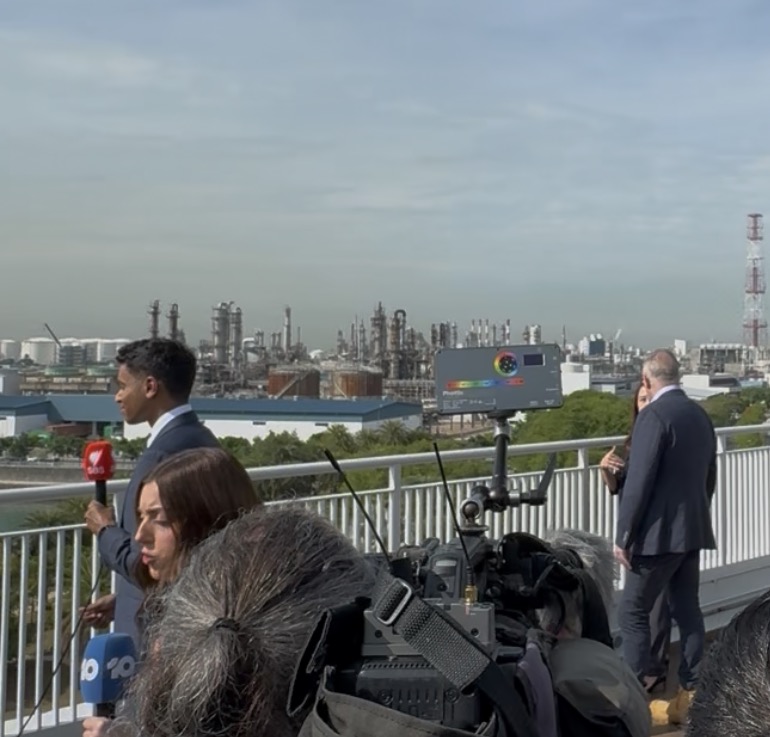 Image via Mothership
During Albanese's Jurong Island visit, part of the press arrangements allowed for him to stand in the background while TV news anchors delivered pieces to camera in the foreground.
Negotiating protocol
Albanese's visit was followed up within the week by a visit from his foreign minister Penny Wong and trade and tourism minister Don Farrell.
They met with their Singaporean counterparts, Vivian Balakrishnan and Tan See Leng respectively, concluding negotiations of a new protocol that formalises PM Wong's and Albanese's joint statement.
The protocol will likely be signed by the leaders when they meet later in the year for the joint leader's retreat, pending approval through the relevant domestic processes.
While the situation in the Middle East and the energy crisis that it has sparked is largely out of Asia and Australia’s hands, leaders cannot be seen to be doing nothing.
Top image via Mothership