News


Comment: Economic Strategy Review recommendations point to potential challenges in creating good jobs despite steady growth
Opportunity, with some peril.
February 03, 2026, 06:57 PM
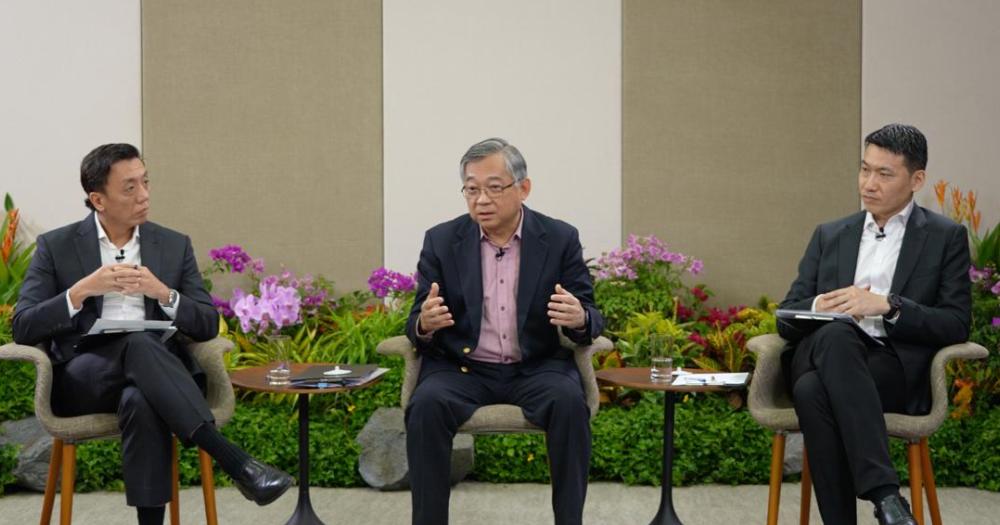


On Jan. 30, the Economic Strategy Review (ESR) Committee gave a mid-term update, distilled into seven recommendations for how to adapt to an uncertain future, rife with technological disruption and a tension-filled world.
Deputy Prime Minister (DPM) and Minister for Trade and Industry Gan Kim Yong, and Acting Ministers for Transport and for Culture, Community, and Youth, Jeffrey Siow and David Neo, respectively, spoke about the recommendations extensively.
The seven recommendations are:
1. Extend our lead and establish leadership in key growth sectors.
2. Boldly pursue emerging opportunities to create new engines that can push the growth frontier of our economy.
3. Establish Singapore as an AI leader with an AI empowered economy.
4. Strengthen connectivity and linkages to global markets, and aggressively support firms to internationalise.
5. Broaden the range of good jobs.
6. Make lifelong learning a practical reality and empower every worker to take charge of their career.
7. Enable our business to proactively navigate transitions.
The recommendations can be quite difficult to understand for many - it's a lot of knowledge squeezed down into as few words as possible, meaning that nuance and understanding get crunched out of existence.
Groups of groups
I actually see three groups of statements:
First: 1 to 3, where the ESR committees have attempted to soothsay the future of the economy,
Second: 5 and 6 acknowledge the ongoing worries and anxieties about jobs and employment
Third: 4 and 7, tries to address concerns from businesses about expanding internationally
Businesses
Group Third is the simplest to explain, as it's a continuation of something that Singapore has already done with relative success.
Agencies like Enterprise Singapore and Economic Development Board (EDB) have had long histories of trying to connect Singapore and Singaporeans with relevant partners across the world.
SMEs in Singapore understandably have a limited capacity to perform such roles, and the Singaporean government is in a good place to act as matchmaker; it's reasonable to expect them to continue doing so into the future.
Growth sectors
Group First is perhaps the trickiest.
Wanting to establish or extend leadership in “key growth sectors” is a question of how; no one needs to explain why Singapore should want to do so.
Boldly pursuing opportunities begs the question of what “bold” actually means.
There are also mentions in the media factsheet about taking greater risks. You know what they say, the greater the risk, the greater the reward; but also the greater the potential failure.
Some of the emerging technologies they speak of, like quantum, show great promise, but they have been showing great promise for decades. One of my favourite movies from the early 1990s talks about the emergence of a quantum technology that would encrypt all the world’s systems; it's been over 30 years, and we're still waiting.
This isn't to say that investment in it is a waste, it's just a warning that between the time a field emerges and it actually becomes practical might be measured in lifetimes, not years.
Uncertainty and opportunity
Even AI is a moment of unusual uncertainty. After the past half-decade of hearing that AI will come for us all, Davos 2026 saw no less than Sataya Nadella, Microsoft CEO, warn that AI would lose public support unless it was soon used to “do something useful”.
But Singapore is not filled with AI sceptics, and the use of the tool has been embraced by all sectors, especially in the government.
With Ministers speaking about AI weekly, I get the sense that the civil servants see its implementation in the service as natural and inevitable.
And this is essential because for the government to promote AI use and the efficiencies it engenders, it would be better if they were clear-eyed about those uses, because, as indicated above, not everyone does.
The ESR recommendation has laid out what it deems to be the areas it targets, helping adoptees in industry to identify where AI can help them, helping them put together the resources and testing they need, and helping them attract the companies and talent that will help them succeed.
Secondary issues
These are the first-order problems of the government’s AI goals, but we should also be aware of the secondary issues a major AI push will have.
Even if implementation and adoption take the most optimistic path, Singapore remains tied to the physical reality of AI, where compute is limited, expensive and getting more expensive, and restricted by factors such as electricity capacity.
That last factor is the specific issue that Nadella was warning of, essentially saying that the public needed to see clear benefits from AI, or they would soon begin to demand that the electricity spent pursuing AI be redirected to something with clearer benefits.
AI adoption is at that vulnerable stage, where the initial promise and amazement have dulled a bit, the downsides are becoming more unavoidable, but the full capability has yet to be revealed.
If investment in AI in Singapore helps reorganise our ports (an issue highlighted by Minister for Digital Development and Information Josephine Teo at Davos, although she was then talking about Quantum), or allows Singapore to take the lead in healthcare research, the investment becomes very easy to justify.
But we’re not there yet.
Jobs Jobs Jobs
And one other worrying aspect of the AI revolution and its related developments is the possibility that, as it progresses, it could drive growth, but the productivity gains that drive that growth may fail to provide more jobs.
The twin promise of economic and job growth is seen to go hand in hand, and my personal suspicion is that the break between the two is not as clear as it might first seem: in the long run.
Unless AI somehow wipes out the need for all human employment, which doesn’t seem to be the case at the moment, economies will eventually adapt and expand to make use of the labour now available.
Certainly, this is the hope in Singapore, as highlighted by David Neo when responding to a question by Mothership.
Technology that multiplied the output of each worker was something that Singapore should welcome, rather than resorting to an instinct to be “a little bit protective”.
Singapore had a perpetual problem of needing every worker available, so the benefit of technology that alleviated this would become apparent.
Listening and reading to the remarks of Gan Kim Yong, Jeffery Siow, and David Neo, two things resonated with me: they believed that they could hit the economic growth target of two to three per cent (on average, they probably didn’t think they could do it consistently), and they were worried about jobs.
It is an odd thing to see a government relatively optimistic about growth but pessimistic about jobs.
Practical realities
To see the recommendations labelled in the way they were: “Make lifelong learning a practical reality”, asked a question about efforts undertaken so far: I guess lifelong learning is not yet a practical reality?
But it shouldn’t surprise us that it isn’t: for one thing, it's not easy.
No developed country in the world has yet managed to enable all its workers to transition to different fields mid-career, under the assumption that it would be necessary.
It requires an acceptance that the jobs of today not only should not be saved, but cannot be saved, and that it is more practical to find alternatives, and cognitive dissonance of being pessimistic about jobs and optimistic about training all at once.
I am being cautiously optimistic about the latest phase of Skillsfuture, and as someone who has benefited greatly from going back to school for further education know the benefits and the perils of doing so.
The skills and recognition were good, but the cost of taking a year off work to do it was... well it could have been better.
Every time the government reiterates its understand of the challenges for individuals to actually embrace lifelong learning, the better off we'll all be.
Top image via Mothership