
News


Comment: China's tough stance on Takaichi didn't win the election for her, but it probably helped
Probably.
February 12, 2026, 10:17 AM
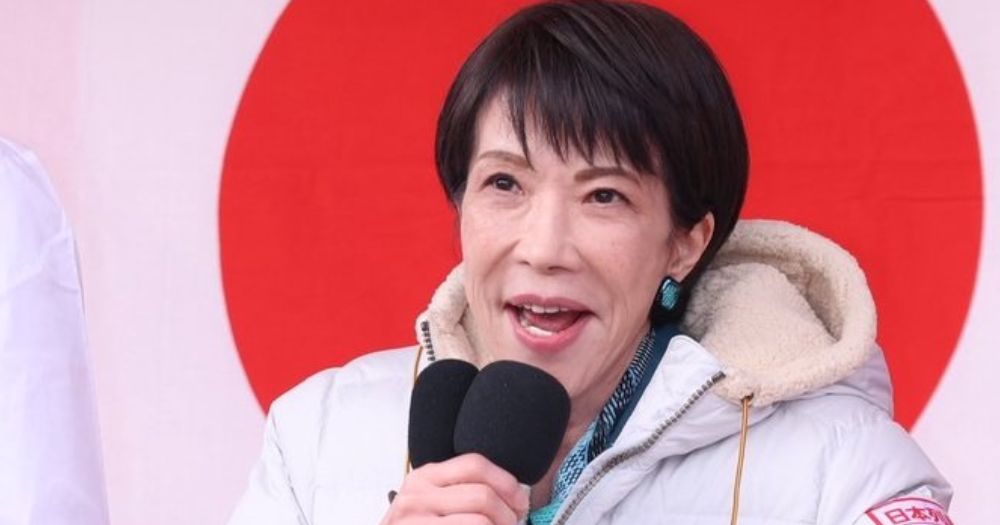


Sanae Takaichi has secured her landslide victory, dragging her party, the Liberal Democratic Party, from the nadir of minority government to the promised land of supermajority.
And the thought that occurred to me all weekend, as the election took place and the days after, was:
Did China win the election for Takaichi?
No
The simple answer is no.
The slightly longer answer is: mostly no.
China has been smarting over comments made by Takaichi in November, when she said in response to an opposition parliamentarian that Japan would consider a naval blockade of Taiwan a “survival-threatening situation”.
That would mean it was enough justification for the highly constricted Japanese Self-Defence Forces to intervene militarily.
But as Singapore’s favourite retired diplomat (that guy you’re thinking of isn’t really retired), Bilahari Kausikan, shared in his post-election analysis, China’s criticism has “backfired” and contributed in “some measure” to her victory, although he cautioned against “exaggerating its impact”.
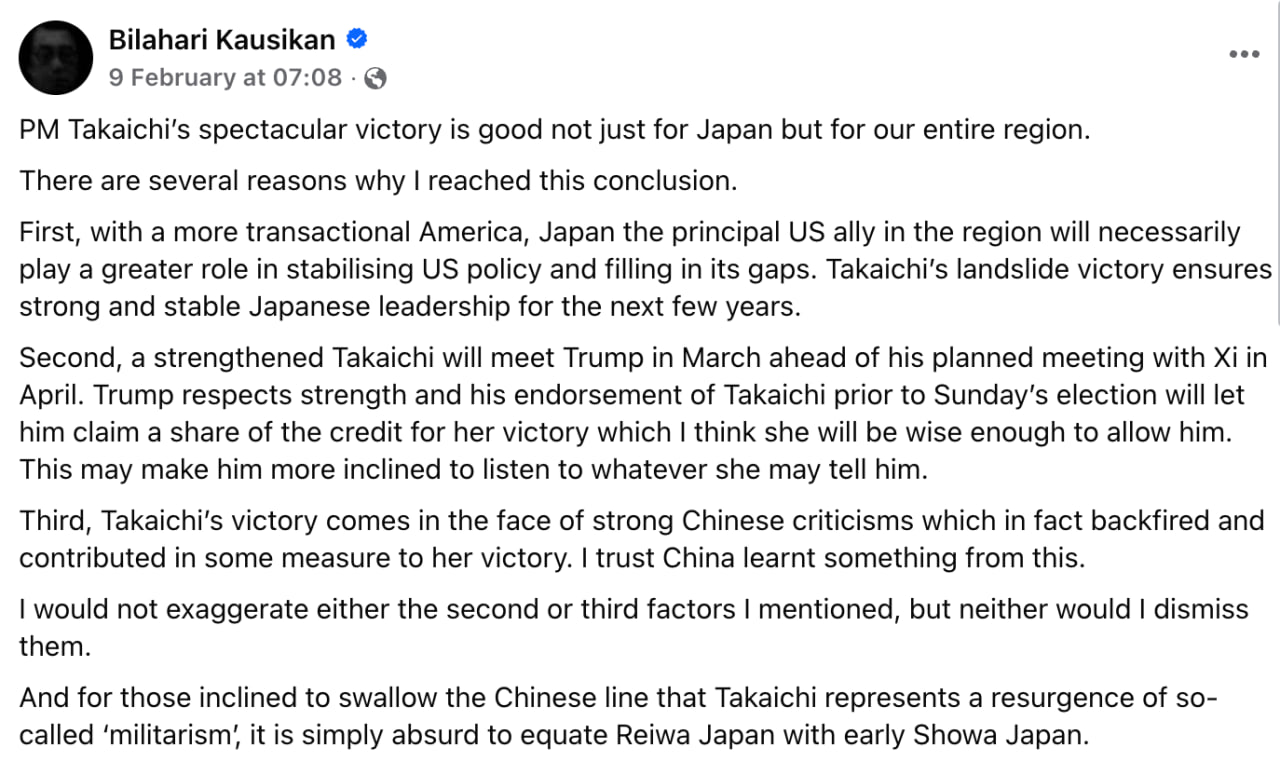 Image via Bilahari Kausikan/Facebook
Bilahari noted that China’s pressure often backfired, citing Taiwan’s Tsai Ing Wen’s seemingly doomed second election bid, which was revived by China’s threats.
Why is this so sensitive for China? And why has their cajoling largely failed?
Dirty, not calmer heads
China’s claim on Taiwan is not new, nor is it surprising that anything other than unbounded acceptance of that claim will illicit retaliation.
So at the beginning of November 2025, when Takaichi responded to an opposition politician’s question by saying that Japan would probably consider a military naval blockade of Taiwan as justification to get involved, it provoked fury.
China’s MFA’s strong language was hardly a surprise; China’s Osaka Consul head comparing Takaichi to a “dirty head that must be cut off” was only surprising because usually officials tended to only retweet such a sentiment, not issue it themselves.
The tweet was later deleted, but was just the first step in China’s attempts force Takaichi to walk back her words.
Escalation
China then banned imports of Japanese fish, and China accounts for a fifth of Japan’s fish exports.
They also sailed naval vessels past disputed islands.
Then came the call for Chinese tourists to boycott Japan as a destination, claiming that there was a crime wave in Japan targeting Chinese tourists.
There, however, appears to be no statistical backing for this claim.
This led to even a stoppage of Japan-bound flights, which in theory would decimate a tourist market where China represented 19 per cent of visitors, second only to Korea. (Ironically, Taiwan is third on this list, with just a million fewer tourists a year).
With Takaichi calling a snap election, all efforts were made to keep China’s displeasure and retaliation top of mind, with some Chinese outlets digging deep, reporting on complaints that the elections would disrupt university entrance exams.
Landslide
The scale of Takaichi’s landslide has put to bed any suggestion that China was successful.
Her Liberal Democratic Party didn’t just win the election. The party, by itself, without any assistance from coalition partners, has a supermajority in parliament, allowing it to bypass a hostile upper house.
This is the first time a single party has achieved a two-thirds supermajority since World War II.
In fact, the victory was so comprehensive that the LDP had to give up 14 seats to other parties because it didn’t have enough candidates to fill all the seats it won due to the proportional representation system.
Adding salt to this wound is the fact that the LDP had bottomed out in popularity; its approval rate was in the 20th percentile, while Takaichi’s approval rating was in the 70th percentile, meaning that it was Takaichi’s personal popularity and her stances that drove the success.
Suffice to say: China did not dissuade many from voting for Takaichi’s party.
Not that it has ever officially claimed to have wanted to dissuade the Japanese people.
Lin Jian, who's a spokesperson for the Ministry of Foreign Affairs of China, said that the election is the internal affair of Japan. But in his answer, also said that there were "deep-seated and structural issues as well as certain emerging views, trends and developments, which deserve serious examination by people with insights in Japan and the international community".
Breaking stuff to look tough
Takaichi’s victory is not about China; it's about domestic issues that Japan has struggled with for years, like a stagnant economy or rising cost of living.
But if you’re a voter worried about a tough-talking politician who backs down the moment things get tough, Takaichi has shown she won’t even back down in the face of China.
China has ironically provided a perfect background for Takaichi to display her nerve, and she appears to have been rewarded for it.
Article 9
This is not to say that China’s concerns emanate from nowhere.
They articulate it in their messaging, citing past grievances from a devastating Second World War experience.
While the People’s Republic of China has not always had a bad relationship with modern Japan.
In recent years, China has focused on a sense of grievance, which it articulates by saying that Japan has not done enough to atone for the sins of the Second World War.
It has, in years past, cited issues like Yasukuni Shrine visits, history education that tries to absolve Japan, but most of all, it takes issue with attempts to remove Article 9 from Japan’s constitution.
Article 9 gives Japan’s constitution its famous “pacifist” quality, legally preventing its government from going to war, or otherwise engaging in the type of militarism that preceded the Second World War.
It was inserted into modern Japan’s constitution by victorious war powers, but has become revered by many of Japan’s own citizens.
Trust
The China Daily articulated it like this in a comment piece published days before the Feb. 8 election: “Pacifism was not imposed to humiliate Japan; it was the prerequisite for trust.”
China’s not the only country that opposes Article 9 reform; Korea has voiced its opposition on numerous occasions, and is probably the only country that suffered longer from Japan’s militarism than China.
But in the most recent incident, there was a distinct lack of support for China’s actions.
The China and Japan of WWII are not the same countries they are now. China's military is now the most powerful in Asia.
Takaichi’s mentor Shinzo Abe spent decades searching for the popular support to change the constitution, and now Takaichi has it.
Top image via Sanea Takaichi/X