News


Economic growth may not create as many jobs due to AI, 'good' jobs need broadening to meet aspirations
DPM Gan said: "The key promise or assurance that we can give is that we will be with you every step of the way."
January 30, 2026, 02:01 PM


It can no longer be taken for granted that economic growth automatically leads to the same level of job creation due to the advent of artificial intelligence (AI) and automation, the Economy Strategy Review (ESR) committees said in a mid-term update on Jan. 30.
This observation, along with others, underpins seven recommendations proposed by the five ESR committees.
The ESR was launched in August 2025 to formulate an economic blueprint for Singapore amidst a volatile global environment.
Seven proposed recommendations
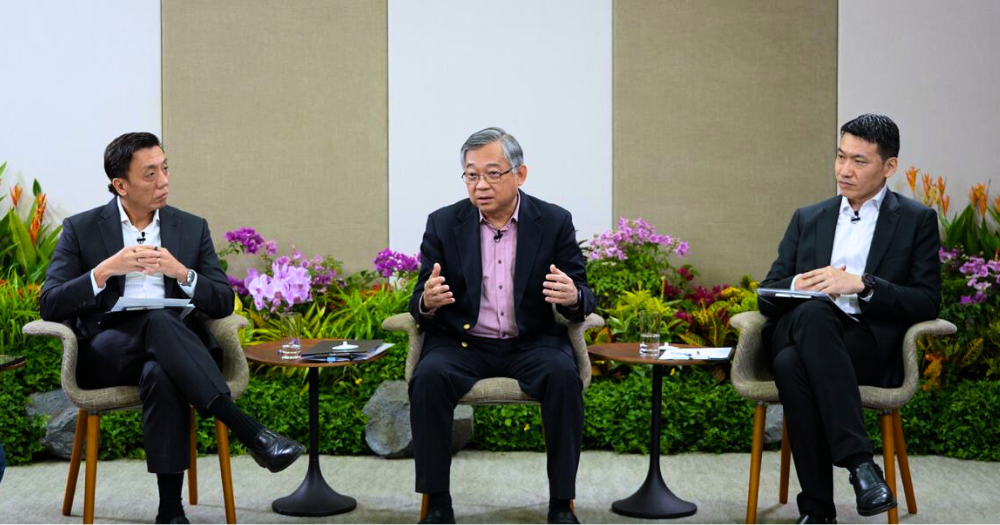
Speaking to the media on the update, Deputy Prime Minister Gan Kim Yong, who chairs the ESR exercise, shared that Singapore is in a new phase of its economic journey, given rising protectionism, advances in technologies like AI, climate change and an ageing population at home.
"Going forward, it's going to be very challenging to achieve economic growth. It will not be the same as we have done before, because the environment is very different today," Gan, who is also the Trade and Industry Minister, said.
"We can no longer assume that economic growth will generate jobs. Therefore, we need to pay particular attention to job creation and making sure also that the jobs created are good jobs for Singapore and Singaporeans," he added.
To address these challenges, the five ESR committees proposed seven recommendations in total.
Acting Minister for Transport Jeffrey Siow, who co-chairs the ESR committee on global competitiveness and was also present at the media briefing, divided the recommendations into two broad categories: growth and jobs.
Good jobs
Acting Minister for Culture, Community and Youth David Neo, who co-chairs the ESR committee on human capital, told the media that the pace of change will be faster due to the emergence of new technologies, and all sectors will be affected.
Workers and businesses will have to be supported as they navigate these changes so that "growth is inclusive and that progress is shared by all", Neo said.
To that end, the ESR committees propose three moves, one of which calls for the broadening of the range of good jobs in the economy that "meet the aspirations of our people".
The other two moves include helping Singaporeans remain agile in acquiring new skills, such as in AI, and supporting businesses in navigating transitions.
Expanding on the expansion of good jobs, Neo said that some new jobs may come from growth strategies to be pursued, such as AI.
However, job growth cannot be limited to this, and effort will have to be devoted to ensure a "more diverse and larger set of jobs" is being transformed and created.
"Many of these jobs are in essential services that every Singaporean household relies on, as well as our businesses. These are jobs from skilled trades to care services," Neo said.
"We think there's a lot of potential to help create better success pathways, better ways for Singaporeans to acquire skills and build stronger pathways to success," the acting minister continued.
On the definition of good jobs, Neo gave the example of an electrician as a trade that is needed by all households in Singapore.
"We're talking about not just the way we understand electricians today, but the whole electrification of the grid [such as] EVs... I think that opens up a whole new possibility in terms of what kind of new jobs [there are] in the electrification sector," Neo explained.
There's a role to examine how skills certification pathways can be structured and implemented such that there is an opportunity for Singaporeans to gradually uplift themselves, he added.
Technology that can increase productivity should be great news: Neo
When asked whether there are concerns that the expectation of reduced job creation levels, coupled with recent discussions on immigration, might lead to frustration among the workforce, Neo said it is natural to be pessimistic at first.
Such pessimism was initially shared by the committee as well, Neo revealed.
"But I think as the conversations [within the committee] go along, a lot of the private sector, as well as our union members, felt that actually... we are a small country, people is our most valuable resource. We can never have enough workers," he shared.
"The appearance of a technology that can increase multiple-fold the productivity of each person should be great news to us. That means that every single Singaporean worker now can do way more, and then perhaps our limitations around manpower... can all be overcome," Neo continued.
Adding to Neo's response, Gan acknowledged that there will always be anxiety among workers towards change.
He likened the circumstance today to automation "a few decades ago", when people were worried that productivity growth would lead to lowered demand for workers and thus, fewer jobs available.
That did not prove to be the case, Gan shared, adding that he believes it will be the same with AI and that the key is whether we can transform fast enough as a country and workforce.
"So, I think the key promise... or assurance that we can give is that we will be with you every step of the way. We must do this as a whole-of-society," Gan remarked.
Key move for growth will include an AI-empowered economy
On growth, Siow explained that there are four key moves.
The first key move is to extend Singapore's lead and establish global leadership in growth sectors, such as advanced manufacutring and modern services.
The second key move is to push up Singapore's growth frontiers in new technologies (quantum computing, decarbonisation opportunities, space technologies), nurture global leading businesses, and strengthening Singapore's startup ecosystem.
A key thrust of the moves is to tap into AI to drive overall productivity, establish Singapore as an AI leader, and use it to transform Singapore's advanced manufacturing industry.
Recommendation three by the ESR committees specifically focuses on AI.
"AI is going to be a fundamental transformational force, not just for the economy, but even for society," Siow said
"Our ambition is, when someone thinks about AI leadership in the world, they think about Singapore," he added.
While Singapore already has a refreshed national AI strategy, Siow noted that we can do more to encourage investment, application and talent development.
The last move include deepening Singapore's connectivity to global markets.
"When we are able to achieve this, Singapore will be in a better position for us to compete in a changed world," Siow said.
PM Wong to deliver response during Budget statement
Prime Minister Lawrence Wong is expected to respond to the ESR mid-term update when he delivers his Budget statement on Feb. 13, 2026.
A full response will be delivered by the government after the ESR final report is released, Gan shared.
Top image via Mothership