





Branded
‘Mindset over skillset’: How AI is helping S’poreans thrive & not just survive in their careers
More job possibilities and career growth in the future.
Ever lie awake in bed overthinking your job, questioning whether you’re good enough and whether you might be replaced by smart robots in the future?
No? Good for you!
But the truth is, AI is not going anywhere and will likely change the way we work, so it’s totally understandable if you’re concerned about how to stay ahead of the curve.
We spoke to three Singaporeans about how they have picked up AI skills and deployed it in their jobs, what it’s like working alongside AI, and more importantly, how AI presents growth opportunities for Singapore.
Exploring different pathways and picking up new skills
After graduating with a law degree, Lavanya Karthikeyan didn’t pursue a career in law.
Instead, she navigated different roles at the intersection of business development, policy and tech, proving time and again that it's never too late to pick up relevant skills on the job.
Now, she’s a Senior Community and Customer Marketing Manager at Workato, a leading agentic orchestration platform headquartered in the US.
Workato is a business automation software company that connects various business systems, automates workflows across them, and orchestrates all of this seamlessly.
The company opened an AI Lab in Singapore in 2025 – their first outside the US, and they also forged partnerships with local institutes of higher learning to offer students learning opportunities in AI.
Currently, her role involves designing experiences to bring innovators together, and building education partnership programmes to provide students with access to advanced AI tools and real-world industry projects.
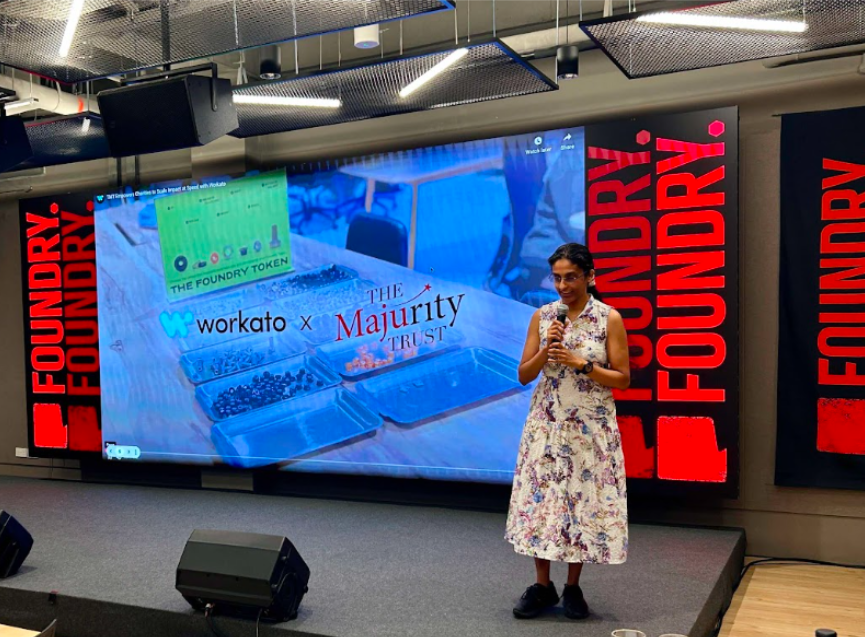 Photo courtesy of Lavanya Karthikeyan.
“I came into tech with no tech background, and have been relentless about upskilling.”
To keep up in this industry, Lavanya constantly learns from leaders and teammates, pursues courses to hone her craft, and regularly experiments with new capabilities.
“The tech sector rewards mindset over skillset,” she said. “Ultimately, tech is a mindset: it’s about solving problems creatively, embracing change, and believing tomorrow can be better than today.”
And what does she think about the future of work and AI? Should we be worried?
She said:
“The future isn't humans or AI — it's humans leading with AI.
AI can draft emails, analyse data, generate code, but it needs human judgment for strategy, ethics, and context. The most valuable workers won't resist AI; they'll orchestrate it effectively while leading with empathy.”
Picking up new AI skills
Melvin Ang works in the logistics industry, but he has successfully integrated AI and new technologies into his role.
He’s an Assistant Manager (Analytics) at ST Logistics, which provides supply chain management and logistics solutions to the defence, government and healthcare sectors.
Ang’s role involves providing businesses with insights and solutions to improve the performance and operations of their business verticals.
He deploys AI skills in his daily work to automate repetitive tasks, analyse operational data, and rapidly test ideas.
This has cut processing time, improved his decision-making skills, and allowed him to focus more on innovation.
“While jobs used to be more manual and labour-intensive, nowadays we incorporate automation and technologies to help increase efficiency in our operations,” Ang said.
Ang and his team also came up with the Majulah application, which was used to manage the deployment and recovery of items used at over 1,500 rally sites, polling stations and counting centres during Singapore’s 2025 General Election.
AI was used to support the extraction and analysis of election administration data.
As this project involved over 1,500 documents on operational and administrative details, Large Language Models (LLMs) and Optical Character Recognition (OCR) were used to extract, review, and validate the information accurately.
Using AI not only reduced the time taken for this task, but also allowed the team to focus on decision-making and planning rather than manual data processing.
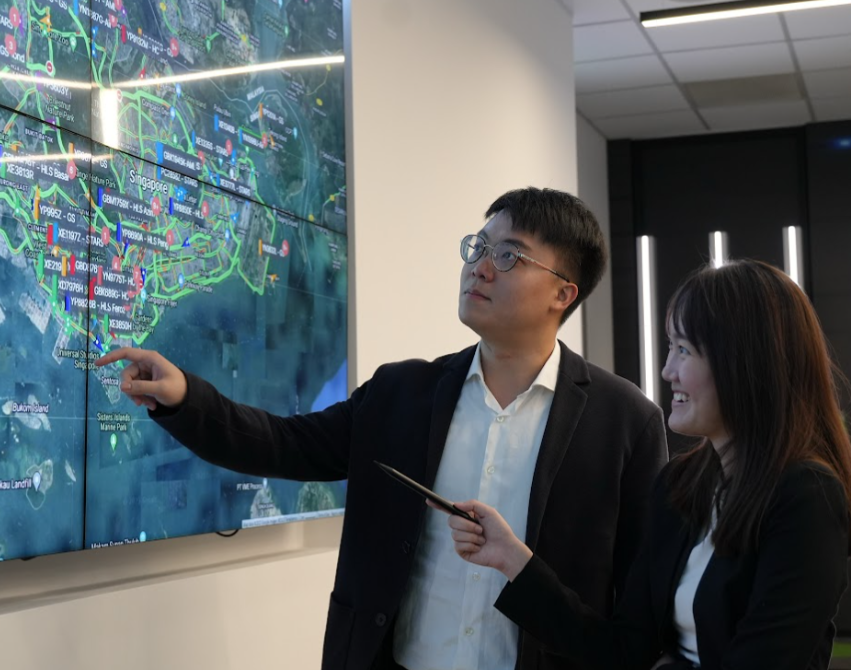 Photo courtesy of Melvin Ang.
Given the scale of this project, it may come as a surprise to know that Ang had no prior experience developing mobile applications before he joined the company in 2023.
ST Logistics is helping their workforce upgrade capabilities to remain globally competitive as nearly 98 per cent of their employees participate in an in-house programme, the Skills Allowance Scheme, to pick up new technical and digital skills including those related to AI.
Ang had leveraged on this upskilling initiative to learn how to design and deploy a front-end application that tracks the progress of document processing as well as the extraction of information.
He picked up new skills, such as how to integrate AI outputs into a usable interface for operational tracking while ensuring clarity, traceability, and usability for the team.
New technologies, such as data analytics and AI, offer new learning opportunities and perspectives to those in the logistics industry, he said.
“Younger folks who are keen to join the field will certainly have a different taste of logistics as compared to the past.”
New job opportunities with AI
Apart from augmenting job functions and enhancing productivity, AI has, in fact, created new and interesting job opportunities within Singapore.
TE Connectivity, a global technology leader in connectivity and sensor solutions, designs and manufactures electrical and electronic components.
In 2024, the company launched a proprietary AI application – fully developed within Singapore – boosting engineering workflows for its connectors and sensors. This application was built in addition to ongoing collaborations with various local research institutes, universities, and private companies.
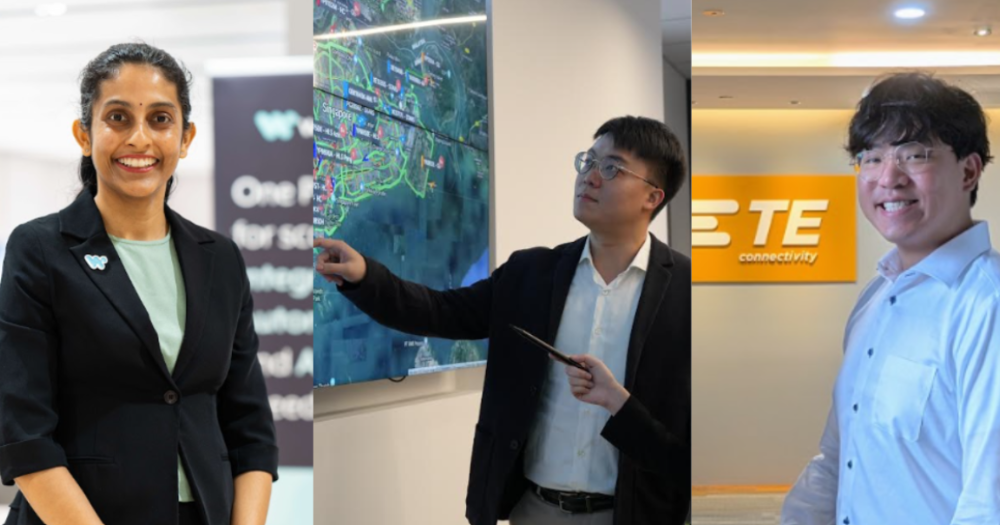
Nathaniel Yeo was one of TE Connectivity’s interns, but this eventually became a full-time role after he graduated with a degree in Computer Science.
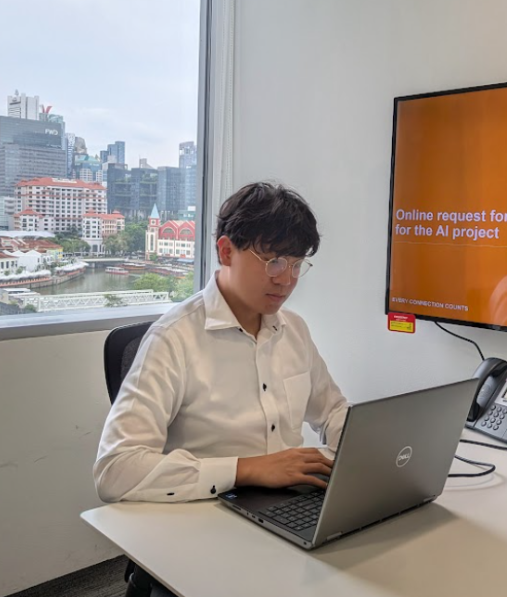 Photo courtesy of Nathaniel Yeo.
During his internship, Yeo witnessed how AI can be applied to solve real-world problems. “The first-hand experience inspired me to commit to a full-time career as a data scientist after graduation,” Yeo said.
The 27-year-old Data Scientist now works within the TE AI Hub team in Singapore, which drives AI transformation and innovation across the entire company.
Yeo’s role is to develop AI-driven solutions that optimise business processes and enhance decision-making.
A project he is particularly proud of is creating a machine learning model that leverages past data to optimise product designs. This means that they are able to produce designs that are more effective within a shorter time frame.
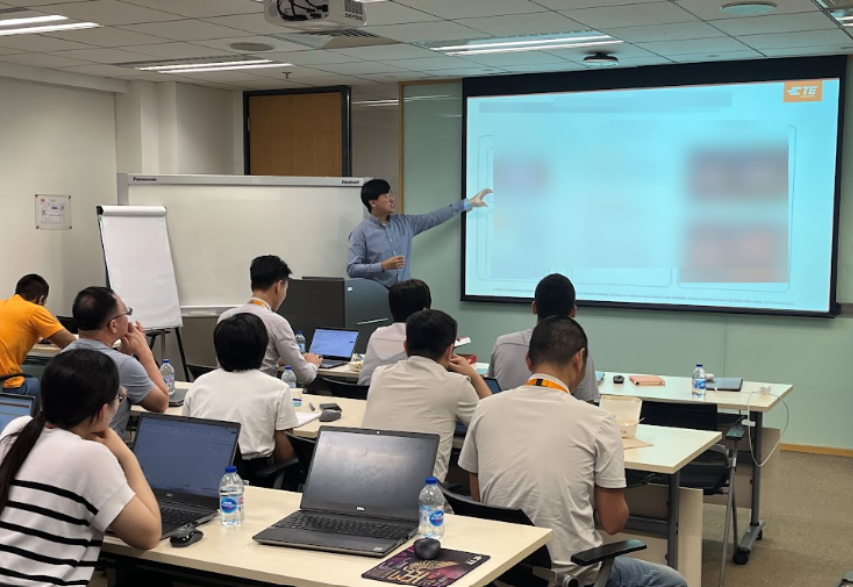 Photo courtesy of Nathaniel Yeo.
Yeo has also represented the Singapore AI Hub’s team overseas in training workshops and networking sessions, elevating the visibility of Singapore’s AI capabilities and promoting global collaboration.
What’s next?
Nearly three in four workers surveyed reported using AI tools at work, with many already using AI several times a week or even daily, according to IMDA's Digital Economy Report 2025.
Want to boost your AI skills and find out how you can prepare for the economy of the future?
Explore different schemes and programmes here.
This sponsored article by the Singapore Economic Development Board (EDB) was written by a human.
Top photo composite image, photos courtesy of profiles.