News

A lawyer with 1 client: Tommy Koh on representing S'pore in the Pedra Branca dispute
A dramatic dispute.
November 17, 2025, 01:32 PM


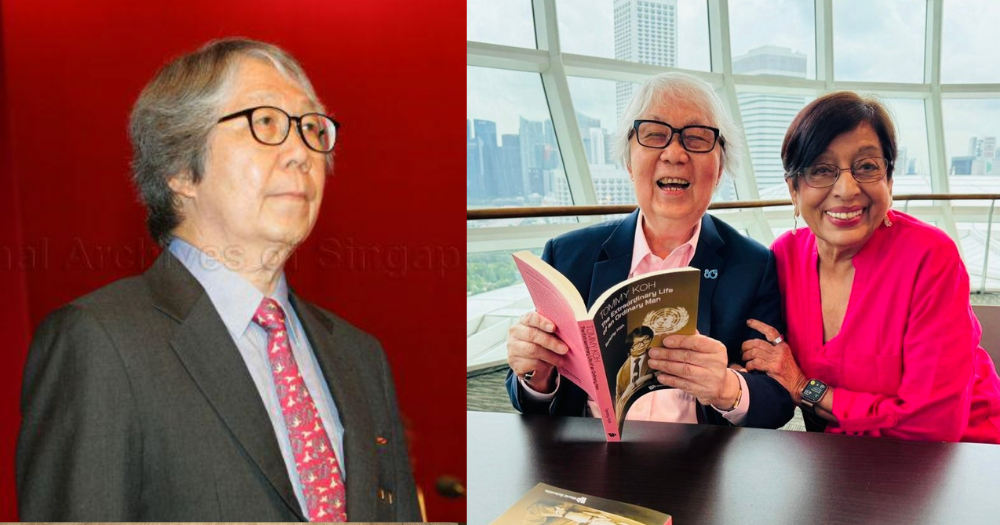
When Tommy Koh turned 88, he did what his wife told him to.
“In January this year, my wife, who is my boss, told me to write my life story for our grandchildren,” he told Mothership. “As an obedient husband, I have carried out my wife’s instruction.”
The result is “Tommy Koh: The Extraordinary Life of an Ordinary Man”, a memoir that spans eight decades of Singapore’s history and his own.
The book traces his journey from a young boy catching spiders and climbing fruit trees to one of Singapore’s foremost diplomats. Today an ambassador-at-large at the Ministry of Foreign Affairs, Koh has seen Singapore through some of the country’s most pivotal moments.
But he sees himself as not more than a fortunate witness to history, whose curiosity, decency and sense of duty have placed him at the crossroads of Singapore’s diplomatic story.
“I am certainly not a genius. I have been successful because I have been given the opportunity, by Singapore and by the United Nations, to serve.”
An abridged excerpt from his memoir, in which Koh reflects on one of his best-known feats — representing Singapore in the Pedra Branca dispute with Malaysia — has been reproduced here.
By Tommy Koh
I am a lawyer with only one client. That client is Singapore. On two occasions, I was appointed by the Singapore government as its agent.
The Pedra Branca case
The dispute between Singapore and Malaysia over the ownership of the island Pedra Branca, also known as Pulau Batu Puteh, began in 1979.
That year, Malaysia claimed for the first time that the island belonged to Malaysia. The truth was that the island has been in the possession of Singapore since 1847 when the British built a lighthouse on it. There was no protest from Malaysia or any other country for 132 years.
In 1981, Dr Mahathir Mohamad became the fourth Prime Minister (PM) of Malaysia. He made a successful visit to Singapore that same year.
Pedra Branca was discussed during his meeting with PM Lee Kuan Yew. They agreed to exchange documents to establish the legitimacy of the respective claims to the island.
PM Lee instructed the Attorney-General (AG), Tan Boon Teik, to visit his counterpart in Kuala Lumpur and show him our documents.
The objective was to show Malaysia that Singapore had a strong legal case and Malaysia should withdraw its claim.
It was an unprecedented unilateral move for Singapore to show its cards to Malaysia. Malaysia refused to withdraw its claim.
Going to ICJ
PM Lee proposed to PM Mahathir, in 1989, that the dispute be referred to the International Court of Justice (ICJ).
Malaysia accepted Singapore’s proposal only in 1994, after it had won its case against Indonesia over the two islands of Sipadan and Ligitan.
I was appointed as the agent of Singapore. My friend from our Washington postings, Tan Sri Abdul Kadir, was the Malaysia agent.
The two agents submitted the Special Agreement to the Registrar of the ICJ on Jul. 24, 2003. But Abdul Kadir was hostile and uncooperative.
Singapore had to assemble its team to prepare for its legal battle with Malaysia. The team was united and worked harmoniously.
Unlike Singapore, the Malaysian team was internally divided. This was disclosed to us by the Malaysian AG.
The next phase of our work consisted of writing and exchanging our written pleadings. This phase took nearly three years and was completed in 2005.
We then waited anxiously for the dates of the oral hearing. After a two-year wait, the hearings finally took place in November 2007.
Singapore's first case
This was Singapore’s first case at the ICJ and we had much to learn. The court consisted of 15 full-time judges.
As both Malaysia and Singapore did not have a judge from their countries on the court, they could each appoint an adhoc judge. Malaysia appointed a South African Professor, Christopher Dugard, and Singapore appointed Dr P. S. Rao of India.
Before departing for The Hague, we were advised to get a flu jab. However, instead of protecting me, the jab gave me a serious attack of flu. I lost my voice.
I went to see a Dutch doctor, Dr Einhorn, who gave me some medication. On the first day of the oral hearing, Nov. 6, 2007, my voice was very weak but at least audible.
Malaysia made its presentations on Nov. 13, 14, 15 and 16. On Nov. 16, the Counsel for Malaysia, Elihu Lauterpacht, fainted and collapsed in his chair. An ambulance was summoned which took him to a hospital.
I visited him in the hospital. He recovered and rejoined the Malaysian delegation on Nov. 20. He had requested the Registrar to expunge from the record all reference to his illness.
The Acting President of the court decided to turn down his request and asked me whether I agreed with his view. I said yes.
He then requested me to accompany him to inform the Malaysian Foreign Minister, Syed Hamid, and Lauterpacht himself of his decision.
Bad faith
The second round of the hearings took place on Nov. 19 and 20 for Singapore, and 23 and 24 for Malaysia. The final statement was made by the Malaysian AG.
In the course of his final statement, he made a new argument knowing full well that Singapore would have no opportunity to respond to him. This was acting in bad faith, and we were disappointed that the court didn’t stop him.
We prayed for a miracle. The New Zealand judge on the court, Kenneth Keith, answered our prayers.
He asked Singapore to reply to the question posed by the Malaysian AG. Singapore opted to give a written reply to his question.
Friday, May 23 2008, was Judgment Day. Deputy Prime Minister S. Jayakumar, Chief Justice Chan Sek Keong, lawyer Ian Brownlie and I attended the court to receive its judgment. The proceedings were telecast live in Singapore.
My wife was listening in Singapore and felt increasingly worried as the court had rejected Singapore’s argument on legal history and the argument that Pedra Branca was terra nullius, or no man’s land.
In the end, the court held, by a vote of 12 to 4, that sovereignty over Pedra Branca/Pulau Batu Puteh belongs to Singapore.
Top image from Tommy Koh/Facebook and National Archives of Singapore