Branded
Despite her suspicion, S’porean, 26, lost S$4,900 to govt officials impersonation scam. How was she taken in?
Always stop and check.
You may think of scams as something that happens only to old people, or those who are not tech-savvy. After all, how difficult can it be to spot a scam if a supposed Prince of Nigeria is emailing you for help?
But these days, scams have become increasingly complex and sophisticated, making use of technology like AI-generated audio and images to weave a web of lies.
Even if you’re aware of scams, and think you’re prepared to handle one, you just might be deceived by an official-sounding person claiming to be from the authorities.
That’s what happened to Stephanie (not her real name), 26, who fell victim to a Government Officials Impersonation Scam (GOIS) in Sep. 2024.
“Richard” from the bank
You may be tempted to judge Stephanie, or think that she was just too naive.
To that I say, hear her out. Her story will illustrate just how sneaky and devious modern scammers can be, using a combination of psychological tactics and publicly available information to ensnare their victims.
It all began with a phone call from someone claiming to be from a local bank. The man on the line asked about the use of a card that Stephanie didn’t even own.
However the scammer, who called himself Richard, was able to accurately recite personal details such as her full name, address and NRIC number.
Richard said that he was dealing with a “serious case of bank fraud” and would have to immediately cancel the card.
It was at this point that Stephanie asked point-blank if this was a scam.
However, Richard deflected, telling her that she could hang up the call and call the bank directly to verify, if she was suspicious.
This made Stephanie trust him more, as she was aware that in other scams, the perpetrators would usually do all they could to keep their victim on the line.
Richard also provided his “staff code”, full name and the branch of the bank where he supposedly worked.
But what provided an air of authenticity to Richard’s call was that he sounded “very local”.
“Inspector Tan” with the "Singapore Police Force"
Not long after, Stephanie received another call from a different person. This new guy claimed to be an Inspector Tan with the Singapore Police Force.
Again, like Richard, he didn’t sound like a foreigner, and his “local accent” made Stephanie trust him more.
Tan said he had received a report from Richard, and he was now “looking into her profile.” After asking some background questions and “running checks”, Tan then changed his tone and threw a major accusation at Stephanie.
“Because of the identification fraud, your details are now tied to a serious money laundering case. Your credit card information was found alongside many other cards discovered at a crime scene.”
Stephanie was nonplussed, as she knew she wasn’t involved in any such scheme.
But Tan was persistent. He kept going, and said that since they couldn’t confirm that she was innocent she would have to “cooperate” further.
The turning point
By this point Stephanie had grown rather annoyed, and resolved to go down to a police station herself to sort things out.
However, Tan had a final card up his sleeve. He said:
“Please feel free to head to any police station, but according to my records, you will be arrested on the spot.”
This made Stephanie pause, as she was feeling confused and threatened by what Tan said. While she still suspected a scam, she couldn’t help but worry about the possibility this was real somehow.
During this time, Stephanie also shared that she had been facing a lot of troubles at work, with a change in management, delayed salary payments, among many other things.
As such, she was in a more vulnerable state due to stress and worry.
“Deputy Public Prosecutor Foo”
Having used the stick, Tan now used the carrot.
Tan switched to a more sympathetic and reassuring tone, and said that as a police officer, he was just trying to help her. He said he was trying to understand Stephanie’s situation, and was not trying to scare her.
Tan also assured Stephanie that the call would be recorded as evidence, and she could refer to it if she needed to testify later.
Stephanie said that up to this point, no monetary requests had been made by either Richard or Tan, which made her believe this might be real.
Tan then referred Stephanie to someone claiming to be a “Deputy Public Prosecutor Foo”, who again gave all the relevant details and spoke at length about this supposed fraud case that she was caught up in.
Stephanie did an online check about the supposed fraud case, and everything Foo spoke about appeared to be true, as the case was covered in the media. When she asked for more details, Foo provided a few, but said the rest was “confidential.”
Using an actual ongoing legal case, and other publicly available information, the scammers constructed a trap that could stand up to a cursory check for those who were suspicious.
Having lowered her defences, the scammers struck.
Foo mentioned that the Monetary Authority of Singapore (MAS) was supposed to “check” that Stephanie did not keep illegally-obtained money for herself. To do this, she would have to make a monetary transfer of S$4,900 to a bank account supposedly controlled by MAS.
In actuality, MAS does not have such legal powers to compel someone to do this.
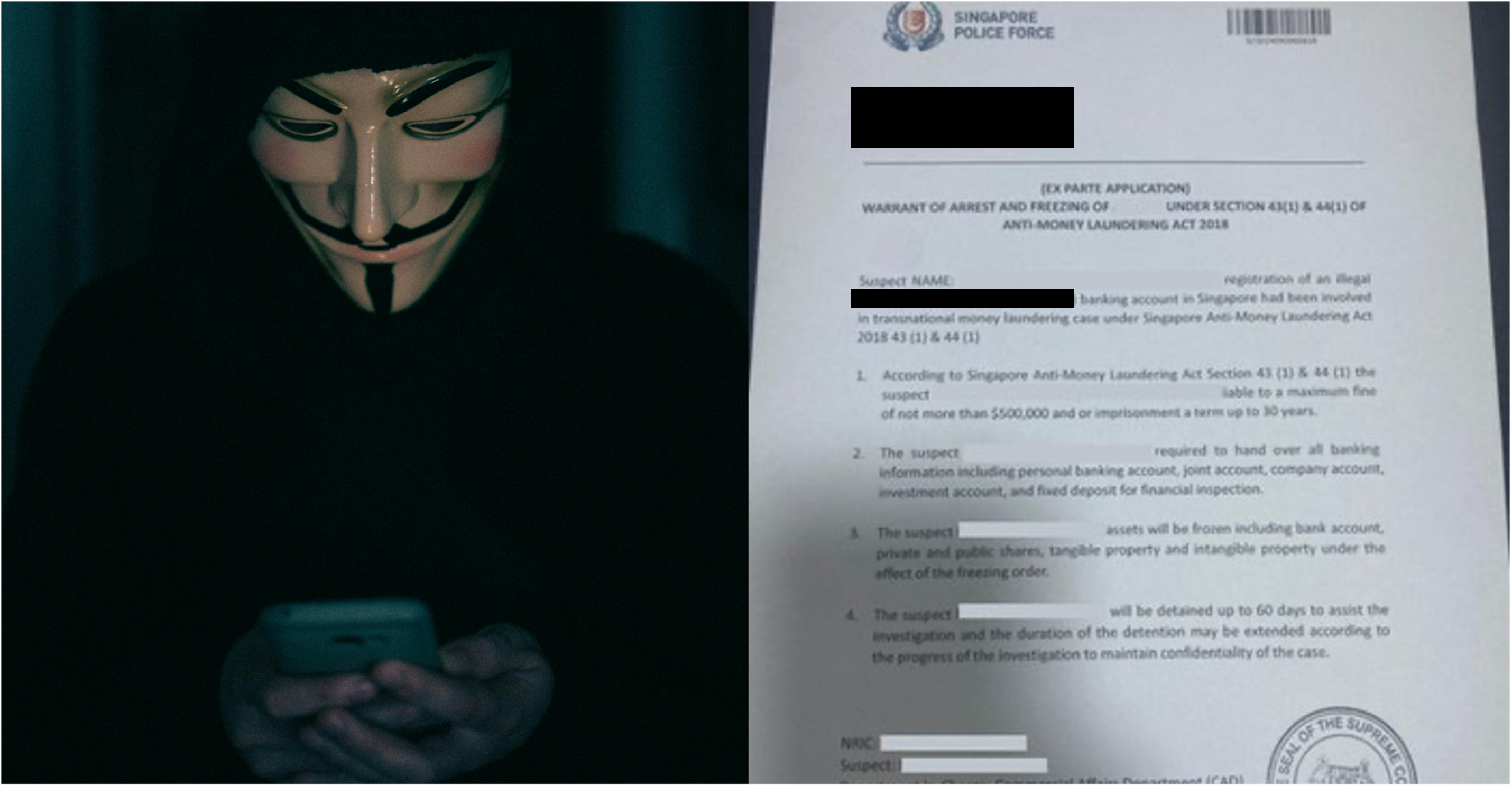
Foo emphasised that if Stephanie refused, the “police” would issue an “arrest warrant.” To place more pressure on her, an official-looking document was sent to her that used the logo of the SPF and the Supreme Court.
Stephanie was feeling overwhelmed at this point, given the barrage of accusations and new information. Bear in mind, she had never been involved in any kind of criminal investigation or encounter with the police, and so she was unfamiliar with how things were supposed to go.
In a decision she would regret, Stephanie eventually transferred the money.
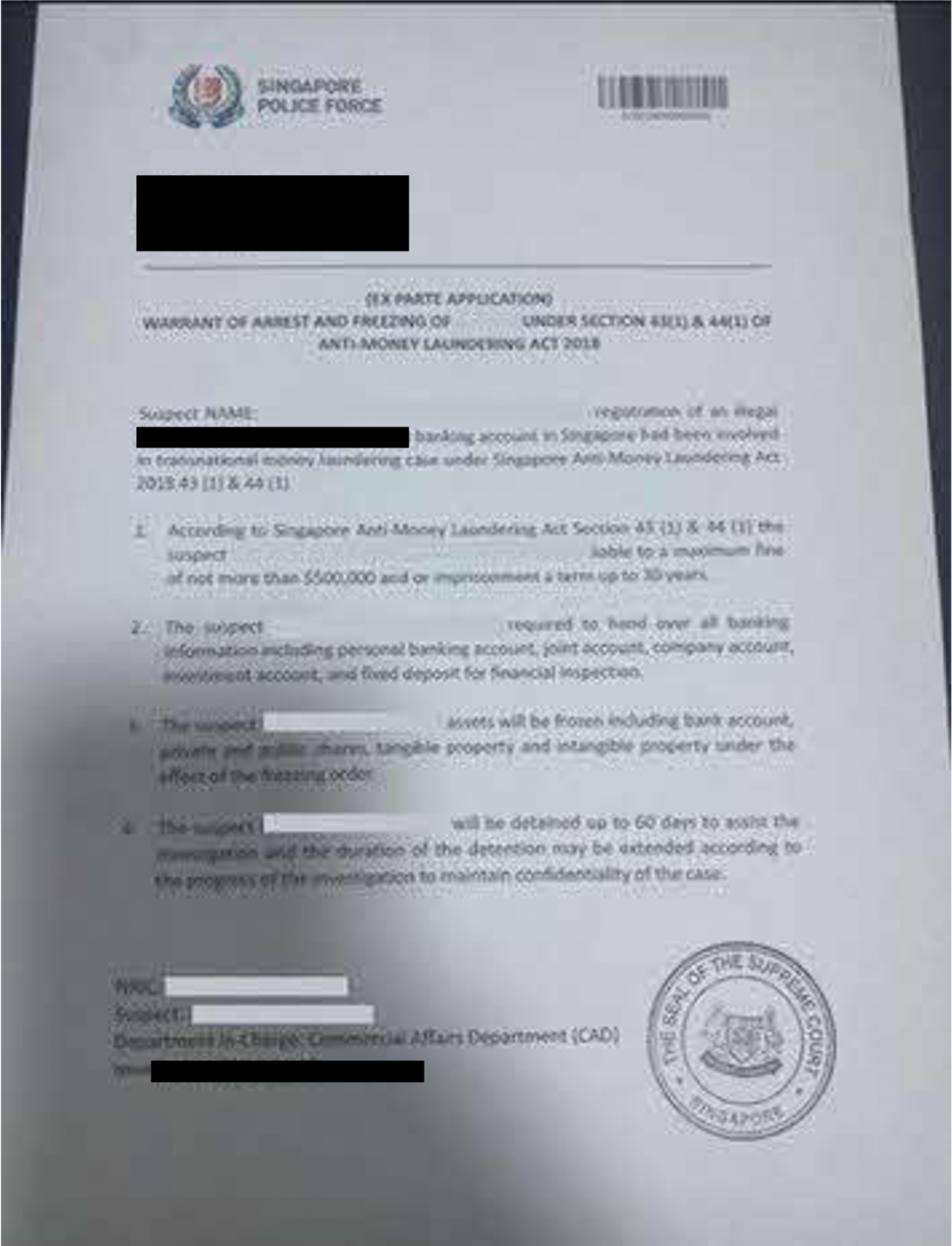 Photo courtesy of Stephanie.
Reflections
At first, Stephanie felt even more stressed looking at the scary “legal document” with complicated technical terms.
But then she noticed something.
The so-called “warrant”, despite the official-looking “logo”, contained a typo.
Feeling that something was not right, she visited a police station on the same day of the call.
Unfortunately at this point, neither the police nor her bank could block the transaction.
The money was already gone - it had been transferred out of the receiving account.
She felt shame and guilt over having been taken in.
“I definitely felt embarrassed and angry with myself, especially because I was known to be more sceptical of such things and generally more knowledgeable about scams compared to the older generation.”
Which just goes to show, scams don’t just happen to older folks. In the right (or wrong) circumstances, no matter how cautious you may be, a scam may get past your defences.
Having learned a painful but valuable lesson, Stephanie now handles such situations with extra caution, taking more steps to verify details independently before responding.
And she has some words of advice for others:
“Scammers put in a lot of effort to draw you into their act.
The biggest red flag is the moment your personal details are cited randomly and when money becomes involved.
Don’t let convenience or fear keep you on the call, hang up immediately and verify on your own through official channels.
Please stay vigilant and guard your assets.”
Be alert and stay aware
It is important to remember that government officials will never ask you to do the following things over a phone call:
- Ask you to transfer money
- Ask you to disclose banking log-in details
- Ask you to install mobile apps from unofficial app stores
- Transfer your call to the police
Scammers may cite your personal information (e.g. name or NRIC number) to appear legitimate. Do not automatically trust someone just because they have your personal information.
More recently, such impersonation cases have now included tricking the victim into handing over physical valuables such as cash, gold bars, luxury time pieces or jewellery.
Police officers will also not, under any circumstances, send its officers or “undercover agents” to collect cash or other valuables from the members of the public.
If asked to prepare cash or valuables for handover to an unknown person or place them for collection, do not engage the caller. Call the Scamshield helpline at 1799 to check if the call is a scam, or call the Police immediately.
SPF also reminds members of the public to:
- NEVER transfer monies, hand monies or other valuables, including pre-signed cheques, to any unknown persons or persons whose identity you did not verify.
- NEVER place monies or valuables at a physical location to facilitate subsequent collection.
Learn how to protect yourself from scams on Nov. 8 & 9, 2025
Anyone can fall prey to scams, that’s why it is important to enhance your scam resilience with practical anti-scam protective measures.
Head down to the inaugural ‘We Can ACT Against Scams” anti-scam roadshow happening at Toa Payoh HDB Hub Atrium on Nov. 8 and 9, 2025, from 10am to 8pm.
There will be several areas within the road show to explore. Particularly interesting would be the opportunity to play and discover your scams vulnerability, experience and learn about scams “in-person” with hands-on and simulated elements.
Check out the interactive displays and games, a photo booth, and get special collectibles and complimentary snacks.
Learn about the common scam types, how you can protect yourself and your family from falling victim to scammers, and make sure they never get to profit from your hard-earned money.
This branded article is brought to you by the Singapore Police Force
Top image via Stephanie and Unsplash