



News

S'pore could turn to nuclear & biomethane as safe, secure & affordable energy sources
"Like Snape, who was misunderstood but ultimately good, nuclear energy is often seen as dangerous at first glance, but a closer look reveals its benefits and safety."
October 28, 2025, 03:20 PM


Singapore could soon mark a new chapter in its clean energy journey by having nuclear power play a role in the nation’s energy portfolio.
Speaking at the Singapore International Energy Week (SIEW) on Oct. 27, Minister for Manpower and Second Minister for Trade and Industry Tan See Leng said the government is “seriously studying the potential deployment of nuclear energy”, particularly newer technologies such as small modular reactors (SMRs).
“Nuclear energy has the potential to be a safe, reliable, and cost-competitive option for Singapore.”
He added that the government has set up dedicated nuclear energy teams within the EMA and the National Environment Agency (NEA) to focus solely on nuclear issues, while deepening international partnerships to build technical expertise.
Why nuclear energy?
 Image via Pixabay
As a small, resource-constrained city-state with limited renewable energy options, Singapore must continue pushing forward to develop clean energy sources that are safe, secure, and affordable.
Unlike larger countries with access to vast land or natural resources, Singapore lacks the conditions to deploy renewable solutions such as hydropower or wind energy at scale.
Even if every available surface were covered with solar panels, the output would meet only about 10 per cent of the nation’s energy needs.
Nuclear energy is therefore emerging as a potential solution to this challenge.
 Image via "Building Singapore's Capabilities to Assess Nuclear Energy" background paper
Nuclear energy produces no greenhouse gas emissions during operation and the cost of generating nuclear power could be on par with other low-carbon options such as natural gas or solar energy.
Shini Foo, a senior engineer at the Energy Market Authority (EMA), said:
"To me, nuclear energy is like a misunderstood villain.Like Snape (from "Harry Potter"), who was misunderstood but ultimately good, nuclear energy is often seen as dangerous at first glance, but a closer look reveals its benefits and safety."
Why SMRs and why are they safer?
The EMA on Monday (Oct. 27) signed new cooperation agreements with two United States organisations, Battelle Memorial Institute and the Idaho National Laboratory, to strengthen Singapore’s nuclear energy capability-building.
A new background paper released at SIEW also outlines how Singapore is equipping itself to assess if advanced nuclear technologies such as SMRs could be deployed here.
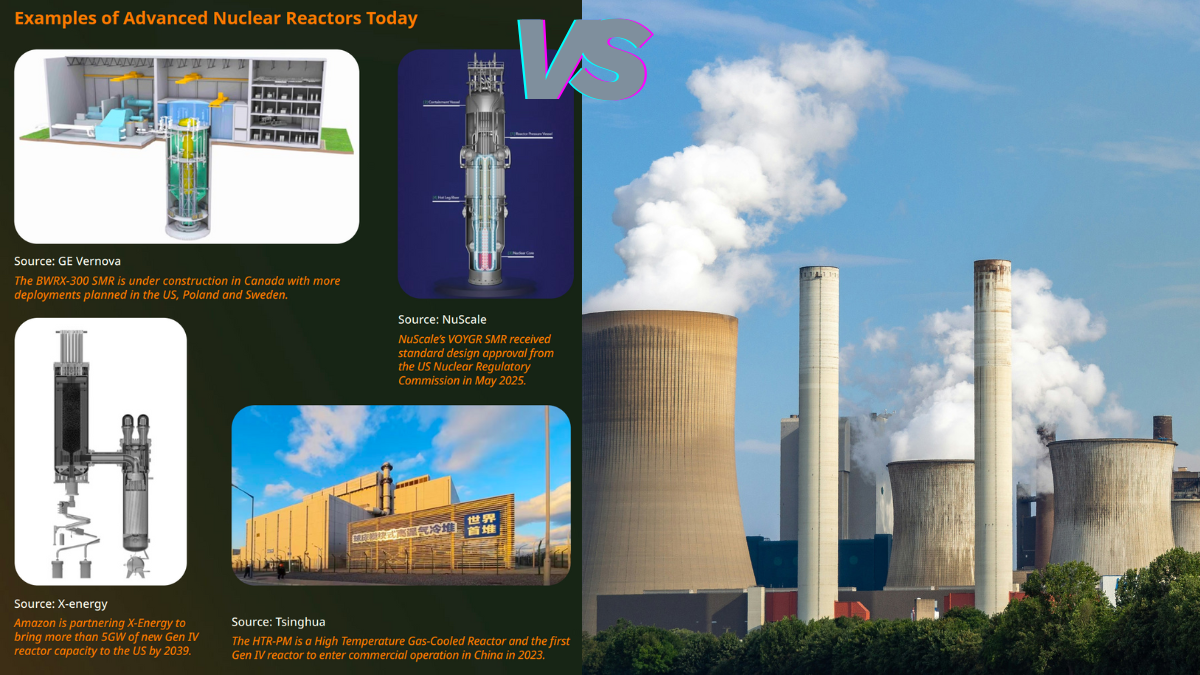 Image via "Building Singapore's Capabilities to Assess Nuclear Energy" background paper, Pixabay
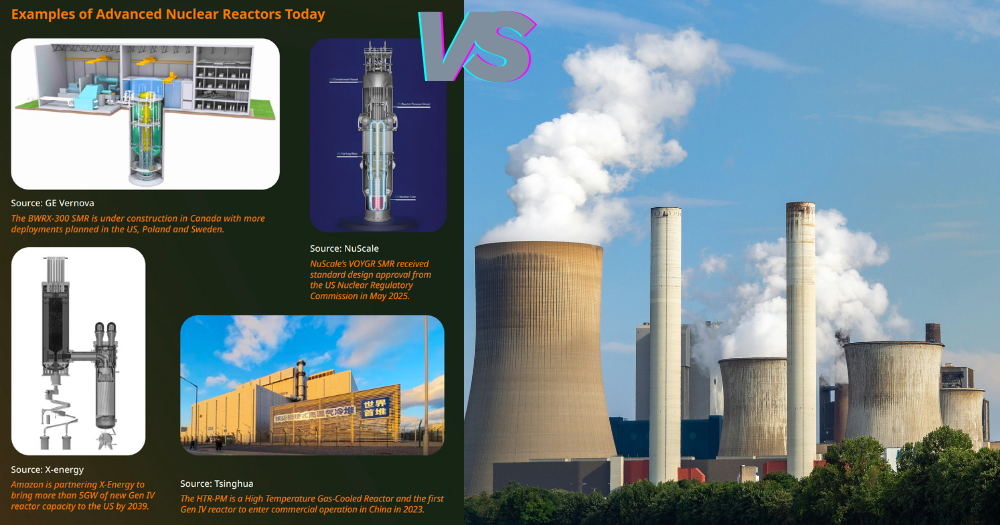
Unlike conventional large-scale nuclear plants, SMRs are designed to be smaller, modular, and inherently safer, according to the background paper.
Each unit can be factory-built and transported for assembly, reducing construction risks and costs.
They also incorporate “passive safety” features by using natural forces like gravity and air circulation to cool the reactor without human intervention, thus making them less prone to accidents.
Globally, momentum is building for SMRs, with projects underway in countries such as the United States, Canada and China.
In Southeast Asia, Indonesia and Vietnam have outlined plans to develop nuclear power plants by 2030, while Malaysia and Thailand have also signalled interest in exploring new nuclear technologies.
These newer nuclear reactor designs are increasingly seen as a viable complement to renewable energy in achieving net-zero emissions.
Biomethane as a low-carbon fuel
Alongside nuclear, Singapore is also moving to pilot biomethane imports as a low-carbon fuel to decarbonise its natural gas-dependent power sector, which currently accounts for 95 per cent of Singapore’s electricity generation.
Biomethane, a renewable form of natural gas made from organic waste, can be fed directly into existing pipelines and used in current power plants without costly retrofits.
Under a new regulatory sandbox to be set up on Jurong Island, selected power generation companies will be able to test biomethane’s commercial and operational viability in a controlled environment, paving the way for wider market adoption.
 Image via JTC
Tan said such initiatives reflect Singapore’s “multi-pathway” approach to energy transition.
“We must pursue a diversified portfolio of sustainable energy pathways to build the future we envision.
It is unlikely that any single solution will suffice, just as there is no one-size-fits-all solution to decarbonisation.”
 Image via JTC
The government’s latest announcements follow a series of clean energy projects on Jurong Island by Sembcorp Industries, including the Sembcorp Jurong Island Solar Farm, Singapore’s largest ground-mounted solar project to date, and an expanded vertical battery stacking solution to support grid stability.
These developments underline Singapore’s broader strategy to balance the so-called energy "trilemma" — sustainability, security, and affordability — as it works towards net-zero emissions by 2050.
Top images via "Building Singapore's Capabilities to Assess Nuclear Energy" background paper, Pixabay