News

Ex-Citibank relationship manager, 27, jailed for involvement in Fujian gang money laundering case
He forged documents to help clients legitimise deposits.
October 23, 2025, 04:46 PM
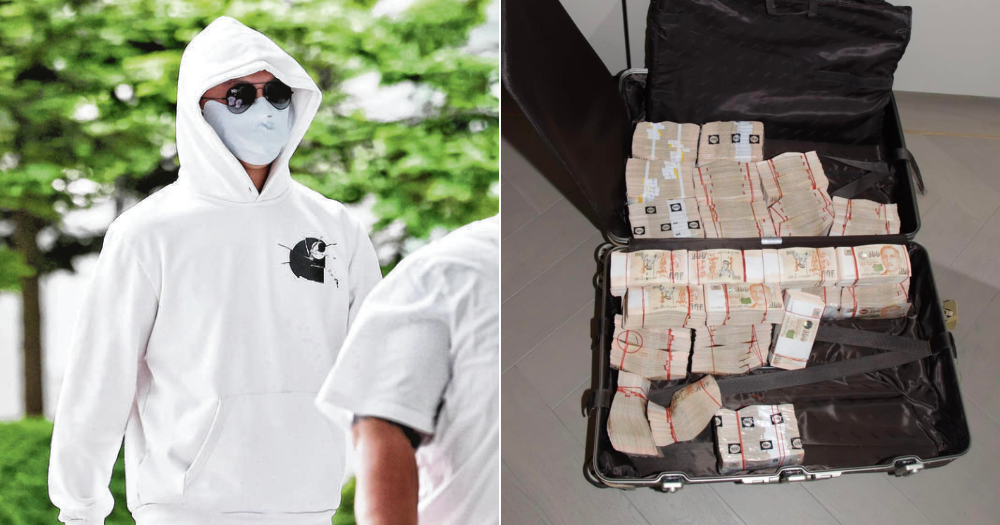


An ex-Citibank relationship manager, Chinese national Wang Qiming, 27, has been sentenced to 24 months' jail for forgery, holding onto laundered cash and obstructing the course of justice.
Wang acted on behalf of Su Baolin, who was one of 10 offenders convicted in the 2023 Fujian gang money laundering case, and used his capacity as a relationship manager at the bank to help Su launder his ill-gotten gains.
He pleaded guilty to his charges and was sentenced in court on Oct. 23.
Wang Qiming
In a news release on Oct. 23, the Singapore Police Force (SPF) detailed Wang's involvement in the S$3 billion money laundering case.
According to CNA, Wang began working at Citibank in August 2020 and was paid a percentage of his clients' transaction fees.
His clients included Su Baolin, Su Haijin and Vang Shuiming — three of the 10 foreign nationals convicted, sentenced and deported for money laundering and other offences.
On or around Dec. 8, 2020, on Su Baolin's request, Wang arranged the sale of up to 1,499,980 units of cryptocurrency (USDT) for Singapore dollars through a third-party sales agent.
To add legitimacy to the corresponding deposits of the sale proceeds, Wang agreed with Su to arrange for the payments to be made in tranches via a remittance company to Su's Standard Chartered bank account.
The first tranche was sold for S$657,980, and the proceeds were deposited into Su's account by a third-party individual named "Se Liang".
Neither Wang nor Su knew who this individual was. Su was angered after discovering that the payment was made via a personal account rather than a corporate bank account, the court heard, according to CNA.
In order to account for the deposit, Su had Wang draw up a "borrowing agreement" dated Dec. 20, 2019, between Su and "Se Liang", where the latter would repay the former S$658,000 within 12 months, accounting for S$20 in bank charges.
Su later asked Wang to cancel the sale of the remaining cryptocurrency as the payments were made via "Se Liang" and not a remittance company, per his instructions, SPF detailed.
However, a second tranche was already sold for S$481,678. Su later instructed Wang to collect the proceeds on Dec. 15, 2020 and deliver them in cash, which he did.
Deleted WhatsApp to cover his tracks
On Oct. 12, 2021, the police started looking into Wang.
They knocked on his door for about 20 minutes from 7:30am that morning. Wang answered neither the door nor phone calls from the police, CNA wrote.
The police managed to reach Wang at 8:52am and entered his house at 9am to carry out investigations.
Four minutes after being contacted by the police, Wang deliberately deleted WhatsApp from his phone to prevent the police from accessing his WhatsApp messages, which contained incriminating evidence.
Police were later able to recover his WhatsApp correspondence with Su via Su's phone.
When questioned, Wang was unable to satisfactorily account for how he came by the said cash of S$481,678, which was reasonably suspected of representing Su's benefits from remote gambling offences, SPF said.
Egregious: Judge
During the court hearing, District Judge Chay Yuen Fatt described Wang's offences as nothing short of egregious, CNA wrote.
While Wang's lawyers argued that the 27-year-old did not know his clients were money launderers, Chay countered that money launderers "could not have a label" on their heads proclaiming that they were money launderers.
He posited that even if Wang had not been aware of his client's money laundering activities, it remained a fact that he helped hide the funds.
In defence, Wang's lawyer emphasised that Wang had only carried the funds with him for 30 to 45 minutes and did not receive a commission.
He also said that Su had a Standard Chartered account and had a relationship manager from the bank, which meant that Standard Chartered itself must have done its own checks on Su's source of wealth and funds.
Wang's defence lawyers asked for a total sentence of seven to 11 months' jail.
The prosecution, noting that the offences were premeditated and that Wang had abused his position at Citibank, sought 24 to 30 months' jail.
Forged documents for other clients
Besides forging documents for Su, Wang was also found to have done the same for clients uninvolved in the Fujian gang money laundering case.
Wang forged three remittance receipts between Feb. 16 and Jul. 4, 2021.
The forged receipts were meant to legitimise deposits ranging from S$999,980 to S$1,999,980 that were deposited into his clients' Citibank accounts.
After forging the remittance receipts, Wang submitted them to the bank's anti-money laundering team to substantiate the said deposits.
Wang faced a fine of up to S$150,000, three years' jail, or both, for holding onto laundered cash.
Committing forgery with the intention of using the forged document or electronic record to cheat carries a prison term of up to 10 years and a fine.
For obstructing justice, Wang faced seven years' jail, a fine, or both.
After the sentence was delivered, Su asked for a moment to speak to his family, CNA reported.
He chose to start serving his sentence today, but his lawyer said they will appeal the sentence.
Related story
Top image via Shin Min Daily News, SPF/Facebook