News

SM Lee says national identity stronger now, but there are 'different layers' to S'pore identity
The dialogue focused on the Singapore identity and what it means to be Singaporean.
September 10, 2025, 07:29 AM
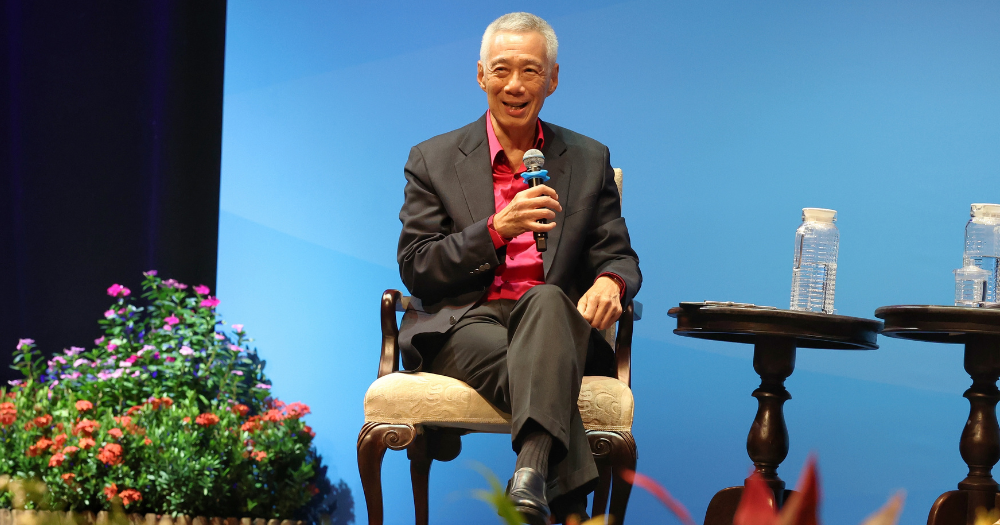


Senior Minister Lee Hsien Loong (SM Lee) said on Sep. 9, 2025, that the national identity may be "stronger" now, but it is "not the only tribe we belong to" as there are "different layers" to the Singapore identity.
Speaking at the annual Kent Ridge Ministerial Forum (KRMF) alongside National University of Singapore (NUS) Vice Provost (Student Life), Associate Professor Leong Ching, he also answered youths' questions on areas such as the Singapore political system.
The forum, held at the Ho Bee Auditorium in the National University of Singapore (NUS), is a yearly event organised by the NUS Students' Political Association (NUSPA), where students and academics engage Singapore's senior political leaders on national issues.
About 800 participants attended the event.
Singapore as a "little red dot"
In the first part of the dialogue, SM Lee spoke about the evolution of Singapore's national identity, from a sense of shared hardship to a stronger sense of belonging.
He noted that Singapore has made the term "little red dot", which was conferred to the country, something to be proud of.
SM Lee added that Singapore has to "have a certain confidence".
"If somebody says you're a little red dot, I'll say, 'Yes, I'm little. I shall show you I can shine'," he said.
He urged youths to take pride in their country and acknowledge that they belong and have ownership of the place.
On whether young Singaporeans have a bond or "sense of service" to Singapore, which is not as strong as the older generation, as they did not experience generational hardships, SM Lee said that every generation will have its own crisis.
However, he noted that Singaporeans have had "quite a few ups and downs".
"We've gone through them together and generally speaking, reasonably well," he said.
"Different layers" to the Singapore identity
SM Lee also touched on the various aspects that make up the national identity, highlighting that some elements are more important to the identities of some Singaporeans.
He said that while the national identity is "stronger", it is "not the only tribe we belong to".
He also said that there are "different layers" to the national identity, such as their ethnicities, religions and more.
"You may also have different political views. You may be pro-government. You may be pro-opposition. You may have different sexual orientations, and therefore different circles of friends and different perspectives of the world."
He noted that the national identity may also not be the most important to many Singaporeans.
SM Lee said: "And I think if I'm honest about it, and we are honest about it, we'd say the national identity as a Singaporean is important, but it's not the only one we have."
Other identities therefore might be more important to some.
He highlighted the war between Israel and Hamas, and how Singaporeans are "all upset" about it, but noted that Muslims in Singapore are "much more upset" about it than the non-Muslims.
"It's a reality. It's natural," he said.
He also pointed out that if something happened in India, Indian Singaporeans would have a closer interest; similarly, if something happened in China, there would be a pull on Chinese Singaporeans.
External circumstances and events would therefore pull Singapore in different directions in the immediate turn, and "our job is to resist that" and "to remember, yes, I'm Muslim, or I'm Chinese or I'm Indian, but I'm also Singaporean, and I do owe something here, and I belong here".
Some burning questions
As part of the forum, students engaged in discussions with SM Lee on concerns about Singapore society.
The questions posed to SM Lee during the Q&A session included areas such as Singapore's social equity, political system, and gender equality policies.
On ensuring social equity in Singapore, SM Lee said that growth is essential for social equity as it provides resources to improve the lives of Singaporeans and create opportunities.
"If Singapore were only a place where you could relax and prosper, I think it would not be a happy place."
He therefore emphasised the need to feel a belonging to Singapore, and help make a difference to it. In response to a question, SM Lee also noted the need to balance growth and social cohesion.
SM Lee said that a zero-sum game approach, where resources are taken from one group to help another, may become a "very unhappy exercise" which makes societies equally unhappy.
"Actually, you need growth if you're going to have social equity, but you need to use the growth in order to benefit a wide range of Singaporeans so that their lives can improve.
If you don't have growth, you just talk about making a more inclusive and more equal society. The only way to make people who are not doing well do better is to take resources from people who are doing better than them. In other words, it's a zero sum game."
A participant also asked him about the political system in Singapore, referencing SM Lee's May Day speech, and how to keep the system an exceptional one.
SM Lee said that an "exceptional political system" requires "exceptionally sensible voters".
"Vote for good people to be your MPs and to be your ministers, and work with them to make the country better," he urged.
A participant also noted the number of women politicians in Singapore and asked about the future of gender equality in Singapore's political system.
SM Lee said that Singapore has "come quite a long way", with about one-third of MPs now being women.
He said the progress has made a "big difference" to parliamentary debates and the range of perspectives which are aired.
"The women add something which you can add two or three more men, but again, you cannot make up for the women's voice. You need that."
He also said he would like more women in parliament, but that it depends on various factors.
"We would like more. It depends who comes forward. It depends who gets elected, but we will keep on trying. And I hope the numbers will keep on growing," he added.
SM Lee didn't think quotas were the right way to go about it, but rather merit.
However, he said they would work hard to identify women who are qualified and suitable.
"And it will be easier for us to do that if their partners, husbands, are supportive, carry their share of the household responsibilities and are prepared to see their women, their wives, do well and progress and be proud of their spouses."
SM Lee also acknowledged that it is harder for a woman to be an MP than a man.
"And I can tell you that it's harder for a women to be an MP than it is for a man to be an MP, because the expectations on her are higher. Her home responsibilities probably are heavier, and she walks a very tight, tight rope, because if she is aggressive, they will say, wha so fierce?"
And if they were to be gentle, there would be unfair stereotypes for that as well.
However, he expressed hope that more women would be encouraged to come forward and serve in local politics.
Top photo by MDDI