




News

S'pore parents most worried about child's exposure to inappropriate content online: MDDI survey
More than half of all parents also wanted more governmental support in helping them manage their child's digital activities.
September 12, 2025, 06:02 PM


Exposure to inappropriate content online is the top concern for parents in Singapore worried about the online harms and risks their child can face.
This is followed by their children potentially interacting with strangers online, as well as being cyberbullied, said the Ministry of Digital Development and Information (MDDI).
In February 2025, MDDI conducted a Digital Parenting Survey to gain an understanding of how parents in Singapore are managing their children's digital activities.
This, MDDI said, informs the government on how it can effectively support parents in their efforts.
1,986 Singapore resident parents with children aged two to 17 years old were surveyed.
Parents are most concerned about their child's exposure to inappropriate content online
MDDI's survey revealed that an overwhelming majority of parents were concerned about the online harm or risk that their child may face when engaging in activities online.
Parents were most concerned about their children's exposure to inappropriate content, followed by interactions with strangers online and the risk of cyberbullying.
Below is the full list of the concerns held by parents, in descending order:
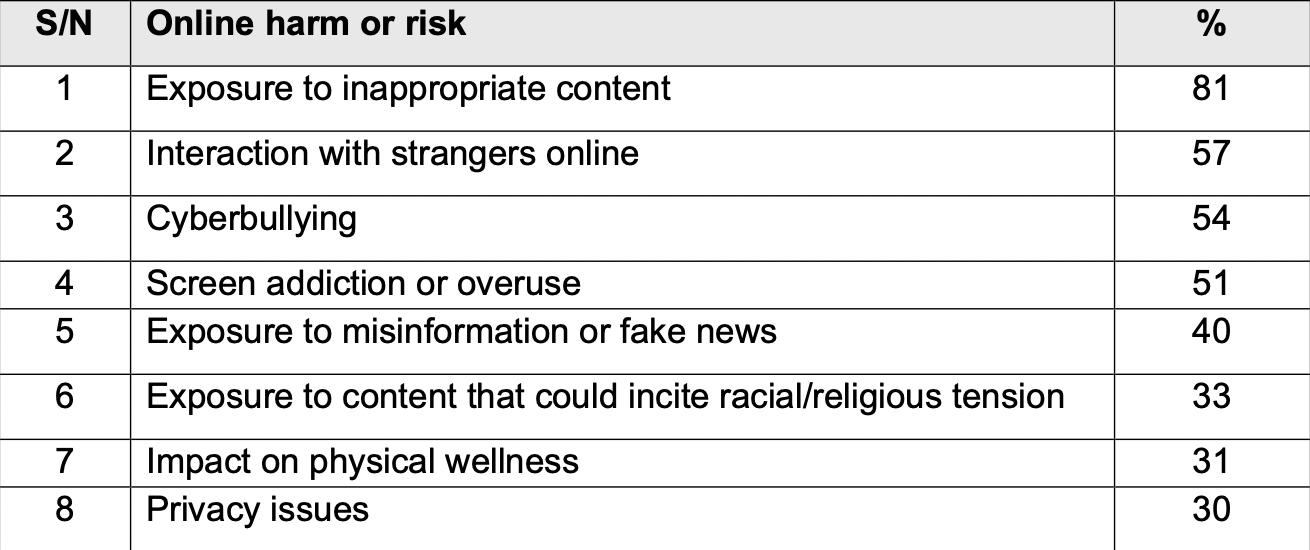 Screenshot from MDDI
These results are based on responses from parents whose child owned or used a device.
According to MDDI, most parents recognised their vital role in shaping their child's digital habits, with nearly nine in 10 of them taking at least one measure such as limiting screen time or controlling the types of content consumed.
However, only 37 per cent of parents felt confident in their abilities to do so.
Parents who expressed little or no confidence said that this stemmed from limited time due to work or other commitments, reluctance of their child to follow rules, their child's ability to bypass parental controls, and their own lack of familiarity with parental controls or monitoring tools.
Many children exceeded the daily screen time limits recommended by MOH
MDDI's survey revealed that digital device usage among young children is very high.
More than half of parents (55 per cent) of children aged two to four reported that their child either owned a device or regularly used one belonging to others.
Parents who already allowed their child to use a device did so as early as when the child was three-years-old.
Among those whose children owned or used digital devices, an overwhelming 94 per cent said that their usage was primarily for leisure, with media streaming and gaming being the most common activities.
The survey also found that many children exceeded the daily screen time limits recommended by the Ministry of Health (MOH).
According to MOH, it recommends limiting screen time to under one hour daily for children aged 18 months to six years, and under two hours daily for those aged seven to 12, excluding schoolwork.
There should also be no screen time for children under 18 months.
MDDI provided a breakdown of children's daily screen time by age group:
- Among children aged two to six, 58 per cent spent more than the recommended one hour on digital devices on weekdays; 81 per cent did so on weekends.
- Among children aged seven to nine, 27 per cent spent more than the recommended two hours on digital devices on weekdays; 55 per cent did so on weekends.
- Among children aged 10 to 12, 47 per cent spent more than the recommended two hours on digital devices on weekdays; 71 per cent did so on weekends.
 Photo via MDDI
Parents would like better measures and resources to support them in managing their child's digital activities
The survey also found that more than 50 per cent of all parents wanted more governmental support in helping them to manage their child's digital activities.
Besides stricter laws to protect children online, parents also wanted access to resources such as online courses guides, workshops and peer support groups.
 Photo via MDDI
According to MDDI, the government acknowledges the concerns held by parents and is committed to strengthening legislation to better protect children from online harms.
Since July 2023, the Infocomm Media Development Authority (IMDA) has required designated social media services to implement systems to shield users, particularly children, from harmful content.
In March 2025, IMDA extended this to designated app stores, which are required to put in place age assurance measures to prevent users under 18 from accessing age-inappropriate apps.
These measures are expected to be implemented by Mar. 31, 2026.
The Online Safety (Relief and Accountability) Bill will also be tabled to establish a new Online Safety Commission by the first half of 2026, allowing victims to get timely help if they encounter online harms and ensuring perpetrators are held accountable.
MDDI to provide more support for parents
Minister of Digital Development and Information, Josephine Teo, acknowledged the challenges of parenting, and the complexities that have been brought about by the digital age.
She added that "returning to a play-based childhood will take time, and begins with reshaping norms in children's digital habits."
MDDI shared that it will be supporting parents in guiding their children towards healthy digital habits in three key ways.
1. Make resources more useful and accessible for parents
Parenting resources will be tailored to the various stages in the parenting journey, based on their child's developmental age range and key digital milestones such as their child's first exposure to screens and their first phone.
The resources will also be action-oriented to help parents cultivate good digital habits in their children from a young age.
2. Wider outreach through community touchpoints
MDDI will also be improving community-based outreach to proactively reach parents in their local communities.
MDDI will develop in-person programmes such as workshops to equip parents with tools to discuss online risks, promote safe digital use, as well as share ideas on offline activities to encourage family bonding.
These programmes will be complemented via enhanced online offerings that parents can access anytime and anywhere.
3. Partner community organisations and industry
MDDI will also work with partners such as parent influencers to share bite-sized content through social media and increase their reach.
They will also be working with grassroots, industry and corporate partners to encourage more ground-up initiatives and foster a whole-of-society effort to support parenting in the digital age.
Top photos via Canva