News

Combined Asean tariff negotiations with US unlikely, double down on integration instead: Vivian Balakrishnan
The JS-SEZ, if ultimately successful, could be a 'positive model' for further Asean integration.
July 11, 2025, 09:21 PM


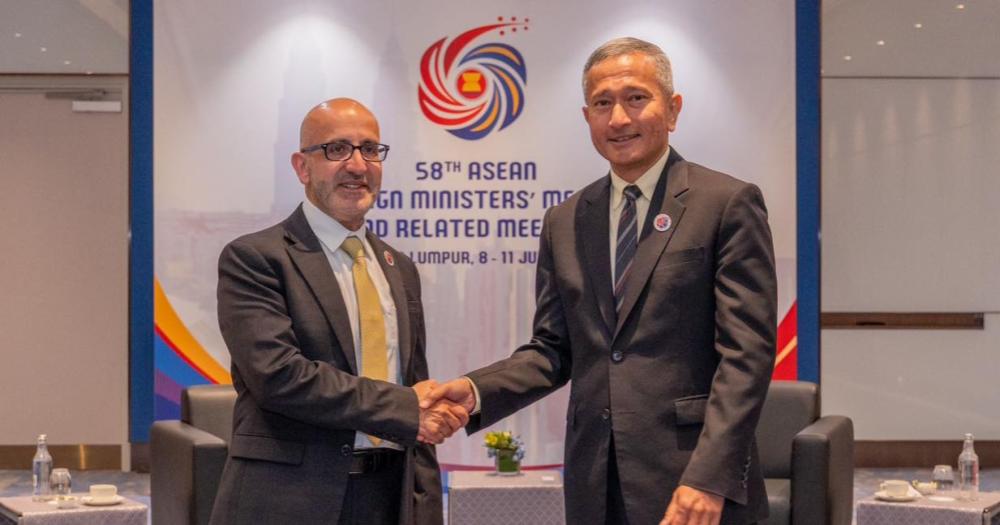
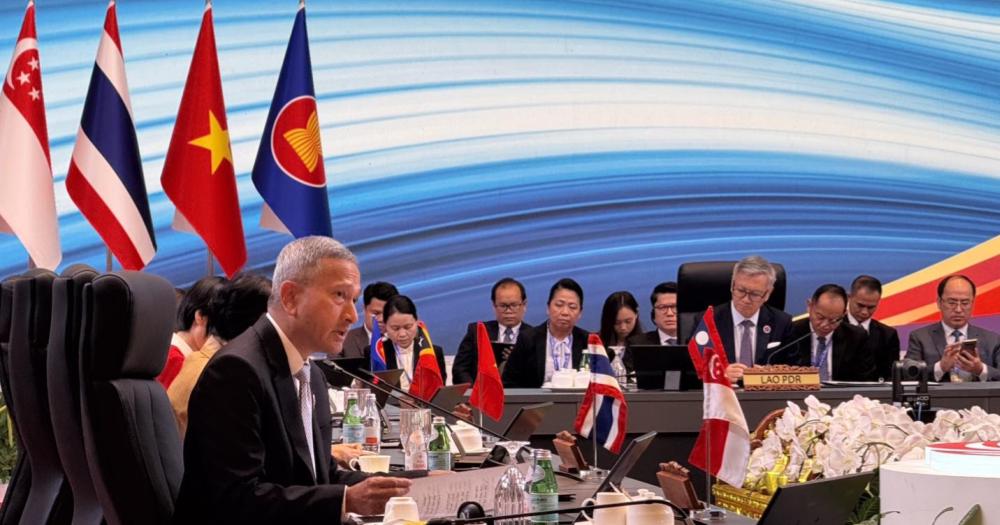
Singapore’s foreign minister, Vivian Balakrishnan, spoke to the press on the final day of the 58th Asean Foreign Ministers’ Meeting in Kuala Lumpur, Malaysia.
Sober mood
Vivian gave brief remarks before answering press questions, acknowledging the very busy schedule that the AMM had run, saying that “every hour had been accounted for”.
Vivian said he had been pleasantly surprised by the attendance levels of Asean’s external partners, which he said reflected Asean’s convening ability, its ability to bring a varied group of partners to the table.
He acknowledged the “sober mood” of the AMM with several ongoing conflicts in Ukraine and Gaza, and added to that were the recent "rapid fire" announcements by the United States regarding tariff announcements that had affected several Asean states.
As a response, the AMM focused more on doubling down on Asean integration as a way to increase Asean’s resilience to the uncertainty and volatility of economic challenges.
The bloc also responded by attempting to expand and strengthen external relations with Asean partners, and attempting to increase the resilience and stability of Asean’s economic ties across the world.
Competitiveness and upgraded FTAs
Ultimately, the goal is to make Asean a single production or investment zone by bringing down both tariff barriers and non-tariff barriers.
This would make it easier for investors to site their facilities, management or regional offices where it would make sense for them to achieve synergy, and therefore make Asean as competitive as possible.
In a related move, Asean is upgrading its trade agreements with countries such as South Korea, Australia and New Zealand, and Vivian noted that most of the work for the upgrade to the Asean-China Free Trade Agreement had been completed.
This was a bid to expand existing channels of trade by making it easier, and allow Asean to reach a point of resilience by achieving “a more omni-directional stability” in its trade and economic ties.
Unified Asean negotiation with the US is unlikely
Vivian was asked about what negotiation between Asean and powers such as the U.S. might look like.
Vivian declined to speak for the current U.S. administration, instead saying that he had often reminded his American interlocutors that in Southeast Asia “trade is strategy”.
The flow of trade and investments is a key strategic focus for all Southeast Asian governments.
It was for this reason that Asean has been so focused for nearly 60 years, primarily on maintaining peace in the region but also on economic integration and expanding economic opportunities.
Vivian also downplayed the idea of a unified Asean negotiation with the U.S., saying that he did not think that that was the way the situation would unfold, as the U.S. viewed tariff negotiations as a series of bilateral negotiations.
Rather than trying to negotiate together, Vivian said that he believed the more effective Asean response was to double down on Asean's own integration.
More integration was within Asean’s own control, and the bloc could ensure that it had removed every tariff and non-tariff barrier, optimising Asean’s competitive position.
Positive model
Responding to a question by Mothership, Vivian spoke about projects such as the Johor-Singapore Special Economic Zone (JS-SEZ) and the Johor Bahru-Singapore RTS link in the context of closer Asean integration.
Vivian said that the JS-SEZ core concept was that of complementarity and synergy, and ultimately making both Johor and Singapore more competitive, and “made sense on its own merits”.
But it was not the only such effort that Johor and Singapore were undertaking, as Vivian mentioned Sijori, the combination of Singapore, Johor, and Indonesia’s Riau Islands, and likewise looking for opportunities in which all three countries could do more together.
From an Asean perspective, such projects could have relevant lessons on how to conduct more cross-border collaborations that also provide competitive advantages.
And should these developments end up being successful, Vivian said that he was “sure it will be a positive model” for the rest of Asean.
Related Stories
Top image via Vivian Balakrishnan/Facebook