News

Heightened tensions & policy uncertainty could be ‘turning point’ for world trade, S’pore committed to staying open: SM Lee
Singapore was committed to remaining open, and investing in both its workers and its technology.
March 24, 2025, 07:26 PM
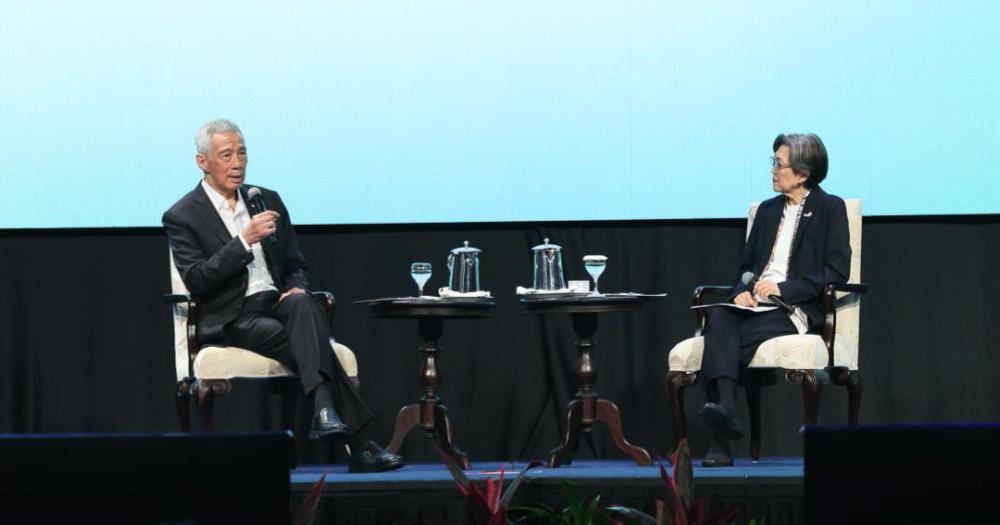

 Senior Minister Lee Hsien Loong delivered the Singapore Maritime Lecture on Mar. 24, on the opening day of the Singapore Maritime Week conference.
He warned about "choppy waters" ahead for Singapore as attitudes towards trade patterns of trade flow were shifting, and that the world could potentially be an epochal "turning point", unseen since the Second World War.
SM Lee then listed three ways that Singapore would secure its maritime future: by committing to remaining an open port, strengthening Singapore as a regional hub and global node, and playing its part in mitigating climate change.
A changing world
SM Lee recounted how the world had globalised over the past 60 years, allowing Singapore's small, open economy to flourish.
Countries big and small had "generally acknowledged" international rules and norms, with a global order that was underwritten by the United States and supported by multilateral organisations such as the United Nations.
Singapore had taken advantage of that world, making investments and implementing policies to build "an open, reliable, and trusted trade and maritime hub", a "key link in global supply chains", and a "gateway between East and West".
But the world is different now and that attitudes towards trade have changed, as have trade flow patterns.
He highlighted two major concerns: geopolitical developments that were "severely straining" the global trade system and climate change.
Intensifying tensions
The former was the result of over a decade of intensifying tensions between major powers.
Countries were prioritising security, resilience and self-reliance over interdependence and cooperation, with SM Lee giving examples such as countries choosing to "friend-shore" or "near-shore production" while trying to impose restrictions in order to preserve competitive leads, such as over investments, semiconductors, and critical minerals.
SM Lee said that strategic policy shifts are reshaping the landscape of world trade, with protectionism and economic bifurcation rising.
"The maritime industry is itself directly affected, with countries acting to reduce reliance on competitors for freight shipping and shipbuilding or to displace rivals controlling strategically located ports."
Impact of climate change
Meanwhile, climate change is also quietly impacting global trade patterns, and along with extreme weather events, it was already affecting established trade routes.
SM Lee gave an example of droughts affecting passage through the Panama Canal or melting Arctic Ice, opening new routes such as the Northeast Passage.
Shipping itself was under pressure to reduce carbon emissions, with international shipping accounting for three per cent of all greenhouse gas emissions.
These global shifts will have a major impact on Singapore "because to us trade is existential and the maritime industry is a major contributor to our economy".
Turning point
SM Lee emphasised that the “present moment” could be a turning point given the heightened strategic tensions and policy uncertainty.
Should trade-to-GDP fall, there would be serious economic and strategic implications, and at the very least, would dampen economic growth in many countries, causing social and political problems domestically and internationally, potentially causing the world to “enter a new epoch” unseen since the Second World War.
SM Lee said that Singapore had to commit to two tasks: firstly, to do its part to enable and foster the growth of international trade and to make Singapore's economy and maritime industry more efficient, more competitive, and more trusted.
SM Lee explained how Singapore would secure its maritime industry's future.
Staying open
SM Lee said that Singapore was committed to staying open. "Being so small, we have no choice."
But he said that Singapore was not alone in this and that even with globalisation "in retreat", many countries still believed in the win-win proposition of trade and wanted to "preserve as much of the benefits of the multilateral trade as possible.
The European Union, Asean, as well as nations such as China and India, were of that mindset.
Therefore, "like-minded partners can definitely work together to preserve oases of stability amid a world of chaos."
Participating in a multilateral rules-based order
Singapore will continue to support a multilateral-based order, international cooperation and interdependence, including participating in several multilateral organisations, such as the International Maritime Organization, and farmworkers, such as the UN Convention on the Law of the Sea (UNCLOS).
Singapore was also a party to several regional and bilateral trade partnerships and agreements.
Singapore has a "network" of Free Trade Agreements that covered 90 per cent of its trade, such as the Regional Comprehensive Economic Partnership (RECEP) and the Comprehensive and Progressive Agreement for Trans-Pacific Partnership (CPTPP); these two covered much of the Eastern and Western Pacific regions.
Regional hub and global node
Singapore will continue strengthening itself as a "regional hub and global node".
SM Lee recounted Singapore's history as a maritime port, from an entrepot to becoming a transhipment port, not just for neighbours in Southeast Asia but the Asia Pacific and South Asian regions as well.
Singapore had invested steadily in port infrastructure, having built the first container terminal in Southeast Asia in 1969, and continued to make "major investments ahead of time in new port terminals".
Singapore's commitment to investing in the maritime industry's capabilities and infrastructure could be seen in the Tuas Port project, a multi-decade project to consolidate Singapore's container terminals, expected to be completed in the 2040s.
Singapore would continue investing in technology and innovation, such as an Artificial Intelligence-Enabled Next Generation Vessel Traffic Management System.
Tripartite partnership
But this was done through a "strong tripartite partnership between the Government, industry, and unions", ensuring that Singapore's workers would benefit from new technology and investments, noting the representation and participation of maritime workers unions at the Singapore Maritime Week 2025 conference.
Singapore will invest heavily in its workers and ensure they were "prepared to take on new and more productive roles, and not be sidelined or displaced by technology or AI".
"With this support, our people will embrace and make full use of technology instead of resisting it and jeopardising both Singapore's competitiveness and their own livelihoods.
Fighting and adapting to climate change
SM Lee said that Singapore would also play its part in mitigating climate change while adapting to its impacts and that Singapore had committed to peaking emissions before 2030.
One such initiative was trials that were being conducted on the bunkering of alternative fuels.
SM Lee expected that in the future, as alternative fuels are developed and put into use, Singapore's sea lines and infrastructure will become key conduits for such fuels' transportation and distribution.
He concluded:
"The world cannot escape the turbulent times ahead. But the future for the maritime industry is still bright. If we plan ahead and take the right steps now, we have every chance of continuing to thrive.
As Mr Lee Kuan Yew said at the Singapore Harbour Board in 1963, more than 60 years ago, “The good things in life do not fall down from the skies. They can only come by hard work over a long time”.
Collectively, we can turn adversity into opportunity."
Top image via MPA/Facebook