News

Pritam Singh questions fairness of EBRC changes, suggests individual precincts are 'closely watched'
'Boundaries are important, and the reasons that justify their changes, matter. A lot.'
March 26, 2025, 11:37 AM


Leader of the Opposition and Workers’ Party chief Pritam Singh has raised concerns over the fairness of Singapore’s electoral boundary redrawing process, following the release of the Electoral Boundaries Review Committee (EBRC) report two weeks ago.
In a Facebook post on Mar. 25, Singh highlighted the public’s response, particularly among young Singaporeans, questioning the fairness of the committee's changes.
The EBRC comprises senior civil servants from the Housing & Development Board, the Singapore Land Authority, the Department of Statistics, and the Elections Department. It is headed by the secretary to the Prime Minister.
"One of the most radical redrawing of electoral boundaries in recent memory"
Singh’s post referenced a parliamentary debate where a PAP intervention dismissed concerns about the process by stating that gerrymandering happens in Western democracies too.
Noting that the most recent EBRC report cited “population growth” as the primary reason for what he described as "one of the most radical redrawing of electoral boundaries in recent memory", Singh questioned the rationale behind these changes, emphasising the importance of transparency in electoral processes.
“Boundaries are important, and the reasons that justify their changes, matter. A lot.”
Suggested that individual precincts are "closely watched"
The Leader of the Opposition also recalled a comment made by former Prime Minister Lee Hsien Loong during the 2016 Bukit Batok by-election, where Lee mentioned that PAP candidate Murali Pillai would have been elected as an MP in 2015 had certain parts of Aljunied GRC been an SMC.
This, Singh suggested, indicated how closely election results in individual precincts, be it in GRCs or SMCs, are "closely watched", raising questions about the motivation behind electoral boundary changes.
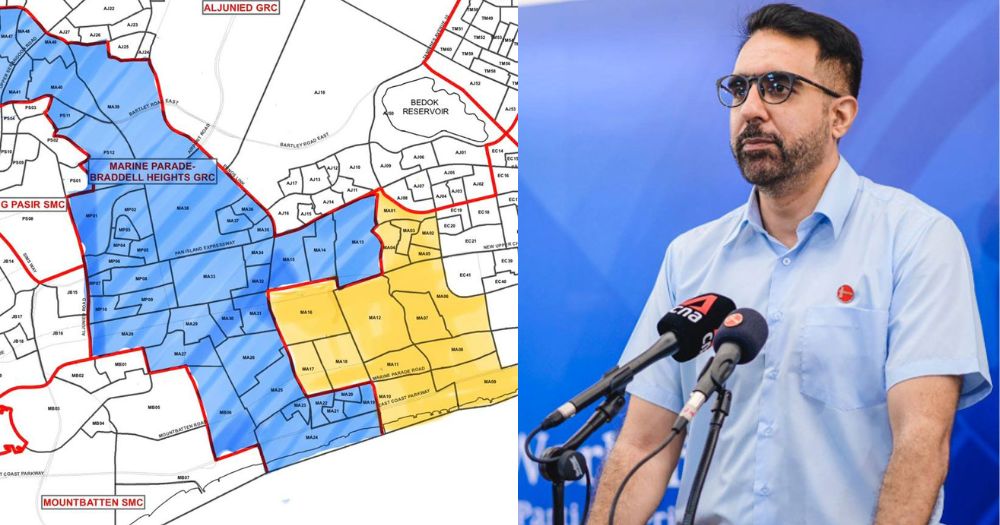
He specifically pointed to the 15 precincts from the former Marine Parade GRC that were absorbed into East Coast GRC for the upcoming elections, questioning how these areas voted in the 2020 General Election.
Singh urged the PAP to release the precinct-level voting data, allowing the public to draw their own conclusions.
He warned that opaque institutions like the EBRC could become "unwittingly divisive" at a time when national unity is crucial due to geopolitical shifts, economic uncertainties, and demographic changes, and urged Singaporeans to press on in building a "more balanced political system".
Population shifts in report, explained
While past EBRCs did not provide any explanation for its decisions in redrawing electoral boundaries, this year's committee explained the "population shifts" that drove the changes it recommended.
In its report, which was more comprehensive than previous years', the committee highlighted that voter numbers in Pasir Ris-Punggol GRC, Sembawang GRC, Tampines GRC, Hong Kah North SMC, and Potong Pasir SMC increased by between 13,000 and 23,000.
Further, in an August 2024 parliament sitting, Minister-in-charge of the Public Service Chan Chun Sing explained that the EBRC works independently and objectively.
He also laid down a few key points:
- The EBRC does not have access to voting information and hence does not make its recommendations based on voting patterns.
- It does not consult the PAP or any other political party. Party politics do not come into this exercise.
- It comprises senior civil servants with no party allegiances.
"Therefore, unlike other countries where political parties are involved in the boundary drawing process, EBRC’s composition and processes are insulated from party politics," said Chan.
"Hence, we do not have the horse-trading and gerrymandering that have taken place in other countries. And I must say, if we get all political parties involved, present or future, it will politicise the whole process and not bring us forward, but backward."

Top images: Mothership file photo, Pritam Singh/Facebook