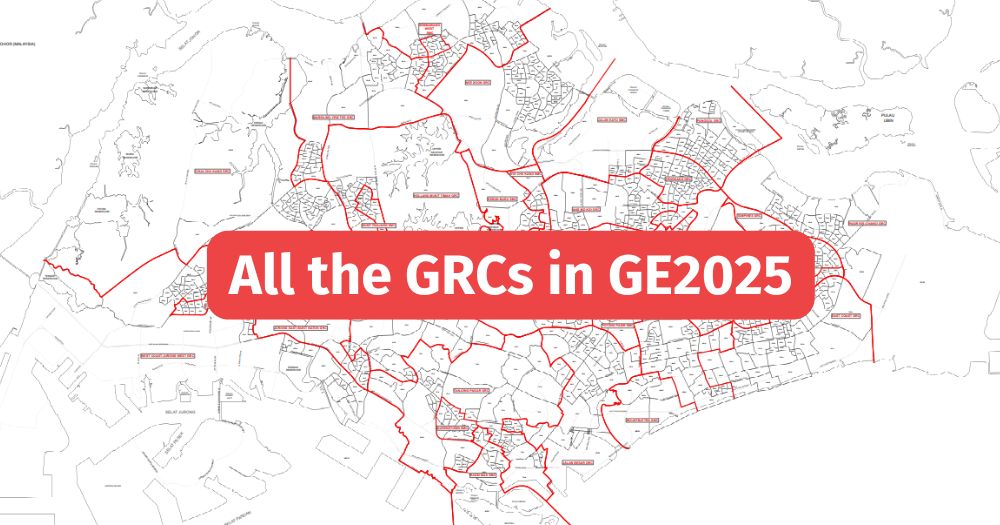


The Electoral Boundaries Review Committee (EBRC) released its report today (Mar. 11), recommending several electoral boundary changes in the lead up to the General Election (GE).
New GRCs
Here are the Group Representation Constituencies (GRC) in GE2025:
- [NEW] Punggol GRC
- [NEW] Pasir Ris- Changi GRC
- [NEW] Marine Parade-Braddell Heights GRC
- [NEW] Jurong East-Bukit Batok GRC
- [NEW] West Coast-Jurong West GRC
- Bishan-Toa Payoh GRC
- Choa Chu Kang GRC
- Holland-Bukit Timah GRC
- Jalan Besar GRC
- Marsiling-Yew Tee GRC
- Sengkang GRC
- Aljunied GRC
- Ang Mo Kio GRC
- East Coast GRC
- Nee Soon GRC
- Sembawang GRC
- Tampines GRC
- Tanjong Pagar GRC
The number of electors in the latest Provisional Registers of Electors as of Feb. 1, 2025 is 2,753,226, an increase of 101,791 electors from 2,651,435 electors at GE2020.
Based on these proposed changes, the Committee recommended increasing the number of MPs to 97 from the 93 that were elected in the last General Election.
According to a White Paper on the report of the EBRC published on Mar. 11, the Government has accepted the EBRC’s recommendations and will implement them at the next General Election.
Check out the new constituencies and boundary changes in this interactive map:
What is the EBRC review?
The EBRC is convened before each General Election to review Singapore's electoral map.
They will then make recommendations on the number and boundaries of Group Representation Constituencies (GRCs) and Single Member Constituencies (SMCs).
According to the Elections Department, the review takes into account changes in housing development and population shifts.
Previous committees worked on the basis of having about 20,000 to 38,000 electors per Member of Parliament (MP).
The EBRC's review is also guided by specific terms of reference.
For instance, before GE2020, then-Prime Minister Lee Hsien Loong directed the Committee to create smaller GRCs and increase the number of SMCs.
This year, PM Wong asked the EBRC to "seek to keep the average size of GRCs, the proportion of MPs elected from SMCs, and the average ratio of electors to elected MPs, all at about the same as that in the last General Election".
What's next?
In the past four General Elections, the length of time between the release of EBRC's report and the General Election was about two to four months.
But there are a few milestones between the release of the EBRC report and Polling Day.
Soon after today, election season will kick off and the political parties will be announcing the constituencies that they are contesting in.
The next key event takes place when Parliament is dissolved. From here, the General Election must be held within three months.
Next, the Writ of Election is issued. This typically takes place on the same day or shortly after Parliament is dissolved.
On Nomination Day, all parties must file their papers at nomination centres in order to contest in the General Election. This also marks the start of the campaign period.
After the campaign period, typically nine days, comes Cooling-off Day, when no campaigning is allowed so that voters can reflect on key issues.
Finally, Polling Day arrives. Voters can cast their ballot at voting centres.
Sample counts, which were introduced in the GE2015, will give an early indication of who the winners are before the official results are available.

Top photo via EBRC report