





Branded

‘I slept in the kitchen while cutting vegetables alone’: Sauté co-founder on passion for recreating cuisines as vegetarian in S’pore
After growing Sauté to an impressive five outlets from its humble beginnings, Tan Ee Ren is planning the brand’s next chapter.
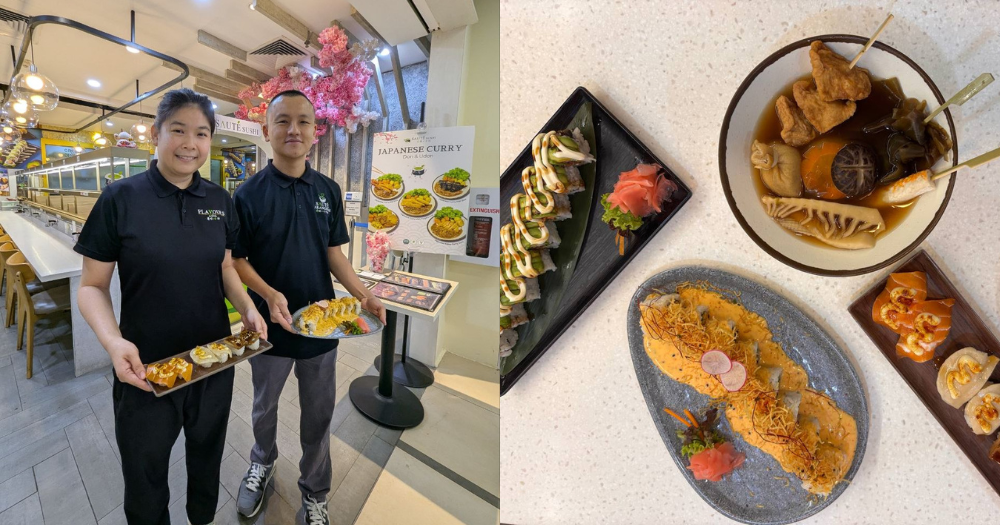
Left photo by Mothership, right photo by Enterprise Singapore.
Tan Ee Ren remembers the moment he decided to become vegetarian at the age of 13.
Speaking to Mothership at Singapore’s first halal-certified, plant-based sushi train restaurant, Sauté Sushi at Paya Lebar Square, Tan said:
“I had watched some videos about the poultry industry, on how the animals are being processed, their lives taken against their will.”
Such documentaries left a deep, vivid impression on him which aligned with his own thinking and religion, Tan added.
“It made me think and sometimes, I teared too, putting myself in their shoes,” he recalled.
“So just one day, I remember, at 13 years old: I told myself in a canteen, from today onwards I’m not going to touch meat anymore,” Tan said.
It is a momentous decision that has stuck with him till today and one that has also served as the driving force behind his decision to open Sauté with his sister, Tan Ai Lin.
Sauté is not meant to make you feel guilty
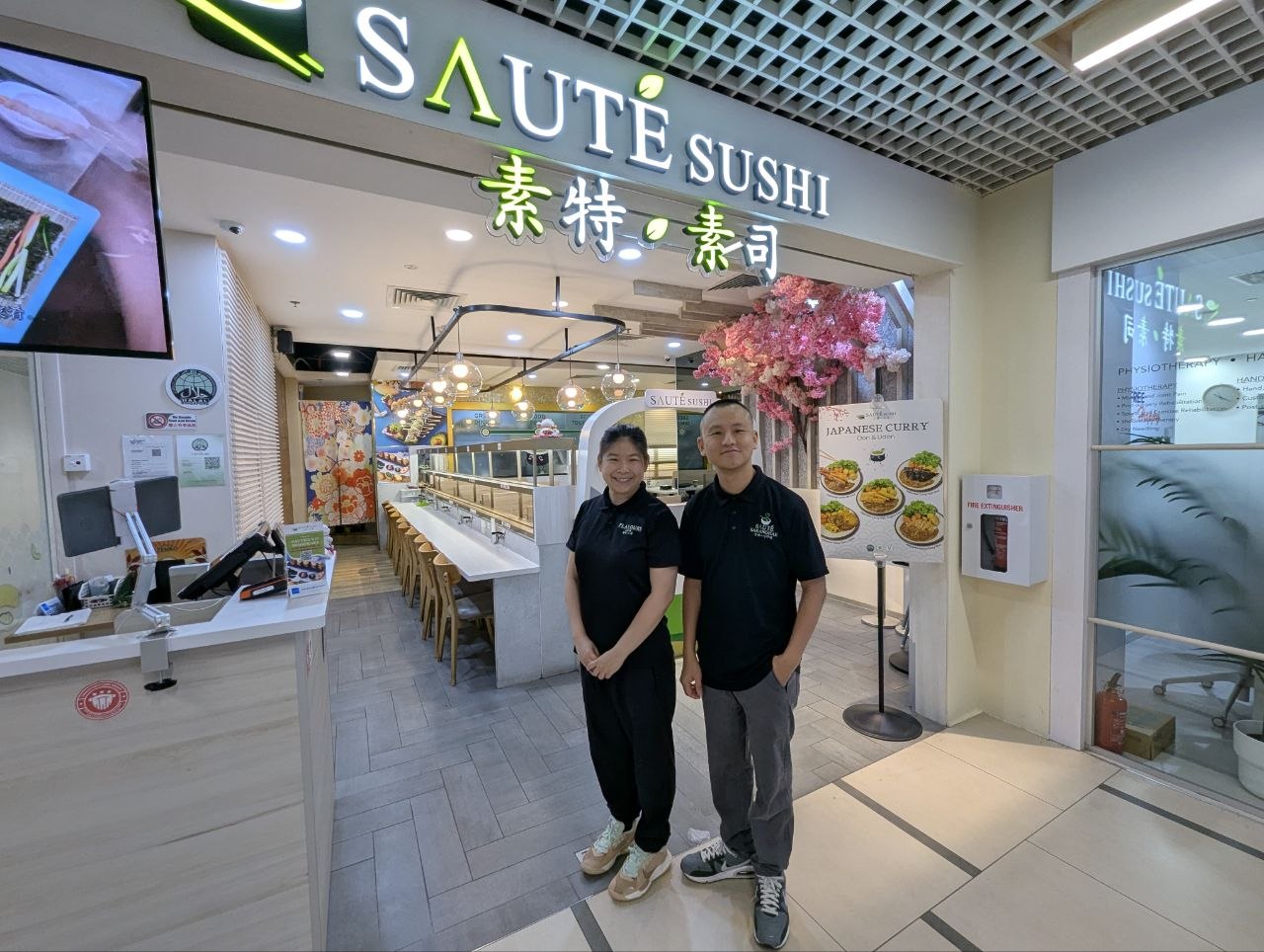 Tan with his wife, Soek Hui, on the left. Photo by Mothership.
Of course, that doesn’t mean his restaurant is aimed at making people feel guilty about eating meat, Tan clarified.
His restaurants do not carry any environmental messages, although this is a secondary outcome of going vegetarian.
“We just wanted to make Sauté taste nice and good, (for people) to step in, who just want to eat one meal that tastes nice without meat. We don’t want any kind of pressure on anyone,” he said.
Sauté, rather, is aimed at filling a “cuisine” gap – recreating entire cuisines as vegetarian, Tan elaborated.
It is an ambitious effort and a sign of Tan’s passion for delicious vegetarian food. Tan thinks that the “cuisine” gap might be due to an absence of people daring to venture out of their comfort zones.
While the market already had “delicious” vegetarian dishes that could be found at hawker centres and coffee shops, there was an absence of something like vegetarian Western cuisine, he noted.
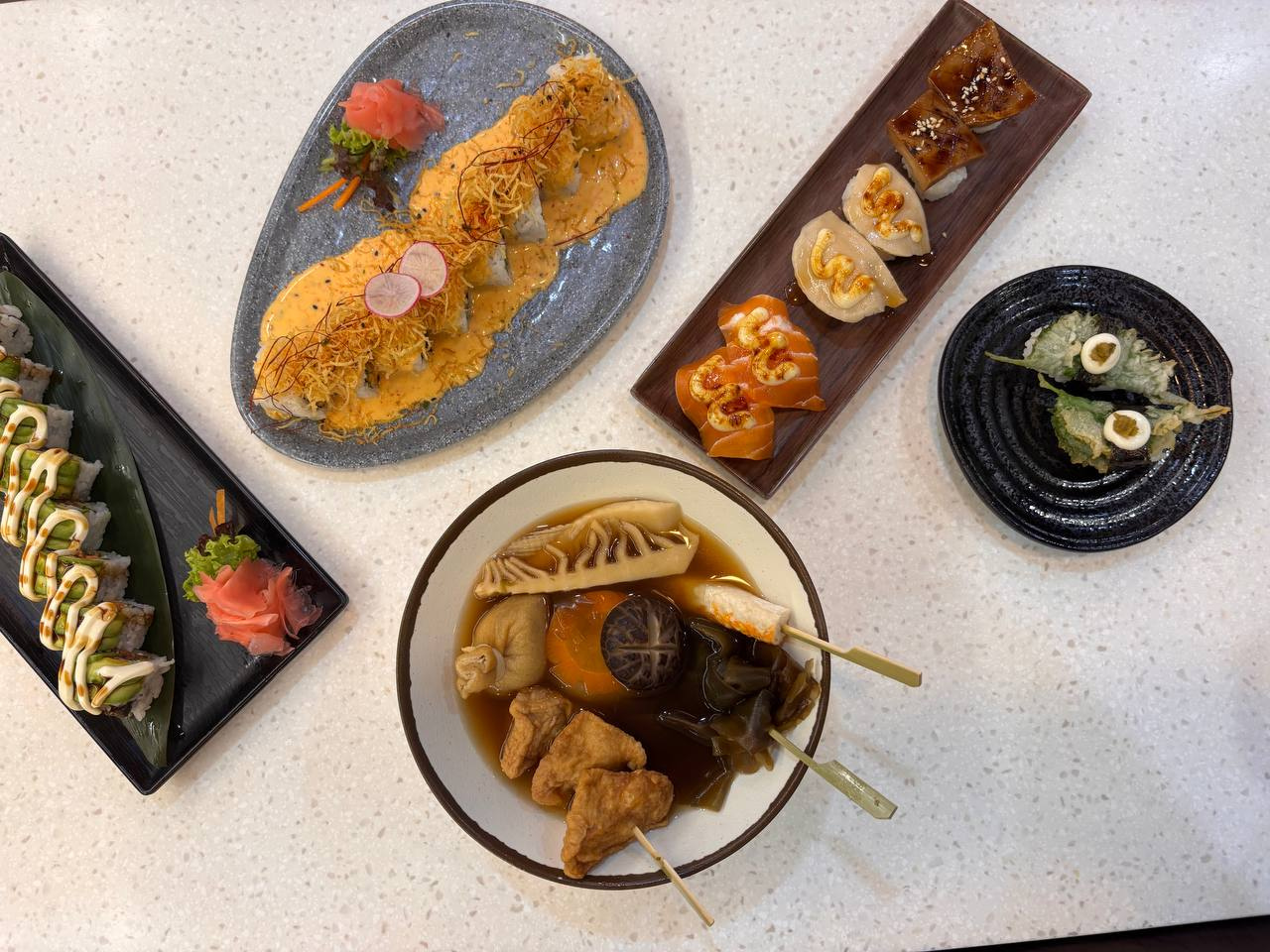 Vegetarian Japanese cuisine dishes served at Sauté Sushi. Photo by Enterprise Singapore.
The first outlet
Today, Sauté boasts an impressive five outlets, with a number of vegetarian cuisines available for any curious member of the public.
The one we visited, Sauté Sushi, is, as the name suggests, focused entirely on Japanese cuisine, complete with its own sushi train system to recreate the experience of dining at a sushi restaurant (and help overcome a manpower crunch as well).
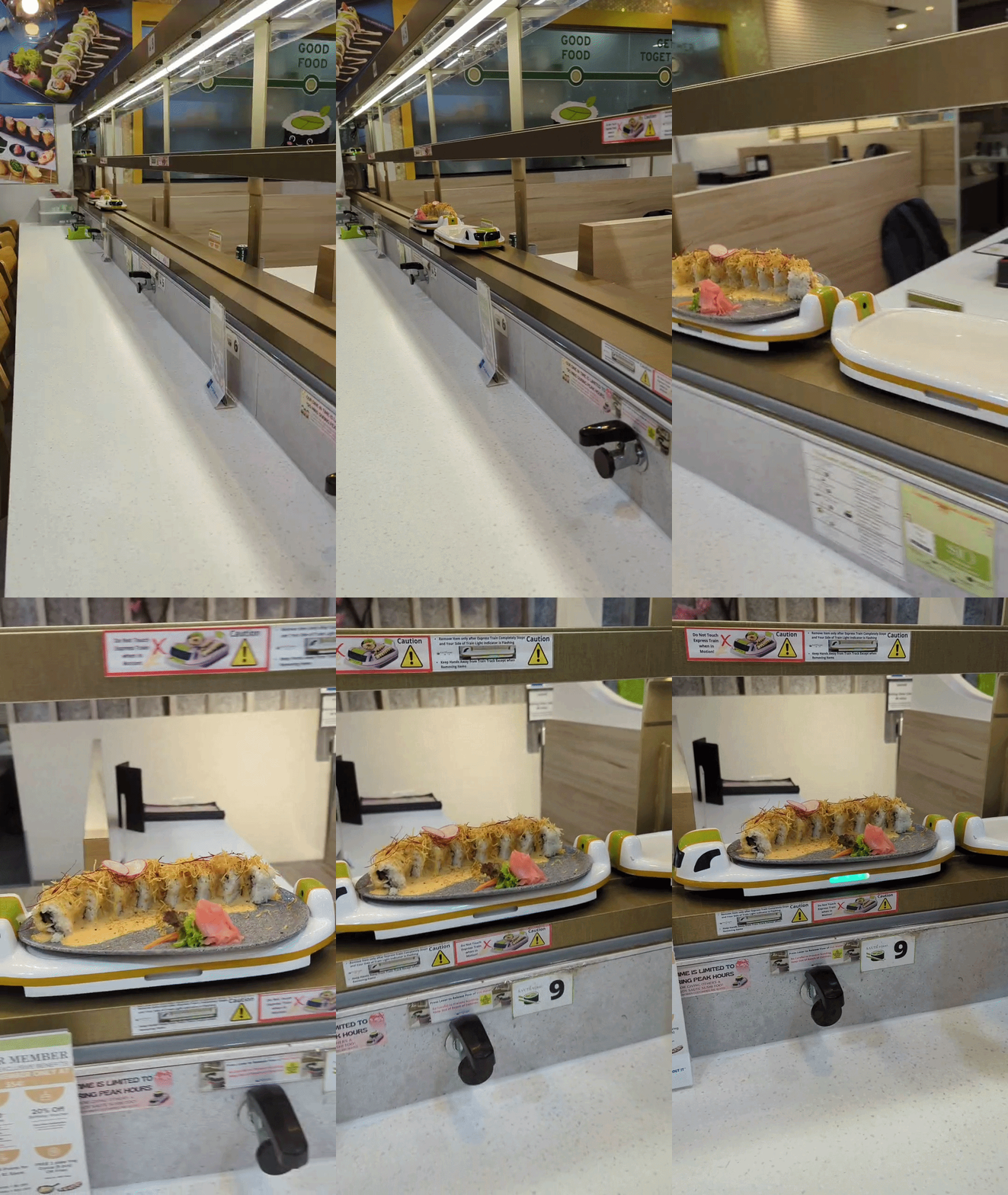 Gif by Mothership.
Another outlet, Sauté Saranghae at Tampines One, is all about Korean cuisine, while Flavours by Sauté features a fusion of local and Western cuisine.
It’s a long way from the humble beginnings of their first outlet, Sauté, which opened at Bugis Cube in 2016, amidst multiple nail salons and massage parlours.
At that time, his wife was pregnant, which meant that besides his sister, his brother-in-law and parents had to come in after work to help.
“It was really tiring. I was sleeping in the kitchen while cutting vegetables. We couldn’t hire anyone yet.”
“The aircon also wasn’t really working and we had to rent a fan (because it was) stuffy,” Tan added with a smile.
However, the building’s management was kind enough to allow them to place chairs and tables outside their restaurant in order to accommodate the crowd.
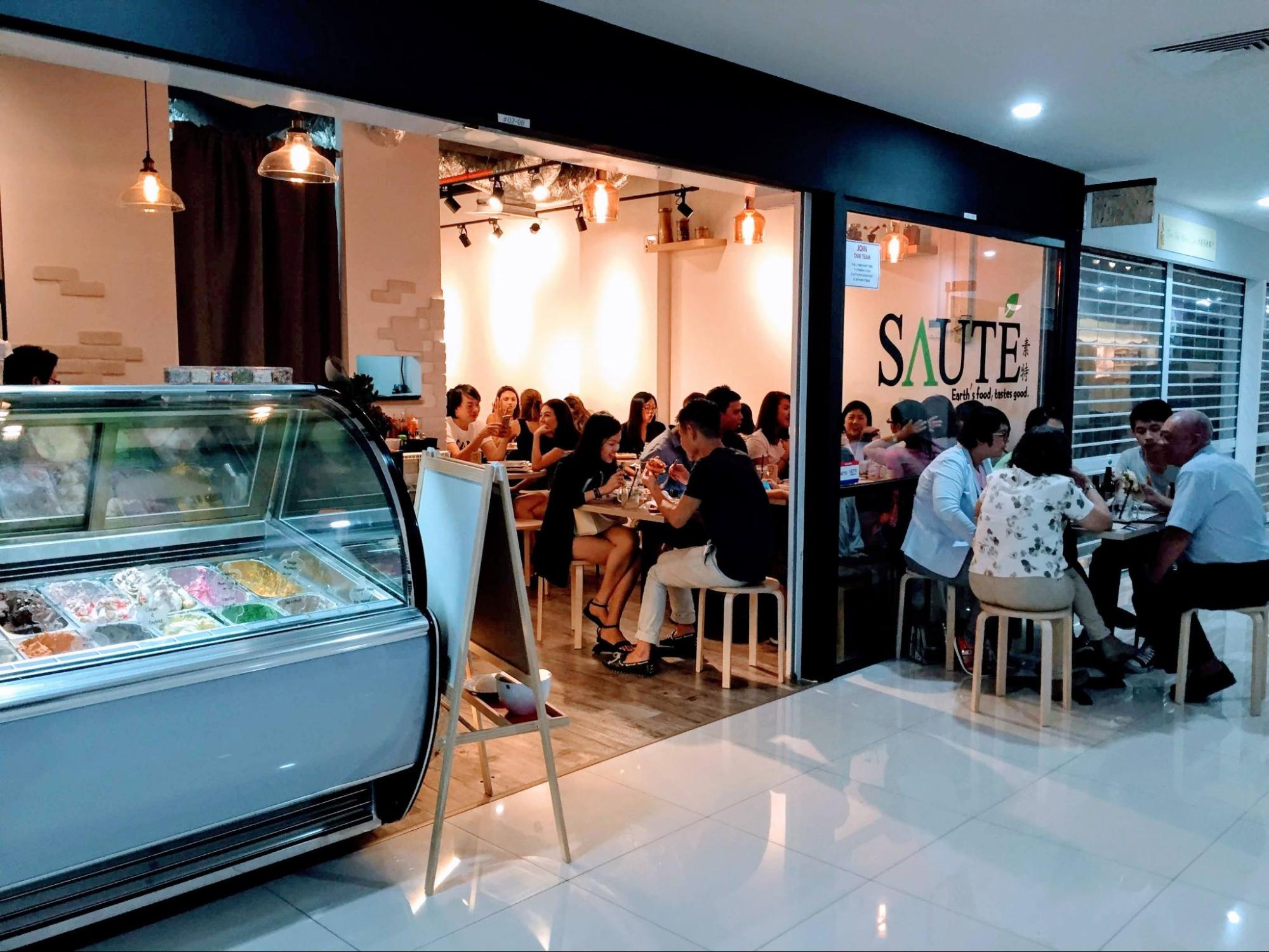 Sauté’s first outlet at Bugis Cube. Photo courtesy of Sauté.
When I asked what prompted them to move to City Square Mall two years later, Tan replied that they had received an email from an agent asking if they wanted to venture into City Square Mall. Tan said yes as he was keen to bring the brand greater visibility, as well as shift it to a more convenient location.
In addition, he wanted to change what he perceived was a public view that did not see vegetarian cuisine as a mainstream dining option.
“That’s where we really went in,” Tan said.
Scaling up and expanding the brand
That’s not to say that Tan’s plans for expansions were simply limited to just improving visibility, however.
From the moment he opened his first outlet at Bugis Cube, Tan had already set his mind on how he could build up a lasting brand, his wife, Soek Hui, recounted.
However, as they were unsure how to go about it, they approached one of Enterprise Singapore’s SME Centres.
Eventually, in 2019, they met Ben Teo, a senior business advisor from the SME Centre at Singapore Manufacturing Federation. He had experience in working with F&B businesses and could share with them various insights.
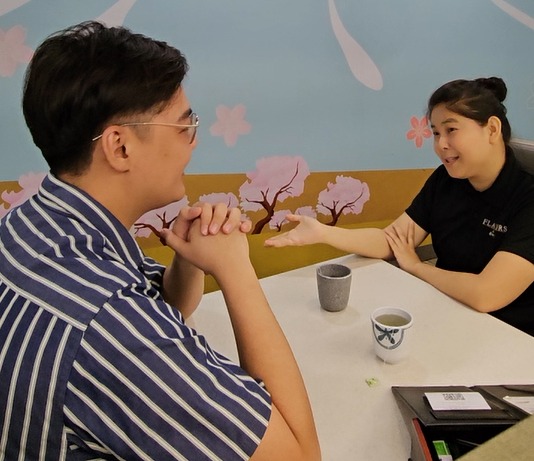 Photo courtesy of Ben Teo (left).
By this time, they had already opened a third outlet, Flavours by Sauté, and had plans in mind to open a fourth, under yet another name.
Teo advised them to standardise the brand’s name and image across all of the outlets.
“That’s (how) we have the brand colour, which is the white, black and green, and the fact that all outlets have the name Sauté,” Tan shared.
The kimchi manpower issue
Amidst their expansion with more outlets, another issue soon emerged – a manpower resource crunch.
Or more specifically, the allocation of manpower for the preparation of kimchi in their vegetarian Korean dishes – a process that can take up a lot of the staff’s time, when they could be attending to other matters, as both Hui and Tan shared.
Part of this has to do with the fact that many of the ingredients in their dishes are handmade, including their kimchi, which does not utilise ingredients such as onion and garlic.
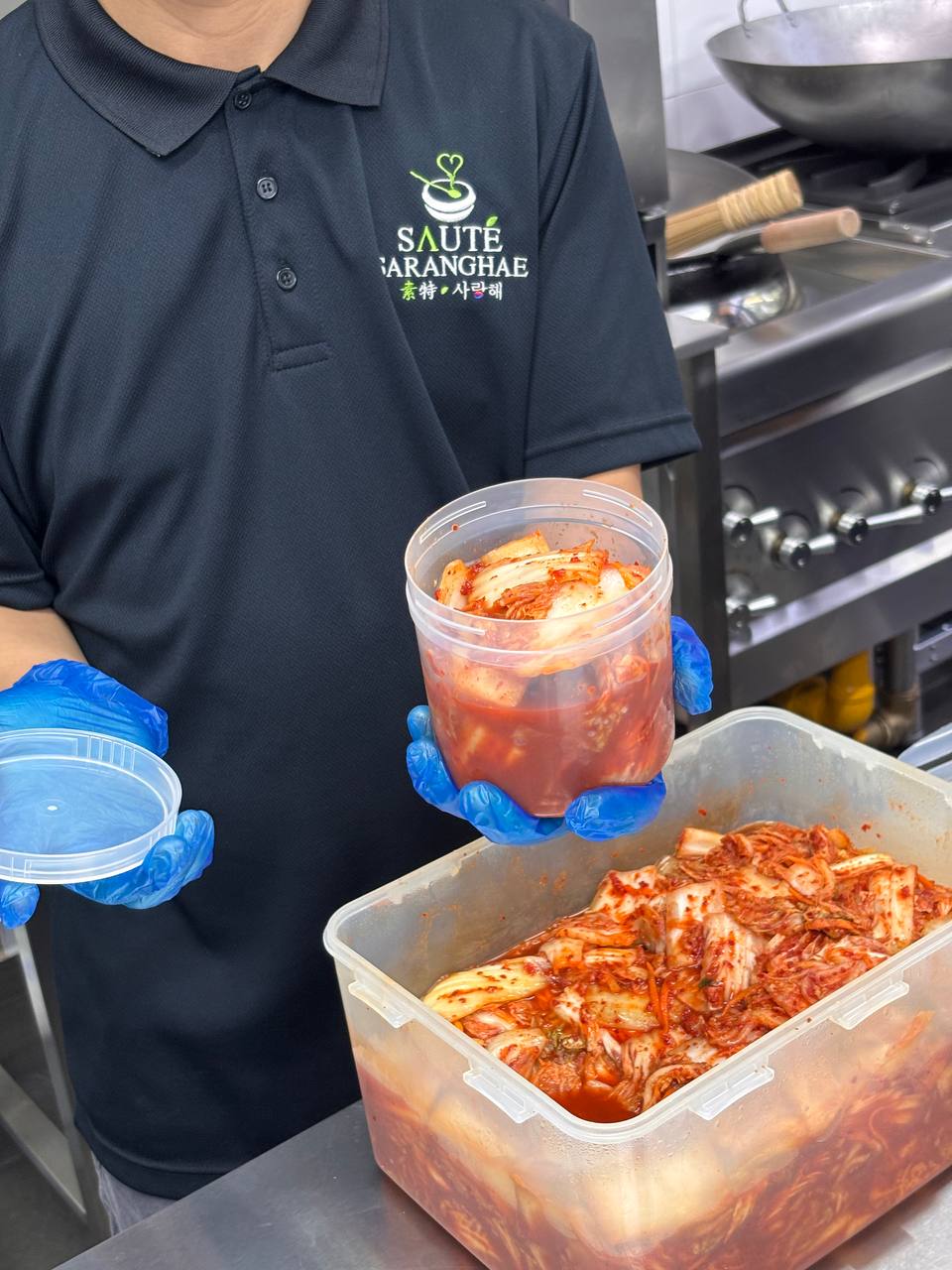 Handmade kimchi. Photo by Mothership.
For Tan, the restrictions on onion and garlic have a religious dimension.
Given that Korean cuisine has been one of the cuisines that Tan sought to recreate as vegetarian right from their very first outlet, he had initially sourced for kimchi from external vendors, only to realise that he could not find one that did not utilise garlic and onion, or was produced in a facility free from those ingredients.
This meant that they had to make the kimchi in their own kitchens, Tan pointed out, a process that now consumes the time of at least three of their outlets – Sauté Sushi, Sauté San and Sauté Saranghae.
The push to open a central kitchen
Fortunately there is one solution that has since emerged as an effective way of addressing this issue – establishing their own central kitchen.
The idea came about following a visit to another successful restaurant’s central kitchen, arranged by Teo.
Hui shared that what amazed them was the fact that this restaurant established their central kitchen when they only had one outlet.
“Meanwhile, we have five kitchens. All the more we needed to pull our resources together,” she said with a laugh.
She also admitted that initially, the idea of a central kitchen felt daunting, due to the machinery involved.
However, after the restaurant’s owner walked them through how they set up one, the costs that were involved, how they overcame the various challenges they faced, and eventually were even able to scale up to work with commercial clients, Hui and Tan felt much more confident in going ahead.
Since then, kimchi-making operations have been shifted to the central kitchen, allowing staff at the restaurants to better focus on customer service, and growing Sauté’s membership programme, Hui added.
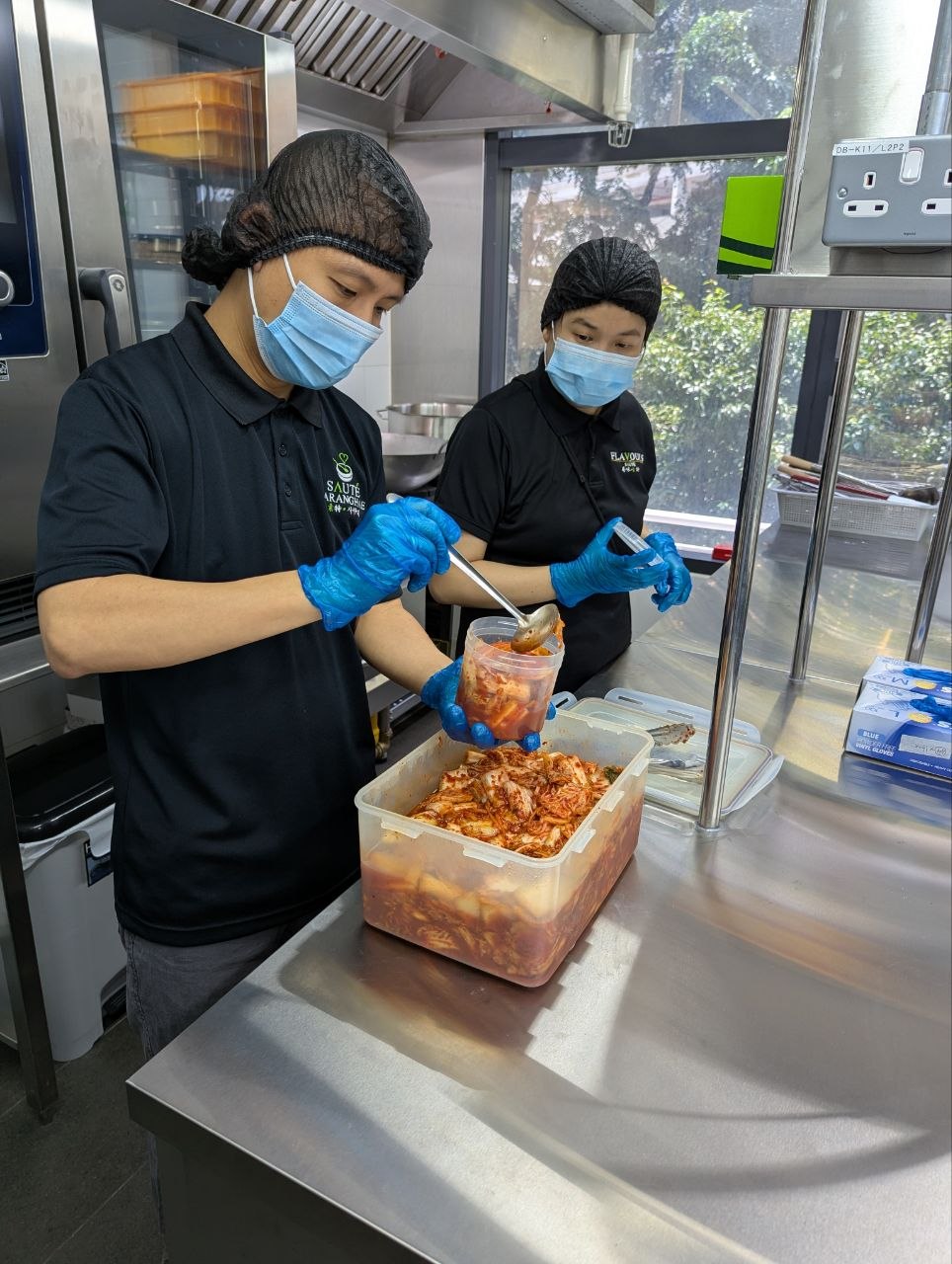 Kimchi being fermented at Sauté’s central kitchen. Photo by Mothership.
Plans for the future
All that being said, Tan is still looking at how he can expand Sauté even further, given that the central kitchen has opened up possibilities, from expanding overseas, such as into Malaysia, to retailing ready-to-eat dishes.
In addition, the quest to craft new vegetarian dishes and cuisine continues - Tan and Hui shared that they travel to places like China and Japan to experience new ways of vegetarian cooking.
Thanks to Teo and the SME Centre, Tan has also been in contact with the Singapore Business Federation for overseas opportunities.
Tan’s brother-in-law and a co-founder of Sauté, Shah, added, “Actually, we are quite blessed to do business in Singapore.”
“If you are unsure about anything, you can just reach out (to the SME Centres) to explore available support,” he said.
Even though sleeping in the kitchen while cutting vegetables is a thing of the past, Tan pointed out that now, the pressure stems from the fact that multiple families, including those of their colleagues, are dependent on the success of their business.
But it is pressure that he has transformed into a driving force.
“So we always have the motivation to continue doing well in our mission of bringing people meatless food and introducing our cuisines to other people.”
This sponsored article actually made the author enjoy eating vegetarian dishes.
Looking to grow your business? You can go here to find out more.