Parliament


No POFMA direction for Israeli report claiming death penalty talks in S'pore as public interest grounds not met: SM Shanmugam
The Israeli correspondent was informed that no such discussions had taken place and that it would be false to suggest otherwise.
October 07, 2026, 06:37 PM
Photos from MHA/Facebook and Haaretz.


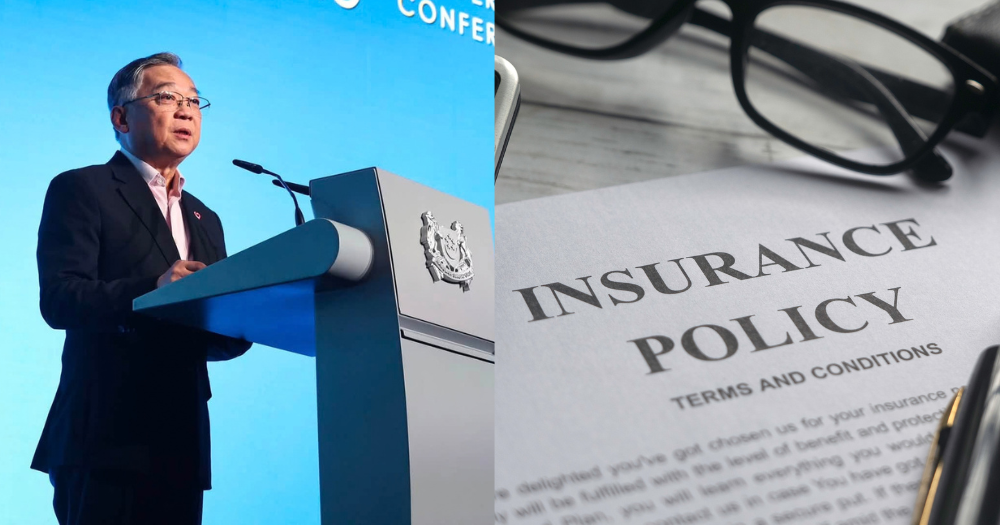
There were no public interest grounds to issue a correction direction under the Protection from Online Falsehoods and Manipulation Act (POFMA) over a report by Israeli media outlet Haaretz, said Minister for Home Affairs and Senior Minister and Coordinating Minister for National Security K Shanmugam.
The media outlet alleged that a delegation from Israel had discussed the death penalty with Singaporean officials.
In a written reply on Oct. 7, 2026, SM Shanmugam said the assessment at the time, based on legal advice, was that the public interest grounds for issuing a POFMA Direction were not met.
His reply came after Workers’ Party Member of Parliament Fadli Fawzi asked about the reported meeting, including why a correction direction was not issued against Haaretz.
Fadli also asked if illegal settlements and settler violence in the West Bank were discussed during the meeting, and if Singapore had requested that the meeting be kept secret.
What was alleged in the article
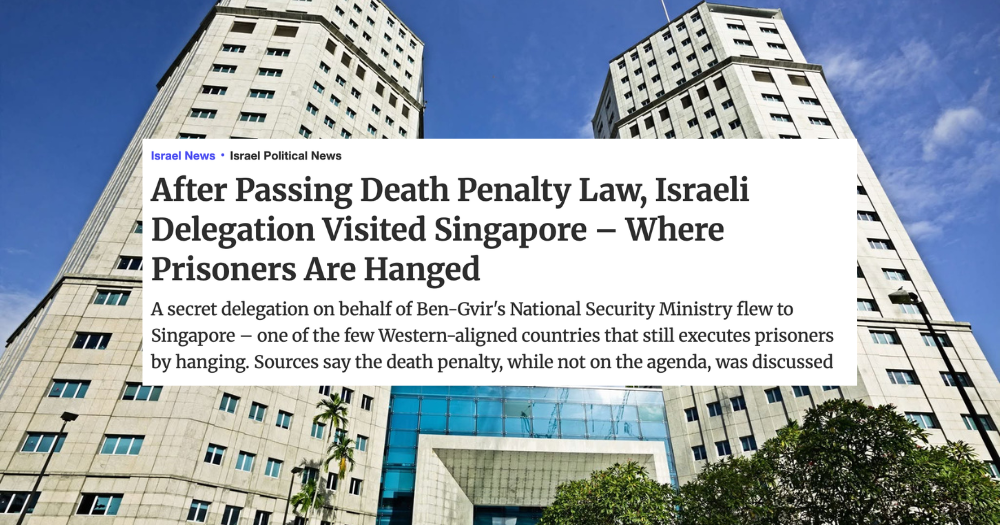
On Sep. 7, 2026, Haaretz reported that a delegation comprising representatives from the Israel Prison Service and the National Security Ministry had made what it described as a "secret visit" to Singapore.
According to CNA, the report claimed that the death penalty was discussed during the visit, citing several unnamed sources.
This claim was subsequently refuted by Singapore's Ministry of Home Affairs (MHA) on Sep. 11, 2026.
An MHA spokesperson told CNA that Haaretz correspondent Josh Breiner had asked whether discussions on the death penalty had taken place.
Breiner was informed that no such discussions had taken place and that it would be false to suggest otherwise, the spokesperson said.
MHA added that it had hosted the Israeli delegation for an officials-level meeting, during which both sides shared best practices in areas such as emergency response, crime prevention, and forensics.
Such engagements allow the exchange of information and operational cooperation in areas like fire and rescue and cybercrime.
"This is part of the Singapore government’s engagement with a wide range of international counterparts in the conduct of foreign relations, economic cooperation, security dialogue, among others, in pursuit of our national interests," the spokesperson was quoted as saying.
Separately, Israel’s National Security Ministry also told Haaretz that representatives from the ministry and its agencies did not discuss the death penalty during the meeting.
Why no POFMA direction was issued
In his written reply, Shanmugam said Singapore regularly holds discussions with international counterparts on security and law enforcement matters.
Such engagements are important for the exchange of information and intelligence between agencies, he said, adding that they have enabled Singapore to identify potential threats, intervene early, and keep the country safe.
He reiterated that the meeting with the Israeli delegation focused on operational and security-related issues and did not extend to broader foreign policy matters.
"Singapore’s positions on such matters are addressed through the appropriate foreign policy channels, including by the Ministry of Foreign Affairs (MFA)," he said.
SM Shanmugam added that the contents of MHA’s exchanges with foreign counterparts are confidential and generally not publicised due to security concerns.
He said MHA had responded to the Haaretz article as its claims were "categorically false".
However, it was assessed that the public interest grounds for issuing a POFMA Direction were not met at the time.
Despite this, Shanmugam clarified that the decision did not preclude issuing a POFMA Direction later if circumstances materially changed and warranted a different assessment.
Shanmugam added that MHA’s approach to discussions with bilateral counterparts was focused on matters of shared operational and security concern.
"If (Fadli) believes that MHA should use such engagements to raise broader concerns about the policies or conduct of the country concerned, then he should say so clearly," he said in his reply.
Shanmugam also asked Fadli whether the same approach should apply consistently to all countries with which MHA engages.
"For example, when MHA holds operational discussions with other Middle Eastern or Asian countries, should we also raise the concerns Singapore may have with their conduct or policies?" he asked.
"If that is (Fadli's) position, the Government would be interested to understand how he proposes that such an approach would serve Singapore’s overall interests."