Abroad


Indonesian president Prabowo has made his largest cabinet reshuffle yet, what does this mean for his agenda?
Relocating allies, coalition partners, and potential rivals.
October 07, 2026, 02:17 PM
Image via Cabinet Secretariat of the Republic of Indonesia & Prabowo Subianto/Facebook


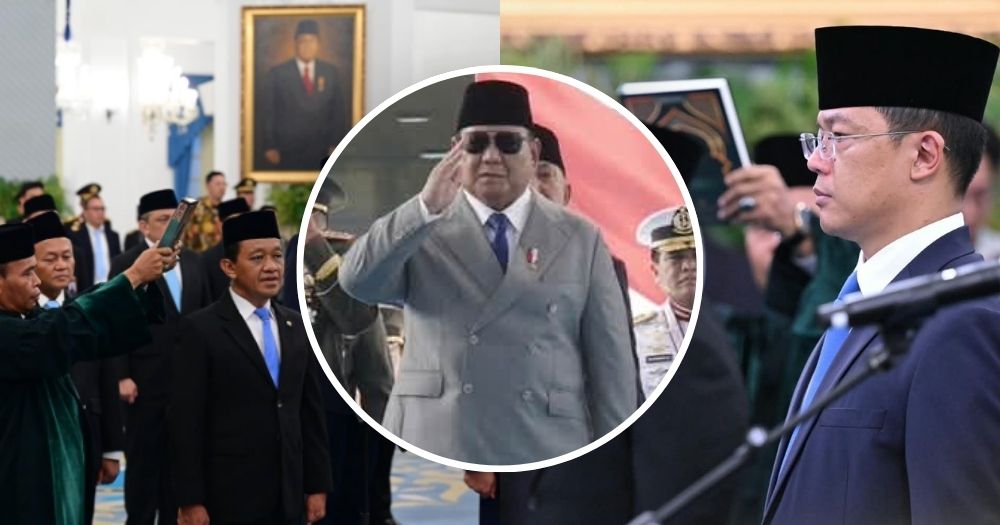
On Oct. 1, Indonesian President Prabowo Subianto carried out what was probably his most significant cabinet reshuffle since taking office almost two years ago in October 2024.
The Jakarta Post reports that the reshuffle, his seventh so far, appointed or reshuffled 18 senior officials.
Prabowo already has one of the largest cabinets in Indonesian history, especially in the post-Suharto period, and it includes allies of both Prabowo and his predecessor, Joko 'Jokowi' Widodo.
Fattening his cabinet
BBC Indonesia cited an expert, who viewed the reshuffle as Prabowo “fattening” his cabinet by adding more roles, particularly deputy ministers.
But Prabowo also placed key allies into key positions, and kept prominent members of other parties within the government’s orbit.
Key allies
For instance, the mononymed Sugiono was moved from Foreign Minister to Coordinating Minister for Human Development and Culture, according to Reuters.
Sugiono has been described as Prabowo’s “ideological son” and is the deputy chairman of Prabowo’s Gerindra party.
The former foreign minister is probably the most prominent change that outside observers would have noticed.
He was replaced by career diplomat and Sugiono’s deputy at the ministry, Arrmanatha Nasir, who was Indonesia’s former permanent representative to the United Nations in New York.
Sugiono, by contrast, had much less experience in diplomacy; his most significant exposure was as the deputy head of the parliamentary commission overseeing foreign policy, and The Diplomat suggests that he was chosen due to his position as deputy chairman of Gerindra.
Another example is that the new Industry Minister, Muhammad Sarmuji, is the secretary-general of the Golkar party, which currently holds about 18 per cent of the seats in Indonesia’s parliament.
Golkar chairman and Energy and Mineral Resources Minister Bahlil Lahadalia retained his position and was put in charge of a new coordinating ministry for downstream industrialisation and energy transition.
Former Jokowi appointees
The Jakarta Post also suggested that Prabowo had used the reshuffle to assert more control over the government, detaching allies of his predecessor from key roles without removing them from government.
The main example they used was that of former National Police Chief Listyo Sigit Prabowo, who was replaced by Suyudi Ario Seto.
Listyo is described as a “key Jokowi ally” and was retained as National Police Chief during the presidential transition in 2024, but now has been appointed the Presidential Chief of Staff, a role which the Post describes as “diminished” in recent years.
The Post said that while the reshuffle was “not a complete purge” of Jokowi allies, an expert it spoke to suggested that Prabowo was “gradually building his own team and placing people he trusts in more key positions,” but still keeping Jokowi allies close, preventing potential political rivals from building influence outside of government.
Another significant change is the appointment of a new Deputy Finance Minister, Luky Alfirman.
This follows on from changes made in Prabowo’s sixth reshuffle in September, where he replaced his finance minister for the second time in two years, appointing Suahasil Nazara.
Coalition concerns
Another commentary in the Post said that the reshuffle shored up coalition support for 2029, when the next presidential election is to be held.
This has long been a proposed policy, as a 2024 article suggests that this was the reason why his initial cabinet was so large: to build as large a coalition as possible.
In addition to Golkar’s chairman and its secretary general, the current cabinet includes the leader of the Democratic Party and son of former Indonesian President Susilo Bambang Yudhoyono, Agus Harimurti Yudhoyono.
The chairmen of the National Mandate Party and the National Awakening Party also hold cabinet positions.
Arya Fernandes of the Centre for Strategic and International Studies told the Post that the reshuffle could be viewed as an effort to reinforce coalition ties as they weigh their interests ahead of the 2029 elections.
Falling polls
But lingering in the background are also more present and pressing concerns.
A July 2026 poll showed that Prabowo's approval rating had fallen to about 51 per cent, and concerns grew about Prabowo's management of the economy.
BBC Indonesia’s article on the reshuffle asked why Prabowo's government was considered “ineffective and inefficient”, with an expert it spoke to suggesting that not enough ministers had a related professional background and were instead chosen for political reasons.
Lely Arrianie, a political communications professor at LSPR, said that some of the officials considered by the public to have fallen short of expectations were not removed from the cabinet but were merely moved to other positions.
Indonesian news site Magdalene also raised concerns that such a large cabinet engendered a high cost, with significantly more salaries, allowances, and operational costs involved.
Midpoint
The South China Morning Post highlights several critiques of the government, with ISEAS Yusof Ishak Institute Indonesian programme coordinator Julia Lau saying that there were concerns about Prabowo's authoritarian governance style, worries about democratic backsliding, as well as economic strain from costly state-led programmes.
Meanwhile, the rupiah remains weak, having breached the 18,000 rupiah mark to the U.S. dollar at the end of September, according to Reuters.
Yet another editorial from the Jakarta Post suggests that 49.4 per cent of Indonesians felt that economic conditions were bad or very bad, despite encouraging inflation and unemployment statistics and robust GDP growth.
It suggested that individuals were not experiencing the benefits of that growth, saying that while “someone’s making money”, most felt that they were not fully participating in the economy.
Prabowo nears the midpoint of his presidency and faces a challenging time ahead as he seeks re-election.
While entering government with lofty goals and ambitious policies, such as his free school meals programme, this most recent reshuffle suggests that his government still needs some tinkering before those goals can be accomplished.