




News


S'pore wife granted 33% of S$2.2 million matrimonial assets, court finds she put in 6% 'direct contribution' but 60% 'indirect contribution'
The couple were also awarded joint custody of their three children.
May 27, 2026, 08:03 PM
Image by Matthias Ang


A high court justice has called on a divorcing couple to scrupulously observe their duty of full and frank disclosure and to resist the temptation to deny the other spouse their right of entitlement, reminding them that the court possesses tools to not only expose such reprehensible conduct but also to visit consequences on errant spouses.
The warning comes after divorce proceedings between an unnamed husband and wife, who began divorce proceedings in 2023, after which the husband attempted to hide a number of financial transactions at the start of said proceedings, as reported by The Straits Times (ST).
Wife receives one-third of matrimonial assets
In a judgement published on May 20, High Court Judge Dedar Singh Gill granted the wife 32.965 per cent of the matrimonial assets.
The judge said the matrimonial pool was valued at approximately S$2.24 million
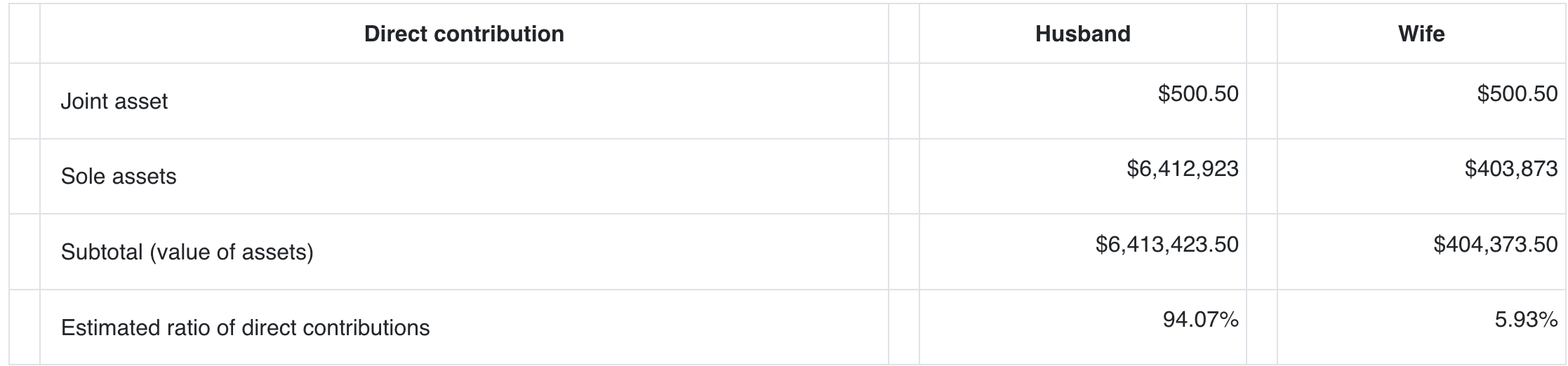
He did this after determining that the wife had made a direct contribution to matrimonial assets of 5.93 per cent or S$404,373.50, as compared with the husband's direct contribution of S$6.4 million, or 94.07 per cent.
 Screenshot from Elitigation
The judge, however, determined that the indirect contributions to the marriage were at a ratio of 60 per cent to 40 per cent in favour of the wife.
In coming to this conclusion, the judge said that the husband had borne most of the indirect financial contributions, as he had “greater financial capacity.”
He said it was clear that the wife had assumed “greater responsibilities on the home-making front”, largely taking care of the couple's three children's physical well-being and overseeing their studies, although the husband and the children's paternal grandparents had also assisted in child care responsibilities.
The wife had also been responsible for managing the household by cooking as well as supervising a helper who had been employed in 2020.
The judge also said it was notable that the wife had supported the husband's career, having resigned her own job to commence work at her husband's company.
He said that there was no doubt that the wife's commitment to assisting the administrative side of the husband's company, coupled with her significant involvement in family life, allowed the husband to “concentrate his energy toward growing his company.”
The company, which, according to ST, had been sold in 2020, was not named in court documents.
The judge also highlighted a number of financial transactions that had occurred before the start of divorce proceedings in 2023.
The husband had transferred large sums of money to his parents, claiming that they were to repay loans given by his parents for the purpose of building up the husband's family and his career at the company he had subsequently sold.
However, the wife disputed the husband's claim of loan repayment, saying that prior to the divorce proceedings, she had never heard of such loans and that, given his company's profitability, the loans were not warranted.
The judge referred to the husband's delay in explaining certain expenditures and disclosing financial documents as egregious, and awarded costs of S$5,000 to the wife.
The judge also declined to order any spousal maintenance.
Joint custody
The couple have had three children since their marriage in 2008, and prior to the divorce, were living together in a rented home.
In 2023, the husband moved out of the home with the two older children, with the youngest child living with the wife.
The wife had sought custody of the youngest child as well as joint custody of the two older children, saying that the husband had been abusive, and that the couple was “completely unable to cooperate with each other.”
The husband denied the wife's allegations of physical abuse against her or the children, noting that her application for a personal protection order (PPO) had been dismissed, and that she had not applied for a PPO on behalf of the children.
The judge agreed that the wife's allegations were unproven and did not dissuade him from awarding joint parental responsibility.
The wife had said that the youngest child had thrived while living with her, and that it was in the youngest child's interest to maintain the status quo for stability and reduce drastic changes caused by the divorce.
However, the husband maintained that it was not in the child's interest to grow separately from their siblings, and that he had the capacity and support network to care for all three children, having secured long-term accommodation, support of a domestic helper, and the child's paternal grandparents.
The judge said that he did not think it would be beneficial for the children's welfare for the siblings to grow up separately, and was of the view that the husband was more able to provide robust care for them, awarding him sole care and control of all three children.
However, the husband and wife are to have joint custody of the children, and both parties were instructed to file further submissions within two weeks on how the wife's access to the children should be exercised.