News


Doctor husband & wife, both 34, help save man's life on SIA flight from New Zealand to S'pore
Life or death dilemma.
May 14, 2026, 02:07 PM
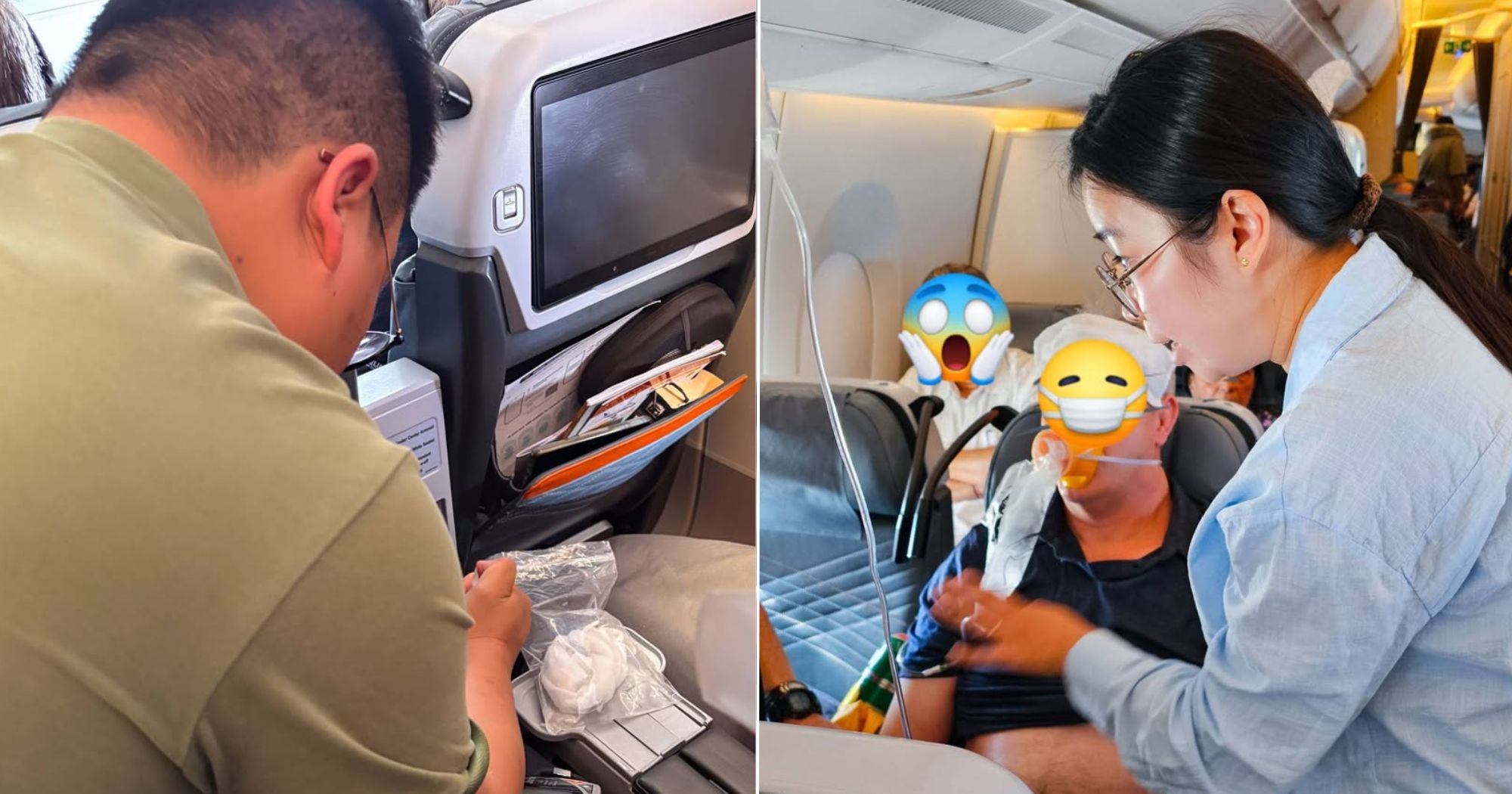
Photo from Boo Chin Fong/Facebook


When Malaysian doctor Boo Chin Fong heard an announcement for medical assistance on his Singapore Airlines flight from New Zealand, he initially assumed it was a non-critical call.
Having encountered similar situations twice in the past 45 days — both involving issues like panic attacks or dizziness — he expected the passenger to stabilise quickly.
Boo asked his wife, Tan Pei Jun, also a doctor, to attend to the call first while he got their five-year-old son settled.
However, it soon became clear that the situation was dire, and the two of them might be the only ones standing between the passenger and a fatal outcome.
Eventful family trip
Speaking to Mothership, the couple, both 34, shared that they were on the 10-hour flight to Singapore before heading home to Malaysia.
Their first family trip of the year had already been unusually eventful — they had already responded to another medical emergency on a domestic flight from Auckland to Queenstown just days prior.
This latest incident on the SIA flight, however, pushed them to their limit.
The passenger, a man in his fifties, had been unconscious for two minutes before Tan arrived.
Though he had regained consciousness, he was struggling to speak due to a severely swollen tongue and a tingling sensation — usual signs of a life-threatening allergic reaction.
"We saw that his blood oxygen content was 88 per cent and his pulse rate was 38 bpm, which is one of the slowest we have ever seen," Tan recalled.
Life or death dilemma
While the symptoms pointed to anaphylactic shock, the man’s medical history made the assessment incredibly complex.
His wife revealed he had recently recovered from a stroke, was on anti-aspirin medication, and had a hole in his heart.
This history gave the couple pause regarding the use of an EpiPen (which is used for the emergency treatment of life-threatening allergic reactions).
With a history of heart issues and no known allergies, injecting an EpiPen could be fatal if the patient was actually having a heart attack instead of an allergic reaction, Boo explained.
High-pressure assessment
The situation was further complicated by unfamiliar medical equipment on board and the fact that neither performs resuscitation in their daily roles.
Tan is a psychiatric trainee medical officer at Hospital Bahagia Ulu Kinta, while Boo serves as a risk manager at Penang General Hospital.
While the SIA flight crew was "very helpful" and knew how to operate the on-board equipment, the couple knew they were the only ones with the medical knowledge to make a decision.
The pressure was on the couple as the patient's condition worsened, and the flight crew inquired with them every few minutes on whether they needed to divert for an emergency landing.
When the couple consulted with a ground-based telemedicine team, they told them, "It’s your call, doctor."
Observing that the patient’s breathing was deteriorating and the swelling was worsening, they decided the risk of withholding the medication was greater than the risk of administering it.
They injected the EpiPen, and the patient began to recover.
"We tried our best, but the EpiPen is what truly saved him," said Tan. "Without it, he definitely wouldn't be here anymore."
The weight of volunteering
When asked about their decision to step forward, Boo admitted there is always a moment of trepidation.
"To be honest, there is always hesitation. Once you volunteer, there is no turning back."
The fear of a negative outcome or potential liability is a heavy burden.
What was a huge reassurance in this case, though, was that the couple, who haven't worked together in six years, were together and could rely on each other.
Boo also noted that their duty to save lives and their professional oaths always prevail (though he joked that they sometimes hope another doctor has already answered the call).
Reflecting on the intensity of the moment, Boo clarified that the photos taken during the emergency weren't for memories; they were taken to record the exact timing of the medication.
The couple remained "on duty" for the rest of the flight, checking on the man every 15 minutes, then hourly, until landing.
Boo also advised the man to visit a clinic before they parted ways.
Unexpected support from public
When they reached home, Boo decided to share their experience on his Facebook page, as a usual update to his friends and family, noting it was good to work with his wife again after six years.
To their surprise, their story resonated with many, and their post has since gone viral.
They were simply doing their jobs, Boo said, so they didn't expect so many people to respond to it.
Even after returning home, Tan hasn't spent much time celebrating.
"I'm still thinking whether what I did right, what I did wrong, I'm still ruminating whether I made a good decision or a bad decision," she said.
Instead, she has been researching medical papers on similar cases to see how they could improve their response in the future.
Despite their heroics, the couple joked that they hoped their next holiday would be a much less eventful flight.