News


HDB architect explains why new estate void decks not as spacious as old estate void decks
He explained that void decks evolved due to privacy-focused redesigns.
May 08, 2026, 06:34 PM
Photos via HDB


Modern Housing and Development Board (HDB) flats no longer have old spacious void decks.
Is it a design quirk? A reflection of modernity? A renewal of urban planning principles?
Kind of.
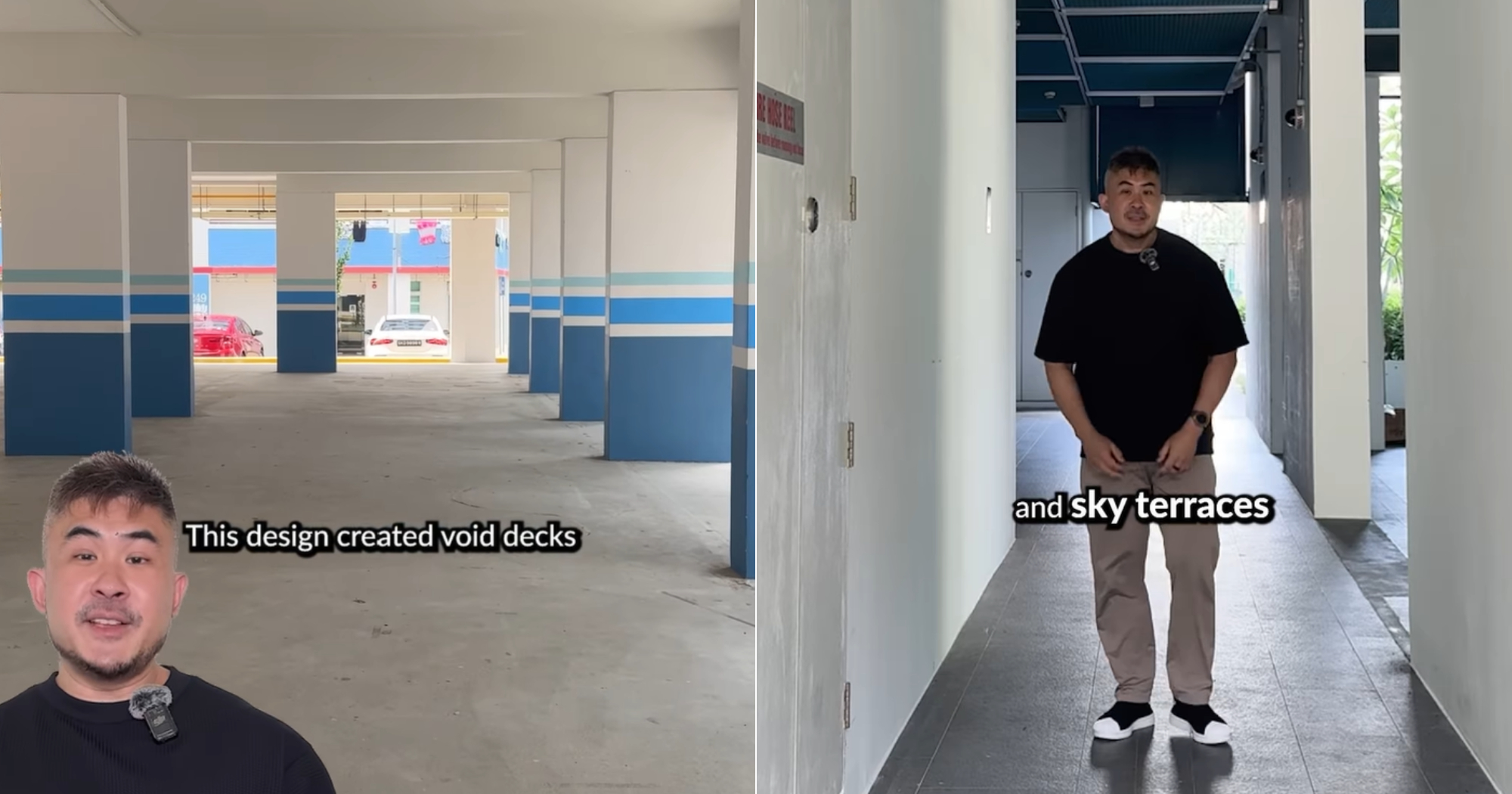
In an Instagram Reel on May 7, a HDB principal architect traced the evolution of public housing void decks and explained that the ground floor evolved due to privacy-focused redesigns.
Xianghua Wu said modern flats were built differently: bedroom windows in older blocks faced the common corridor, while those in newer blocks faced outwards.
Hence, instead of long and linear slabs, newer blocks were built using several stacks.
Old slab block design
The video explained that the old design featured most units arranged side by side, forming a long slab block.
Wu said these slab blocks "were efficient to build and helped us move people out of slums and squatter settlements into proper housing".
He said: "This design created void decks with a big, continuous space."
The video noted that slab blocks were common in the 1960s.
According to The Straits Times, the humble slab block was quick and easy to construct with a simple design that kept costs low.
Slab block downsides
However, the ST report noted that slab blocks had one drawback: height.
Slab blocks could not be built too high, with most ranging from 10 to 16 floors, and the record holder being 24 storeys, reported ST.
In the video, Wu added that slab blocks had the downside of bedroom windows facing the corridor:
"Residents preferred more privacy and better views. So we redesigned each block using several stacks."
Wu said: "Residents now have outward-facing bedroom windows, better ventilation and natural lighting, but the block shapes are less linear."
"Thus, void decks have become smaller and less regular."
Modern blocks
He added that newer BTO projects have more wayfinding signs to help with navigating around the otherwise more confusing design.
He added that community living rooms furnished with seats and tables have been introduced for residents to mingle and chat in new estates.
"There is also a wider range of communal spaces such as precinct pavilions, roof gardens and sky terraces."