News


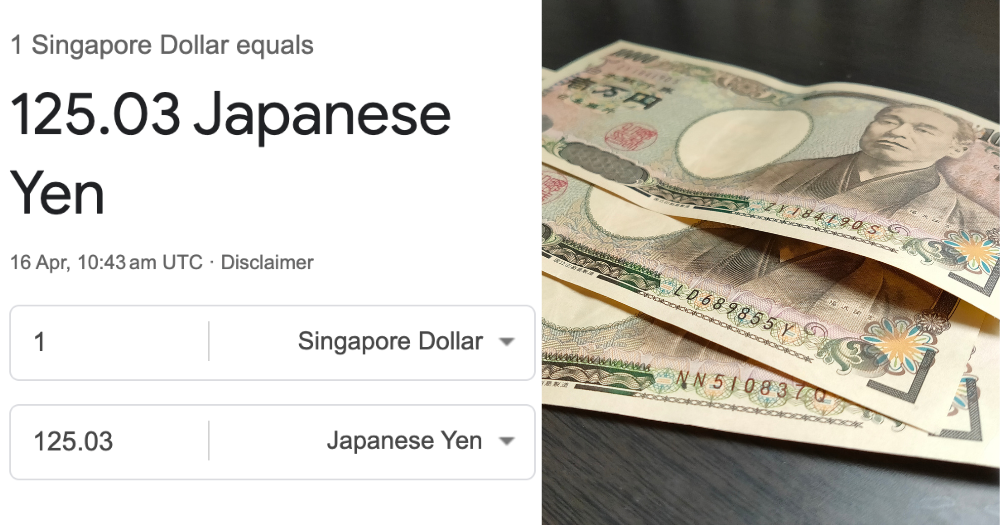
S$1 to 125 yen: S'pore dollar strengthens against Japanese yen again
SGD go brrr.
April 17, 2026, 01:49 AM


The Japanese yen, which has remained under pressure, has weakened against the Singapore dollar, reported The Business Times.
Record low for Japanese yen
As of Apr. 16, S$1 was equivalent to 125.016 yen, according to live foreign exchange data on TradingView.
The latest move pushes the exchange rate above the previous record seen in January, when S$1 briefly rose past 123 yen, continuing a climb that has made Japan increasingly affordable for Singapore travellers.
The Singapore dollar strengthened further after the Monetary Authority of Singapore announced on Apr. 14 that it would allow the Singapore dollar to appreciate slightly faster within its policy band, as part of efforts to manage imported inflation amid rising global energy costs.
The central bank also raised its inflation forecast for 2026, citing stronger price pressures linked partly to higher oil and gas costs.
Why the yen remains weak
The Japanese yen, meanwhile, has continued to weaken because Japan remains heavily exposed to imported energy costs, particularly from the Middle East, while its interest rates remain low compared with those in other major economies, according to Bloomberg.
Analysts say that when oil prices rise, Japan needs more foreign currency to pay for imports, which can weigh further on the yen.
Although the Bank of Japan raised rates late in 2025, borrowing costs in Japan remain relatively low, which continues to encourage investors to move funds into other higher-yielding currencies instead.
This then places sustained selling pressure on the Japanese yen as it is seen as less attractive to investors.
Japanese officials have also stepped up warnings over sharp currency moves after the yen weakened past key levels against the U.S. dollar earlier this year, though any intervention is generally seen as a short-term measure, unless broader economic conditions change.
Top image via Google, Pixabay