News


S’pore Zoo’s 1st-ever Sri Lankan leopard cub triplets make debut after 3-year breeding effort
The cubs have started eating small amounts of meat as they grow, helping them develop natural feeding behaviours like chewing and recognising scents.
April 16, 2026, 05:11 PM


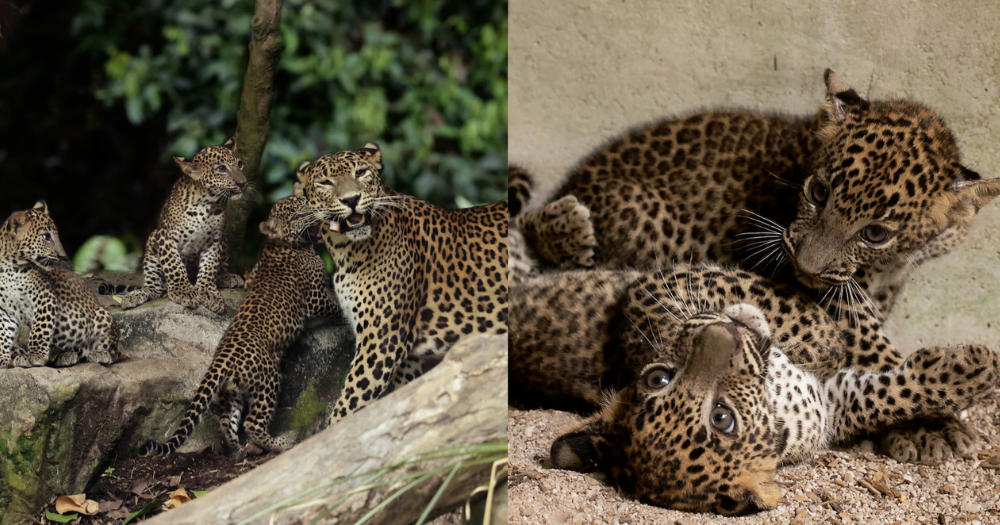
Visitors to the Singapore Zoo can now spot three Sri Lankan leopard cubs making their first public appearance at the Wild Africa exhibit.
The two males and one female were born on Jan. 1 this year, to mother Yala and father Asanka, marking the first successful birth of the species at Singapore Zoo.
The last recorded birth locally took place at the Night Safari about three decades ago.
The triplets are also part of a small global managed population of about 80 Sri Lankan leopards in zoos worldwide, making the birth a notable conservation milestone.
Pairing the parents took nearly 3 years
According to Mandai Wildlife Group, bringing Yala and Asanka together required nearly three years of coordination across international zoo partners.
In a statement, Mandai Wildlife Group curator Anand Kumar said the birth was the result of long-term collaboration under a global breeding programme.
“Bringing together a compatible pair took nearly three years and close collaboration across continents.
To see three healthy cubs thriving and developing their own personalities is incredibly rewarding – not just for our team but also for our colleagues from partner zoos.”
He added that the cubs have already begun showing distinct traits.
“The two males tend to be more laid-back, while the female is feistier.
We can already tell them apart by their demeanour and the spot patterns on their forehead, like fingerprints.”
The parents were paired under the European Association of Zoos and Aquaria Ex-situ Programme (EEP), which coordinates breeding efforts to maintain genetically healthy populations of threatened species.
Fewer than 800 remain in the wild
Sri Lankan leopards are listed as Vulnerable on the International Union for Conservation of Nature (IUCN) Red List.
Fewer than 800 individuals are estimated to remain in the wild, with threats including:
- habitat loss
- declining prey populations
- illegal wildlife trade
Mandai Wildlife Group said managed breeding programmes play a complementary role in supporting long-term conservation of the species.
Kumar added that encounters with animals can help deepen public awareness.
“With such a small managed population globally, milestones like this highlight the importance of these programmes. When people can come face to face with these leopards, that's how they come to care about a species they might otherwise never know.”
Cubs now exploring exhibit and learning survival behaviours
Now over three months old and weighing about 5kg each, the triplets are growing steadily and becoming more confident in their enclosure.
They have begun transitioning to a partial meat diet, an early step in developing natural feeding behaviours such as chewing and scent recognition. Full weaning is expected at around five months old.
The cubs also underwent veterinary checks in February and were given vaccinations and preventive treatments as part of routine care.
Visitors can currently see the cubs with their mother daily until mid-May, and after that on Wednesdays, Saturdays and Sundays.
Their names will be announced at a later date in partnership with exhibit sponsor Haw Par.
With the new arrivals, Singapore Zoo is now home to six Sri Lankan leopards, with one more at Night Safari.
Top image via Mandai Wildlife Group