Branded

From IT support to digital transformation: How one S'pore professional, 49, found his calling in tourism
If you think about it, he’s had two career switches.
When Jacky Lim first entered the tourism sector in 2001 at the age of 24, he wasn’t greeting travellers at the front desk or leading tours around the city.
Instead, his role involved working quietly behind the scenes, ensuring that they could book their tickets, receive emails about their itineraries and begin their trips without a hitch.
It was a role he worked in for 20 years, supporting systems that directly impacted customers’ journeys around the world, even if they never came face-to-face with him.
Then in 2021, he made an unexpected move. He left tourism entirely to pivot into a manufacturing role at a Japanese precision engineering company.
It was a detour that exposed him to a much more automated, process-driven environment and gave him new insights on how workflows can be digitalised.
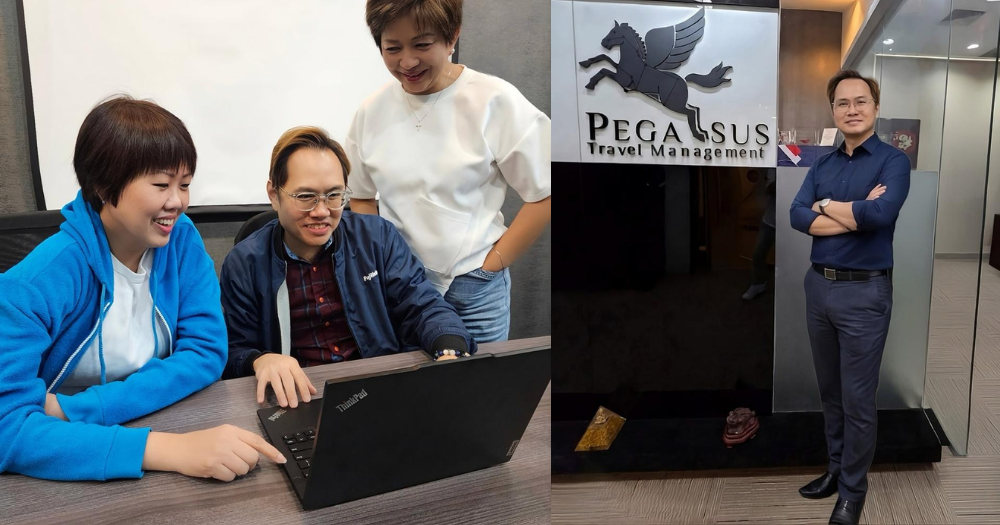
In 2025, four years after his manufacturing role, Lim returned to tourism as a Digital Enhancement Manager at Pegasus Travel Management.
Now, he is involved in improving efficiency across his company’s departments.
“Whether you come from manufacturing, technology or another industry, there is a place for your skills in tourism. The sector needs and welcomes diverse perspectives to keep innovating,” he said.
What people don’t see about tourism
Early in his career, Lim supported booking systems before becoming an IT administrator in a travel agency.
His job was to ensure that customers could book their trips, pay for them, and receive customer support without interruption, and that the technology underpinning these things did not fail.
For Lim, those early years weren’t just about maintaining systems, they were also about understanding how deeply technology shapes the traveller experience. Even from behind the scenes, he could see how a single disruption could ripple across an entire journey, and how smooth operations allowed frontline teams to focus on service.
“When IT runs smoothly, nobody notices,” he says. “But when it doesn’t, everyone does.”
When the server for his company crashed, all of the company’s emails vanished in the blink of an eye. Even the backup wasn’t of much help as it wasn’t up to date.
 Image via Unsplash
It was then that Lim proposed upgrading to a cloud-based system that was more secure.
It was a reminder that tourism operations depend on far more than what travellers see on the surface, and a glimpse of how technology might play an even bigger role in shaping the industry’s future.
How diverse skills can shape a career in tourism
Seeking new challenges and growth opportunities, Lim began upgrading himself, tapping on SkillsFuture credits to enrol in a six-month course in Microsoft Azure Administration through a learning academy as part of his effort to stay adaptable as he navigated this career transition.
He moved on to the role of Senior IT Executive in a manufacturing company, where he was tasked with running the cloud-based administration at the company.
 Image via Pixabay
There, he saw how automation, cloud systems and data dashboards were being used in everyday operations.
There was a defining moment when Lim observed the sales department's automated quotation approval workflow. The system seamlessly routed approvals from salesperson to management without manual emails or follow-ups.
“What surprised me most was how automated everything was,” he says. “Data, reports, workflows, all of these were centralised and accessible instantly.”
It made him realise that Singapore's tourism sector, with its high volume of bookings, quotations, and customer inquiries, could dramatically benefit from these automated workflows.
“I kept thinking to myself, if travel operations adopted some of these systems, they could work faster, smarter, and be more resilient,” he says.
It was a stint that gave Lim fresh perspectives he would carry with him when he eventually returned to the tourism sector, with his skills from precision engineering proving highly transferable.
Coming home to tourism
Lim, you see, never forgot about his first love.
He highlighted how the tourism sector was undergoing a “digital renaissance” as of 2025, with travel businesses embracing cloud systems and new digital capabilities.
Lim was keen to be part of this transformation, as he felt his now-enhanced skillset was a good match.
“In the past, many tourism roles focused mainly on operations and customer service. But today, the industry is becoming much more digital and data-driven.
“Travel businesses are adopting artificial intelligence and data analytics to improve both operations and visitor experiences.”
As for Lim, a typical day at Pegasus now looks very different from his earlier years.
Instead of simply supporting systems, he looks at how different parts of the business can work better together through automation and digital tools that improve efficiency across departments.
Some of the projects he has worked on include introducing mid and back-office systems that allow staff to access work platforms remotely, improving business continuity during disruptions.
He has also helped to streamline internal workflows like invoice generation and distribution, reducing manual processing and lowering the risk of human error.
While these systems operate behind the scenes, their impact is felt directly by frontline teams.
 Photo courtesy of Jacky Lim
By reducing repetitive administrative work such as manual data entry and fragmented processes, staff are able to respond faster, access information more easily and spend more time assisting customers.
He has also worked to enhance the experience of customers when they use Pegasus’ online booking system.
This has included implementing automated travel and visa policy requirements within the system, without the need for staff to manually track such requirements, and running an alert system for any travel advisories.
“When frontline staff see customers, I see processes, systems and data,” he explains. “I make sure everything runs smoothly so they can focus on giving great service.”
“Travellers may never know my name,” Jacky adds, “but they do feel the impact, through faster responses, smoother bookings, and fewer problems.”
For Jacky, this is a point of pride in knowing that his work behind the scenes directly enhances how people experience travel and create memories.
The tourism industry has been evolving
Lim’s career path, from tourism to manufacturing and back again, mirrors how the tourism sector itself has changed in recent years, with technology elevating the behind-the-scenes work that has always been crucial to delivering seamless travel experiences.
Following the pandemic, tourism businesses began adopting technological tools at an accelerated pace, Pegasus pointed out.
Traditional phone-and-desktop systems were replaced by cloud-based phone systems to ensure they could continue to address clients’ needs even during emergencies, while online booking tools were implemented to meet the demand of travellers who are cost-sensitive and particular about their travel patterns.
Pegasus has also made use of the Singapore Tourism Board’s (STB) Business Improvement Fund (BIF) – a scheme to help tourism businesses boost productivity by supporting technological innovation – to help build its website and integrate workflows between different departments.
 Image via Pixabay
“Most people think tourism jobs are all customer-facing,” Lim says.
“But behind every booking, every itinerary, every smooth trip, there’s a whole system working seamlessly in the background to keep all that afloat.”
It is this system and the accompanying technological drive to improve clients’ experience with it that increasingly draws professionals from other industries such as technology, engineering, sustainability and data analytics, offering unexpected career paths that didn’t even exist five years ago in digital product development, visitor analytics, experience design and technology operations.
In the second quarter of 2025 alone, more than 5,000 job postings offering around 6,700 vacancies were listed on Workforce Singapore’s MyCareersFuture portal for tourism-related roles.
 Image via Unsplash
2025 also saw an increased openness to use AI applications across operations to ease the tourism workforce's workload and raise skills, with 28 tourism companies embarking on various technology solutions to improve productivity, service delivery and raise revenue.
Data analysts now also help tourism companies understand visitor behaviour and travel trends, while technology specialists develop digital solutions that enhance visitor experiences — from AI-powered assistants in hotels to augmented reality attractions.
Examples include Conrad Centennial Singapore’s AI-powered Smart Scheduling system, which reduced staff scheduling time by over 90 per cent, from two hours to just 15 minutes, and the Science Centre Board’s monitoring systems and AI-powered tools that assist with visitor queries.
Technological innovation in tourism means there is always something to learn
Such a trend excites Lim who believes these technological shifts will continue to reshape tourism careers in the years ahead and that there will always be something new to learn.
Working in technology within tourism, he added, feels especially meaningful because the results are ultimately felt by people.
 Image via Canva
“What makes my work meaningful in tourism today is knowing that my efforts directly improve how people experience travel, even if it happens behind the scenes,” he says.
“Compared to other industries, tourism connects people, experiences, and moments.”
For Jacky, that combination of technology and human impact is what keeps the work exciting and what makes tourism the industry he sees himself continuing to grow in.
All that said, Jacky knows how frightening a mid-career switch can feel.
“I was scared when I switched careers,” he admits. “But staying stuck can cost more.”
This branded article by Singapore Tourism Board made this writer appreciate the people keeping the travel industry smooth so much more.
Cover photos courtesy of Jacky Lim.