



Parliament


Henry Kwek urges govt to 'adequately' fund public media to combat AI misinformation
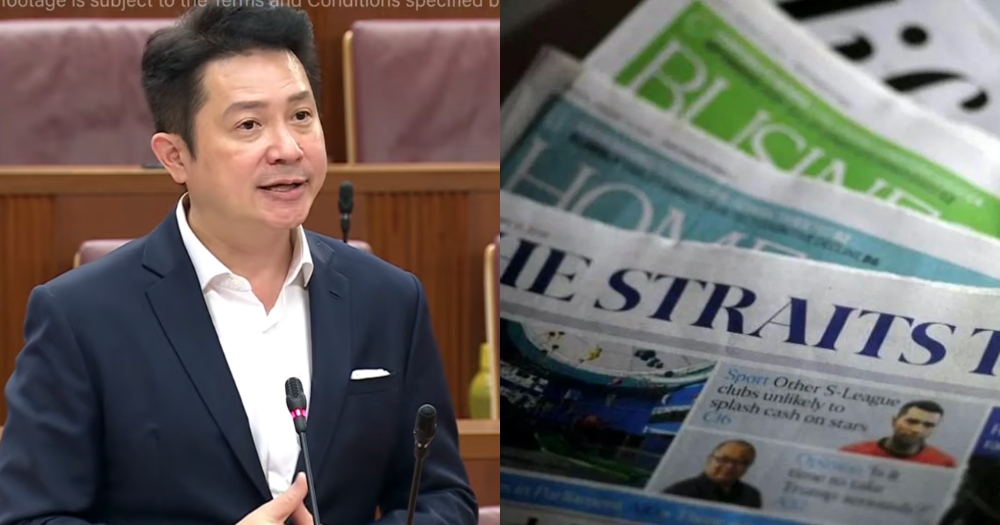
He named The Straits Times, CNA, Lianhe Zaobao and Business Times as Singapore's "trust infrastructure".
February 24, 2026, 03:48 PM

 In the face of rising risks of misinformation generated by Artificial Intelligence (AI), the Singapore government needs to ensure that public service media is adequately funded, said PAP's Kebun Baru Member of Parliament Henry Kwek.
During the Budget debate on Feb. 24, Kwek centred his speech around Prime Minister Lawrence Wong's decisive focus on AI, but also highlighted how the rise of AI can increase the spread of misinformation.
He then specifically named The Straits Times, Lianhe Zaobao, CNA, and The Business Times, calling them "not just Singapore's truth infrastructure, but also our trust infrastructure".
"They stand between our people and a manipulated information space," he said, urging for sustainable government funding so that media professionals find a "compelling future" in them.
"Our media is a source of our trust and is a key voice of Singapore's soft power," he said.
Potential for growth
Nonetheless, Kwek highlighted a number of ways that AI can be harnessed positively if adapted right.
People sense that AI has "matured quickly and is now reshaping their lives in ways that felt theoretical just a year ago," he said.
In light of the government's decision to focus on AI, he raised three areas in which Singapore can "move even faster" in an AI-charged world.
Government can work with leading AI companies
First, the government can build more digital services with the world's leading AI companies' support, said Kwek.
Where government e-services are still largely procured through traditional IT methods today, he proposed making AI-centric development the default, where AI is integral to the design, coding, testing and continuous improvement, rather than voted on.
"Services are faster to build, cheaper to maintain and adaptive, rather than ageing between upgrade cycles," he said.
He further recommended the government co-developing Singapore's AI-centric tech stack with international tech giants such as Google and Microsoft, who have established AI centres of excellence in Singapore, to "build a sovereign, national AI system".
Encourage AI-centric development
Next, Kwek posited that Singapore's IT services industry "may not be adopting AI-centric development fast enough", leading to AI strategies "staying on paper".
This is not a talent problem, he said, proposing a "phased mandate".
"Government IT contracts should progressively require AI-centric development method. New projects first, legacy contracts given longer leeway, and a clear three to five year transition pathway."
This would work similarly to the Building Information Modelling (BIM) adoption in the construction industry, he added, which has "transformed it".
"When the Singapore government becomes the driver of demand, industry follows," Kwek said.
Support for SMEs
Lastly, he suggested greater differentiation of Singapore's SME support when it comes to AI, including the government opening innovation grants to tech-capable SMEs in addition to larger companies.
SMEs that need help adopting AI should also be actively assisted by the government in onboarding, he added.
"Some will argue that the AI levels the playing field against Singapore. In a narrow sense, they are right," Kwek said.
"AI-centric development does not erode this advantage, it amplifies them on trust.
In the AI-centric world, where AI agents transact and AI systems make decisions, trust becomes the most precious commodity in digital economy."
Top images via MDDI/YouTube & X