News

SM Lee launches The Albatross File exhibition, says S'pore independence 'was & still is a miracle'
History has its eyes on you.
December 07, 2025, 01:04 PM
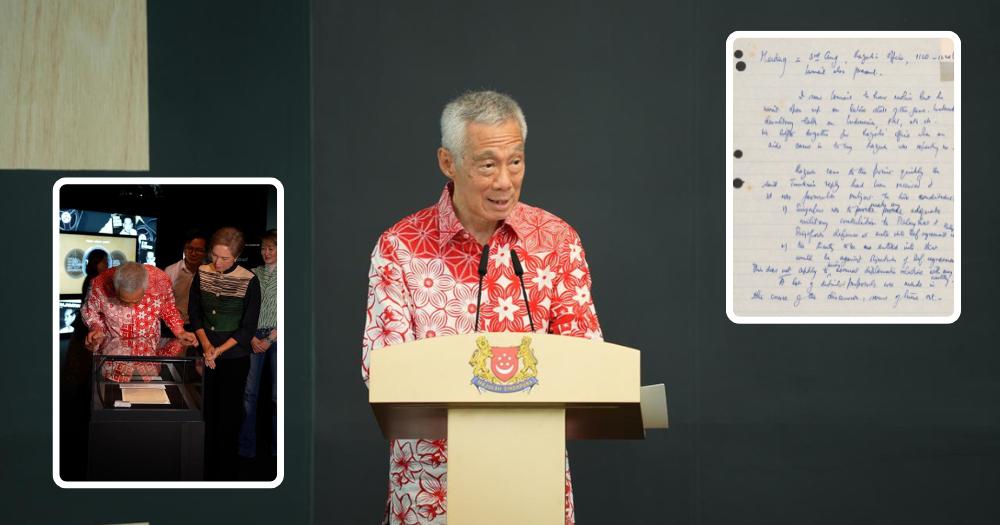


Speaking at the launch of the Albatross Files exhibition and book, Senior Minister Lee Hsien Loong shared that former deputy prime minister Goh Keng Swee was intent on the singular goal of Singapore and Malaysia going their separate ways.
This was something the founding father and former prime minister, Lee Kuan Yew, only discovered in 1994, when he was writing his memoirs.
"It was only then that Lee discovered that contrary to his instructions, Goh had from the start gone for a clean break, and never tried for the looser federation which Lee preferred," SM Lee shared.
SM Lee added that Goh was convinced the merger was "doomed", thus pressing for separation when negotiating with Abdul Razak Hussein, whom Lee Kuan Yew referred to as Tun Razak, the former prime minister of Malaysia.
The Albatross File consists of documents that capture pivotal moments in Singapore's political history, highlighting internal deliberations, diplomatic communications, and the decisions made in the lead-up to independence.
It was later transferred to the National Archives in 1996, and has been preserved in controlled conditions for almost 30 years.
"The Albatross File gives a vivid sense of what happened – a dramatic, blow-by-blow record of how Singapore came to separate from Malaysia," SM Lee said.
Key players
SM Lee said that the four leaders were key to the separation: Tunku Abdul Rahman and his deputy, Abdul Razak, on the Malaysian side, and Lee Kuan Yew and Goh on the Singapore side.
Described by his father as a "decisive" man, SM Lee said that if the Tunku had not decided on the separation early and remained firm in the decision, it would not have happened.
In contrast, Abdul Razak would often change his mind but, fortunately, had gotten along with Goh, having known each other since their student days in London.
"That basic trust between key figures on both sides, despite their deep political differences, enabled a peaceful Separation," said SM Lee.
Goh, on the other hand, was referred to as the "architect of Separation" by another founding leader, E.W. Barker.
Goh's words, according to SM Lee, were:
"I'd had enough of Malaysia. I just wanted to get out. I could see no future in it, the political cost was dreadful and the economic benefits, well, didn't exist. So it was an exercise in futility... it was a project that should be abandoned once you saw that it was worthless."
SM Lee praised Goh, who was "intent" on separation, for handling the negotiations "brilliantly", feeding on his Malaysian counterparts' desire to get Singapore out and avoiding what he considered "distractions" like the possibility of a looser federation.
For Lee Kuan Yew, separation was not the preferred outcome, but he supported Goh in negotiations, said SM Lee.
Lee Kuan Yew went on to persuade all his ministers to sign the Separation Agreement, thereby avoiding a split in the Cabinet.
"At the strategic level, it was the political pressure that Lee orchestrated, the international stature that he had built up, and the courage and leadership that he showed, which compelled the Tunku to let Singapore go.
Had Lee shown any signs of being afraid, or being willing to bend, we would have been rolled over."
Lessons learned
From their time in Malaysia, SM Lee said there was one important lesson they learned:
"Trust in government, and in the political leadership in particular, is founded on the people knowing their leaders will always have their backs."
SM Lee added that Singapore's founding leaders won the right to govern as Singaporeans were convinced that Lee Kuan Yew and his team "could not be intimidated into compromising Singapore's interests".
"His successors have not forgotten this lesson. No Singapore PM has ever allowed any force or power, whether foreign or domestic, to intimidate us into compromising our national interest or sovereignty," he said.
Another lesson learned was to never take racial and religious harmony for granted.
"We separated from Malaysia because of identity politics based on race and religion. We will not allow race or religion to break up Singapore, ever."
Reflecting on the separation, SM Lee noted that at the time, "it was far from obvious that Singapore should be independent", despite it now seeming like a move that was "inevitable and right".
"For those who lived through those times, each step was uncertain, each negotiation harrowing, each decision wrenching. Neither our founding leaders nor the people they led could be certain Singapore would survive, let alone thrive, as an independent island-nation"
"You will realise it was hardly foreordained", SM Lee said. "It was − and still is – a miracle."
What to expect
SM Lee encouraged Singaporeans young and old to visit the the Albatross File exhibition.
The Albatross File, consisting of original papers, handwritten notes, and confidential Cabinet documents, will be displayed to the public at the National Library Building.
These documents were kept by Goh between 1964 and 1965.
For a period, the file was lost, before it was found in a Ministry of Defence storeroom in the early 1980s, said SM Lee.
When SM Lee was Prime Minister, he decided to declassify and publish the Albatross File.
Members of the public can access original documents detailing the decisions and negotiations that led to Singapore's separation from Malaysia in 1965.
Visitors to the exhibition will see original artefacts such as handwritten notes between Goh and the founding prime minister Lee Kuan Yew, Cabinet papers discussing policy deliberations, and first-person narratives of the founding fathers and others involved.
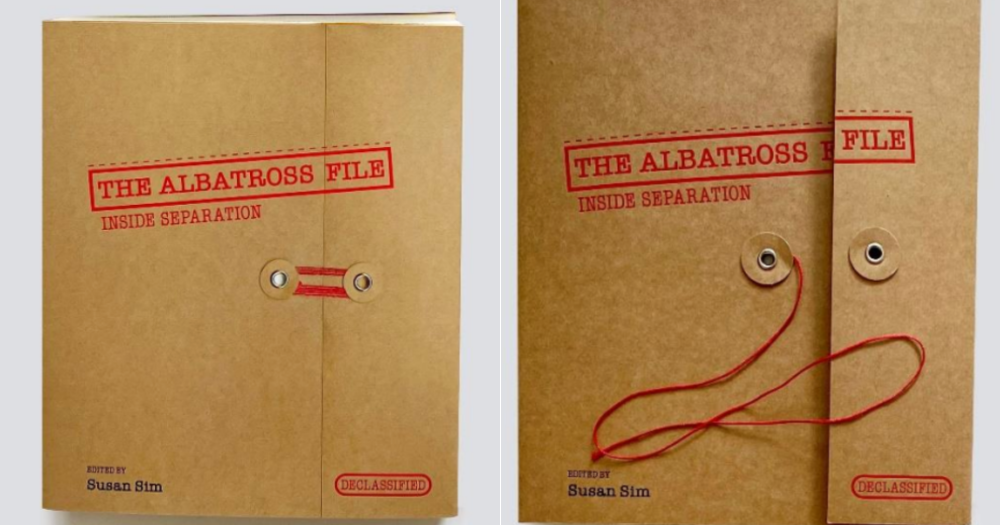
A new book titled The Albatross File was launched in conjunction with the exhibition.
 Photos via NLB & MDDI
Spanning 488 pages, the book is organised into three parts:
- Historical introductions by Professor Tan Tai Yong and Professor Albert Lau, who provide context to the events leading to the Separation.
- Primary documents: 23 declassified papers from the Albatross File, cross-referenced with contemporaneous international records.
- Oral histories: Dramatic firsthand accounts from Goh Keng Swee, Lee Kuan Yew and his wife Kwa Geok Choo, presented to the public for the first time.
"It is a history well-worth publishing," SM Lee said.
Members of the public can book tickets to the exhibition for free on a first-come, first-served basis.
The experience would take about 60 to 90 minutes and is recommended for visitors aged 10 and above.
Book your tickets here.
Top photos via Mothership & MDDI & NLB