News

Hougang back lane shortcut closure: Residents hope 'kampung spirit' prevails or govt steps in
History.
December 09, 2025, 02:46 PM


In late October 2025, a back lane in an Hougang private housing estate was suddenly fenced off.
It had been used as a shortcut by the public for decades to reach the main road.
Pedestrians in Robey Crescent and Poh Huat estates were left scratching their heads in frustration.
In response, a group of homeowners in Robey Crescent, some of whom have lived there since the mid-1980s, are calling for access to the back lane to be restored.
They are hoping that communal spirit will prevail, given the area's historical precedence.
Memories of community
The affected back lane is located behind a row of houses at Robey Crescent, namely, units 10A to F.
One resident, Serene Chua, 74, has lived at 10M Robey Crescent, across the road from 10A to F, since 1986.
Her memories of the estate, the back lane and the adjacent canal revolved around two key figures: The original developer, the late Koh Peng Hai, and the estate’s former Member of Parliament (MP), Lau Teik Soon, who both imbued the estate with a strong sense of togetherness.
Chua is the original owner who bought her house directly from the late Koh, whom she described as a "community man".
According to Chua, the late Koh resided at Robey Crescent as well.
Searches online showed that Koh was a leader of the Teochew Poit Ip Huay Kuan and the Upper Serangoon Citizens' Consultative Committee.
He was conferred the Public Service Star (Bar) in 1992.
He passed away in 2002.
Kampung spirt
Chua recalled that Koh had handed her a pair of his house keys so that she could pass through his house to reach the main road, instead of having to go the long way.
In the early days, there were no shortcuts as the back lane had not been built and the estate was surrounded by thick vegetation.
By the time one got to the main road, their shoes would be soiled, Chua recalled.
To her, Koh's small gesture spoke volumes about his generosity and his sense of community.
Lau, the former MP, had also added to the estate's 'kampung' spirit via his proactive actions in helping residents.
Back then, floods were also a recurring problem as the canals and drains were "not so proper".
Chua said her entire residence was filled with floodwater on one occasion.
"So, after that, when we approached [Lau], he was very supportive," she recalled.
"That's how the canal was covered up," she explained, going on to suggest that having the canals double as walkways was part of the "long-term plan" during Lau's time.
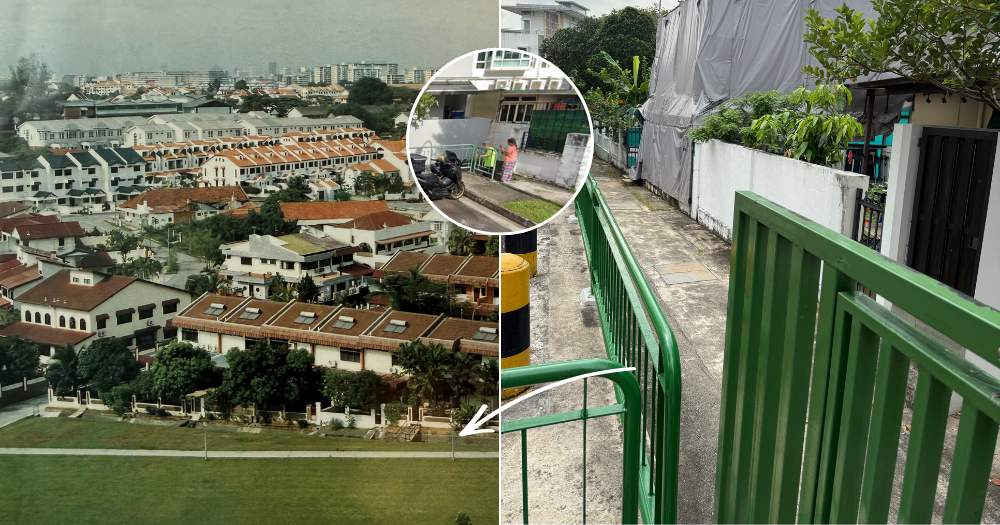
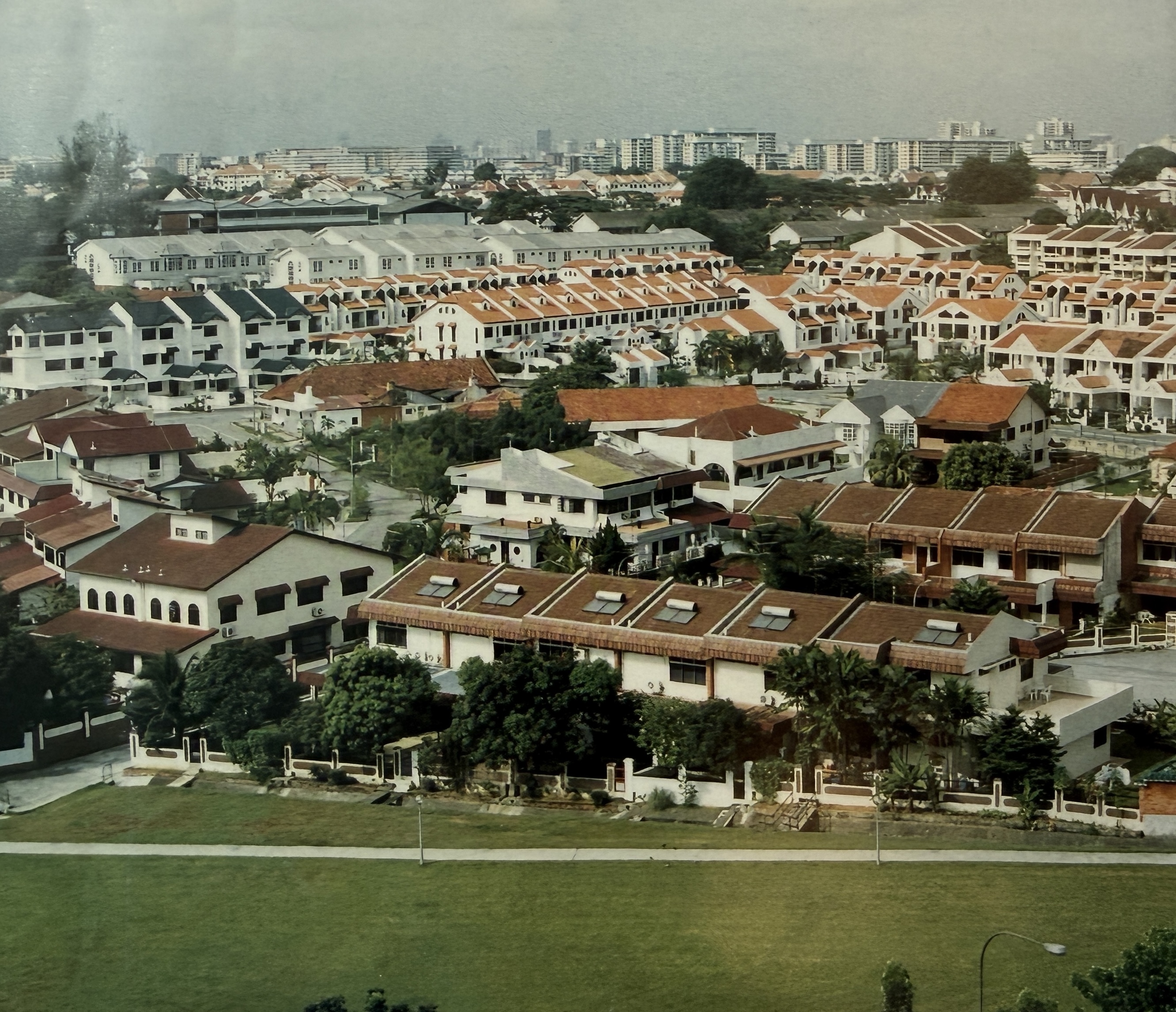 Robey Crescent and the back lane, which used to be an open drain. Photo via Mothership, from the URA's "Hougang Planning Area: Planning Report 1995".
Today's kerfuffle
Another resident, Lim Tong Kay, 68, has lived at 10A Robey Crescent since 1993.
He is the third owner of the home and a development consultant with an extensive background in land and development matters.
He dove into historical records and tried to reverse engineer the circumstances that might have led to the kerfuffle today.
According to Lim, citing the 1985 Urban Redevelopment Authority (URA) Master Plan when Robey Crescent was developed, the neighbouring Henley Gardens was still a reserved site.
 The area marked 'R', which stands for ' Reserved Site', is now Henley Gardens. From 1985 URA Master Plan. Screenshot via NAS.
A photo in the "Hougang Planning Area: Planning Report 1995" published by URA showed the estate and the back lane, which was an open drain back then.
Lim surmised that the drain must have been left as a drainage reserve, as was required by the government then, which was why it was not part of the residents' lots.
Notably, a concrete path could be seen in the photo cutting across an open field, where Henley Garden now sits.
Then, in 1996, a tender for the land was put up, and it eventually went to Yeo Hiap Seng Limited for the development of Henley Gardens, Lim said, referring to Housing and Development Board (HDB) records.
Lim claimed, based on recollection, that the Henley Garden developers paved over the Robey Crescent drain after they damaged it, and that was how the back lane of today was born.
This might have been around 2001, he shared.
Pitch to buy back lane
So, what triggered the sudden closure of the back lane after so many decades?
10C Robey Crescent is currently under construction, and the long-time residents theorised that its new owner was approached to buy the back lane land.
The new owner declined, and this may have led to the back lane closure, they surmised.
Mothership understands that the current owner of the back lane is a descendent of the late Koh.
On property records, the land is owned by a real estate development company, Island Chartered.
Mothership also understands that late Koh's family resides at one of the units along Robey Crescent.
When Mothership previously approached the unit, a man directed media queries to Island Chartered's office number and pointed out that he, too, was affected by the back lane closure.
Another resident, known as Won, 75, who has lived in 10B Robey Crescent since 1985, revealed that the homeowners residing adjacent to the back lane were previously approached to purchase the land back in 2013.
This was triggered by a sale that took place in a similar back lane behind 10M Robey Crescent and its neighbouring units.
Chua said she and her neighbours decided to buy the alley behind their houses for safety reasons.
The asking price was S$1,000 psf, but was later negotiated down to S$210 psf.
However, for Lim and Won, the public utility of the back lane far outweighed the value of it under private ownership.
"So, nobody wanted to buy," Won remarked.
Restoring access
When approached by the residents, the Land Transport Authority (LTA) responded by saying that the installation of the back lane fences did not infringe planning requirements, according to the Singapore Land Authority.
LTA recommended residents find alternative routes.
The current detour involves extra flights of stairs, which Won pointed out was slippery when wet and had no handrails, thereby posing a hazard to the elderly.
But the was apparently always a way.
Lim opined that a concrete public path from the Robey Crescent estate to the main road had always existed, as seen from the photo in the 1995 URA report.
Provisions should have been made during the Henley Gardens development to ensure that this path continued to exist in some shape or form, he continued.
Instead, Lim posited that this concrete pathway was allowed to be expunged without a similar replacement, leaving residents dependent on the privately-owned back lane and the generosity of its owners for ease of main road access.
"Ultimately, I feel that the government has made an omission," he commented.
With all these in mind, Lim said he hoped that the authorities will now ensure that there is a public path to the main road in the estate.
“The state, having benefitted from maximising the sale price [from selling the Henley Gardens reserved land], should now pay for the drainage reserve used as a main access path for 2,000 residents,” Lim said.
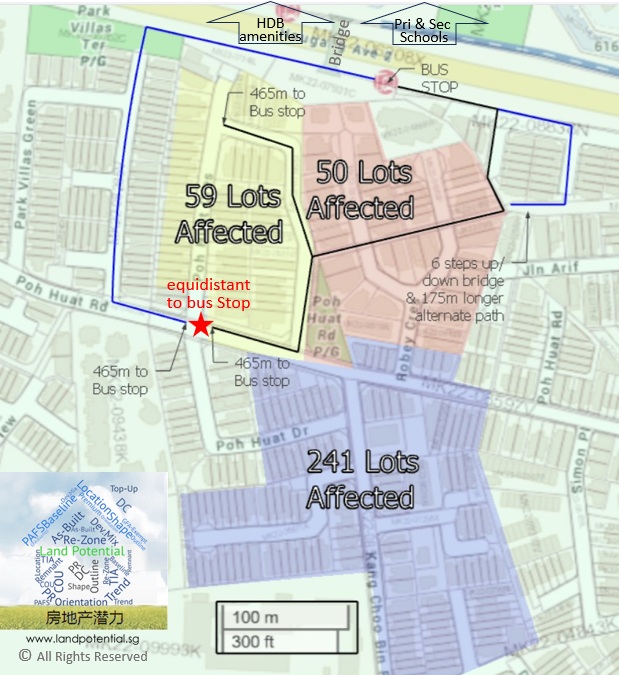 Graphic by Lim.
He estimated that it would be far less resource-intensive and far more cost-effective for the government to take over the back lane land and allow public access, as compared to carrying out works to ensure the detour is safe and accessible for all.
When asked why not consider appealing to the owners to re-open the back lane, seeing that they have provided access for years, Lim said the state stepping in would be the fairest solution for all parties.
On Dec. 1, Lim shared that workers have added a layer of screed along the canal walkway, near the back of his home.
However, he felt that this did not address the accessibility issues posed by the stairs.
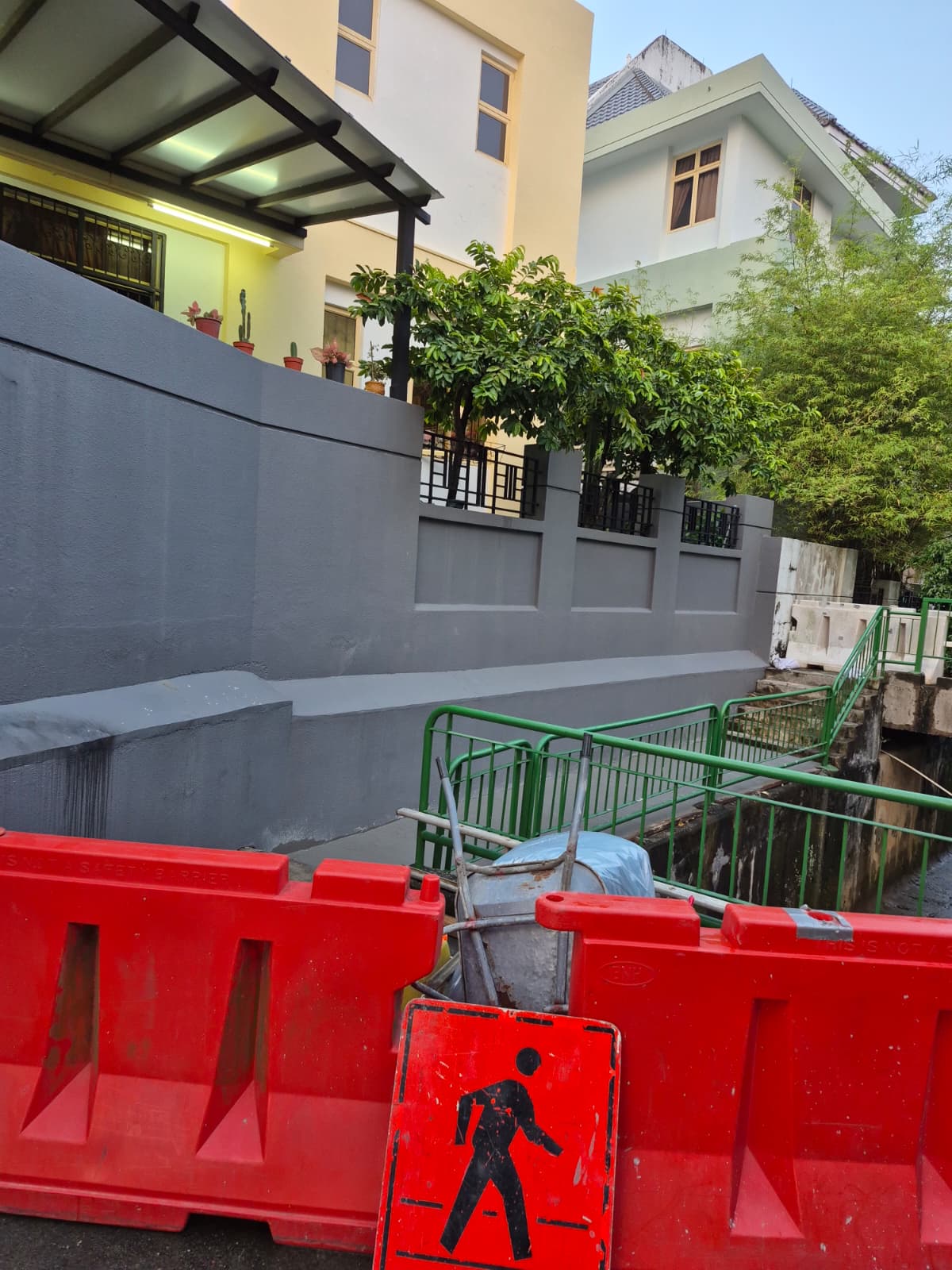 Photo via Lim Tong Kay.
No infringement
According to Daniel Chen, partner at Lee and Lee and a litigation resolution lawyer, it is unlikely that the Henley Gardens developer had infringed on planning requirements or guidelines.
He noted that had they done so, they would not have been issued a Temporary Occupation Period or Certificate of Statutory Completion, which is required before a development can be occupied.
Mothership understands that LTA is still in the midst of working with the relevant stakeholders to explore possible solutions.
'Kampung' spirit
Lim, along with Chua, shared that they decided to speak out because the responses received so far from all parties have yielded no fruitful solution.
Mothership understands that the area's current MP, Kenneth Tiong, had previously written to Island Chartered on Nov. 20 requesting for a meet-up to discuss the matter.
Island Chartered has yet to respond to a request for comments.
Today, Lim estimates that more than 300 households might be affected with the back lane fenced off.
Assuming each household has about four members, and taking into account visitors to the estate, such as regulars at the nearby Chinese temple, the number of people affected could easily reach the thousands, he shared.
Beyond a matter of logistics, for the long-time residents, restoring access to the back lane is about allowing the common good and "kampung spirit" to prevail.
Top image via Mothership, Google Maps