News

S'pore drops '30-by-30' local food production goal, sets new targets for fibre & protein
Revision of targets.
November 04, 2025, 03:03 PM


Singapore will drop its "30-by-30" local food production ambition after six years, shifting instead to more targeted local production goals which focus on specific food types, like fibre and protein.
It will also look to establish more global partnerships in order to ensure food security, complementing Singapore's current food resilience strategies.
These were announced by Minister for Sustainability and the Environment Grace Fu during her speech at the Asia-Pacific Agri-Food Innovation Summit on Nov. 4.
"30-by-30" faced headwinds
Speaking on the "30-by-30" goal, Fu shared that progress has been made in terms of local food production since 2019, when the ambition was first laid out.
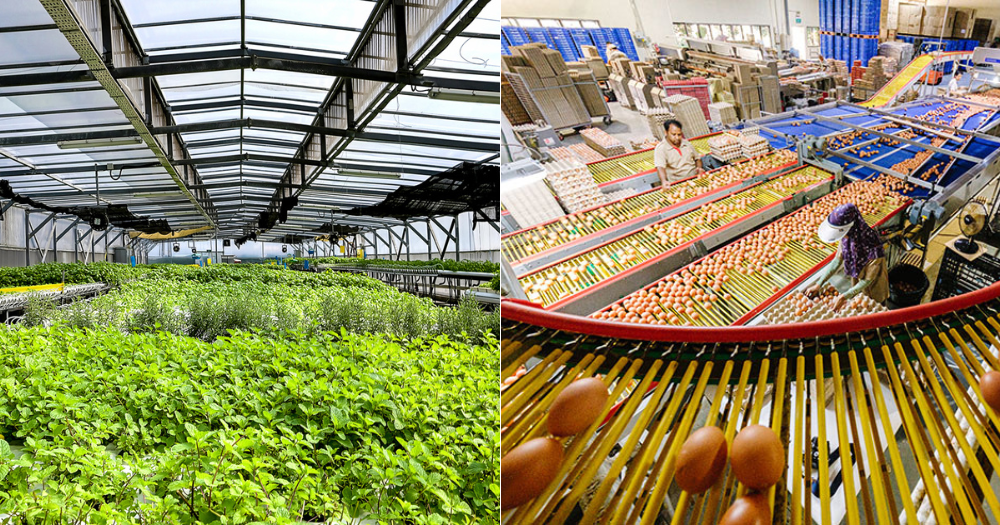
Local production of hen shell eggs and beansprouts now make up more than 30 per cent and 50 per cent respectively of local consumption, while productivity of local vegetables, seafood and eggs farms have also improved.
Despite these, Fu mentioned that there had been some challenges in other areas.
For example, the local agri-food sector has faced headwinds such as supply chain disruptions, inflationary pressures on energy and manpower costs, and a tougher financing environment.
"This has led to delays in farm development and some exits, even as we witnessed new start-ups," Fu said.
The alternative protein industry has also faced challenges in scaling up due to higher production costs and weaker-than-expected consumer acceptance around the world.
"Drawing from our experience over the past five years, we have re-assessed our local production strategy to be more targeted," Fu announced.
Under "30-by-30", Singapore aspired to produce 30 per cent of its nutritional needs locally.
"But this did not mean that we had to produce every food item on our plates."
The minister added: "That would be neither efficient nor possible in land-scarce Singapore. For example, we did not grow rice as it was very land intensive and not feasible to do so in Singapore."
Revised local production goals more targeted
As such, under revised targets, Singapore will aim to produce 20 per cent of the local consumption of fibre, in the form of leafy and fruited vegetables, as well as 30 per cent of protein, in the form of eggs and seafood, by 2035.
"These goals take into account the strengths of our local farming eco-system, and the potential for growth in supply," Fu commented.
The government will take steps to support this new focus on local production by helping local farms manage production costs and fund capability building.
As an example, Fu highlighted that the government is looking into the development of a multi-tenanted facility for agri-food production that could feature plug-and-play farm spaces.
Food resilience "whole-of-society" effort: Fu
The "30-by-30" goal was part of a food resilience concept called "Singapore Food Story", which was conceived of in 2019 and includes two other pillars — import diversification and stockpiling.
These two other pillars will remain a part of Singapore's re-conceptualised food security plan, called "Singapore Food Story 2".
"We will also rely on these pillars to ensure the supply resilience of food types that we do not produce, such as rice and protein such as poultry," Fu shared.
A new pillar — establishing deeper global partnerships — will be added.
Fu explained that these global partnerships are more essential now as supply chains risk fragmentation.
"We will strengthen G to G relations with like-minded countries to safeguard flows of food to Singapore," the minister said, citing Singapore's recent food supply agreements with countries such as New Zealand and Vietnam as examples of this.
Fu wrapped off her announcement by pointing out that food resilience is a "whole-of-society" effort.
As industries actively explore new sources of food and tap on local produce to diversify supply, consumers can also support local farmers by purchasing local produce and dine at food business which use farm-to-table produce, Fu said.
Related story
Top image via Singapore Food Agency, Seng Choon Farm