News

S'pore MRT reliability dips to lowest point since 2020, LTA to add new rail reliability indicators
Metrics on how Singapore compares to other metro systems worldwide will also be added.
November 14, 2025, 12:06 PM


The Land Transport Authority (LTA) will introduce three additional measures of rail reliability in an effort to give commuters a “more complete picture” of MRT performance beyond the Mean Kilometres Between Failure (MKBF) indicator:
- Train Service Delivery
- Train Punctuality
- Passenger Impact of Rail Disruptions
The reports will also be published monthly instead of quarterly, and the new indicators are intended to capture what LTA describes as service consistency and passenger experience.
Metrics on how Singapore compares to other metro systems worldwide, along with the Thomson-East Coast Line (TEL) performance, will also be introduced into the report.
They mark the most significant change to the Rail Reliability Report since its inception in 2016, when reliability was primarily measured through MKBF and the number of service delays exceeding 30 minutes.
Government metrics show high reliability
Under LTA’s reporting framework, MKBF measures the average distance trains travel before encountering a fault that causes a delay of more than five minutes.
Singapore’s MRT network recorded an overall MKBF of 1.67 million train-km for the 12 months ending September 2025, which is above its target of one million train-km.

LTA emphasised that the new indicators aim to move “beyond simply counting train faults”, capturing whether trains are operating as scheduled (Train Service Delivery) and whether they arrive on time (Train Punctuality).
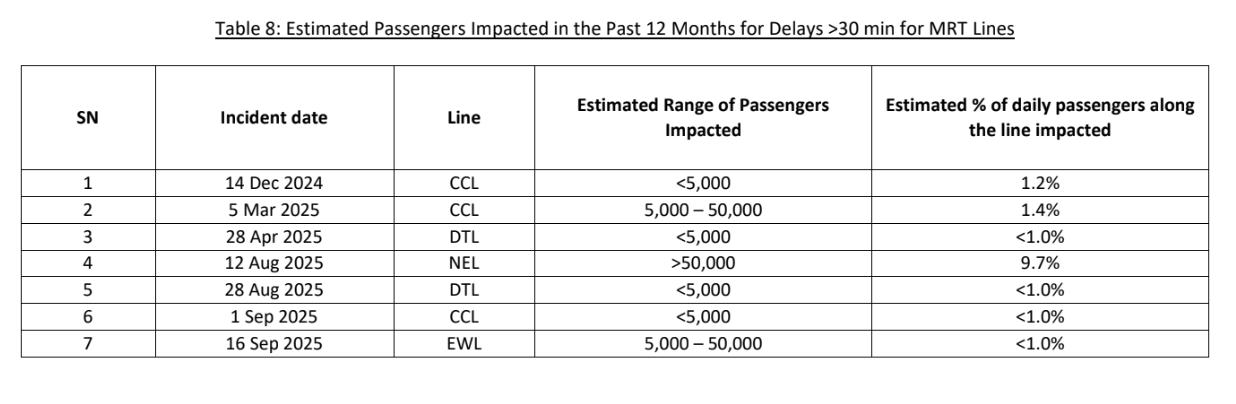
The agency added that severe disruptions will now include estimated passenger impact, offering “a clearer view of service consistency” across the network.
Comparisons with other metros
LTA notes that performance remains comparable to that of metros in cities such as Hong Kong, Paris and Taipei.
Singapore’s MKBF, at 8.06 million car-km outperforms New York, though it sits below Taipei and Hong Kong's figure.

When measured by the number of service delays lasting more than 30 minutes per million train-km, compared to metros in the largest Japanese cities, Singapore is on par with Nagoya Subway and performs better than the Tokyo or Osaka Metro.

Metros in Chinese cities and the Seoul Metro for punctuality are amongst the highest globally, but Singapore outperforms several major Western metros including New York and Melbourne.

MKBF at its lowest point
The MKBF, however, is at its lowest point since 2020.
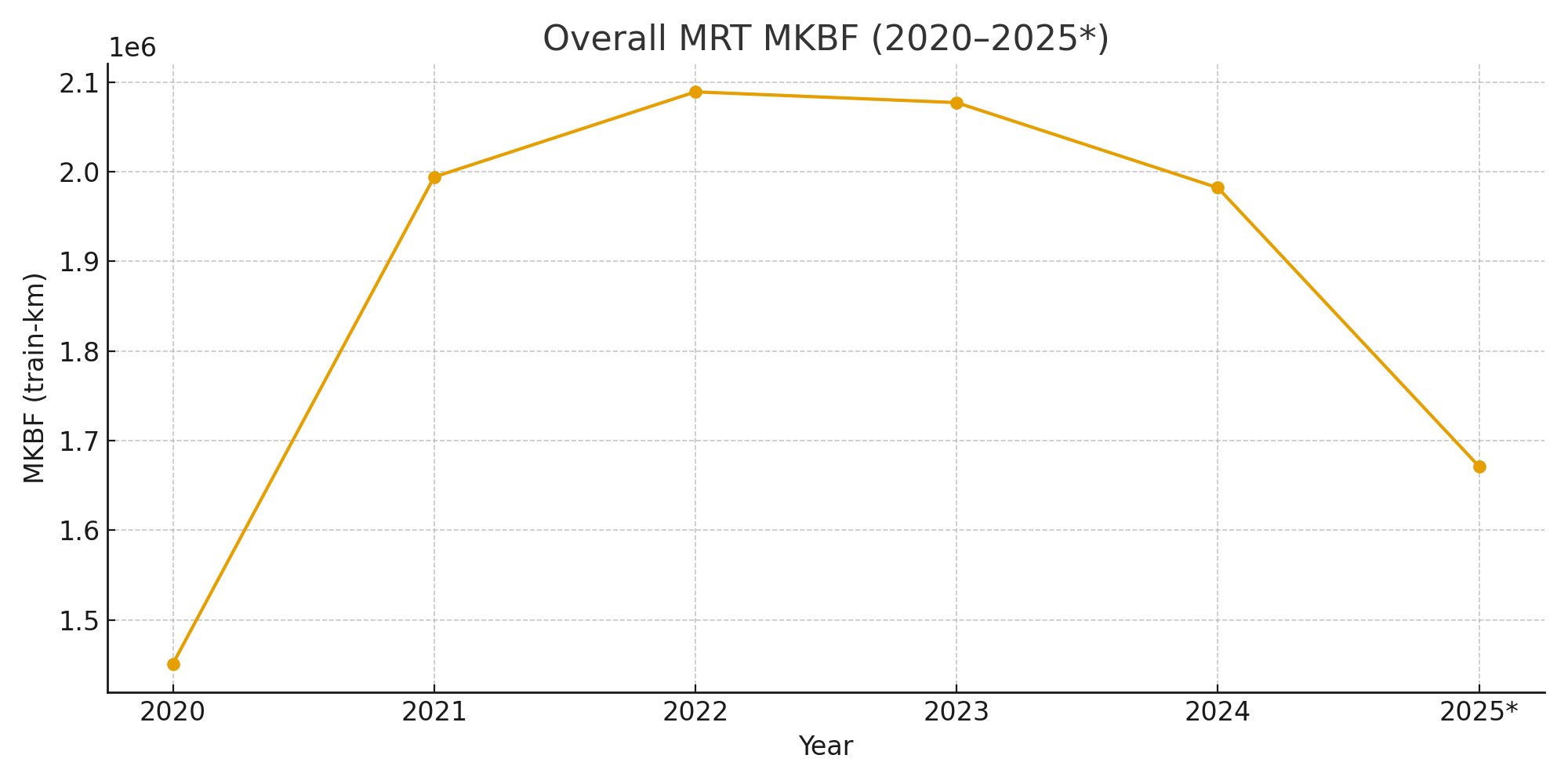
The 12-month average MKBF for the overall MRT network peaked at over two million train-km in late 2024 but fell to 1.67 million by September 2025, its lowest point in nearly 5 years.
Passenger impact of rail disruptions
The severity of disruptions can be measures by its length, number and proportion of passengers affected, said LTA.
LTA will provide an estimate of the number of passengers affected for severe disruptions exceeding 30 minutes.
The estimate is based on the historical average ridership through the affected section during the period of disruption, as ridership data during the actual incident may not fully capture the impact of the incident.
Why was TEL not included?
LTA said that as a newer line, LTA and operators are still working with the Original Equipment Manufacturers (OEMs) of the TEL to resolve issues that emerge as operations are scaled up and stabilised.
However, LTA has commenced sharing MKBF data for TEL to provide commuters a sense of the progress in improving TEL reliability over time.
"This will capture all significant disruptions to the line," LTA said.
LTA will review whether to include other data points for the TEL in subsequent publications, based on whether these other indicators are reflective of the performance of the line.
Passenger-centred reporting
While MKBF is at its lowest since 2020 despite exceeding targets, and the older lines such as NSL and EWL show their MKBF dropping by almost half, TSD and Punctuality remain competitive with major Asian cities.
LTA’s enhancements represent a move towards more passenger-centred reporting, incorporating punctuality and passenger impact into the public dataset.
The new indicators aim to capture commuter experience and are intended to “move beyond counting faults” and improve transparency.
Top images via Google Maps