News

Not 'just cleaning': When someone dies alone at home, who cleans up their remains?
The smell of death is the smell of balacan.
October 24, 2025, 02:26 PM


When news broke in August about the father and daughter found dead in their Sengkang flat, Singapore reeled.
The discovery was horrific, not just because of the tragedy — two bodies found — but it also peeled back a layer of society.
It revealed the way the vulnerable and neglected can simply disappear in silent deaths.
But what happens when the sirens have faded, the forensic work has been done, and the police pack up and leave?
That is when Rahman Razali and his company step in.
The accidental cleaner
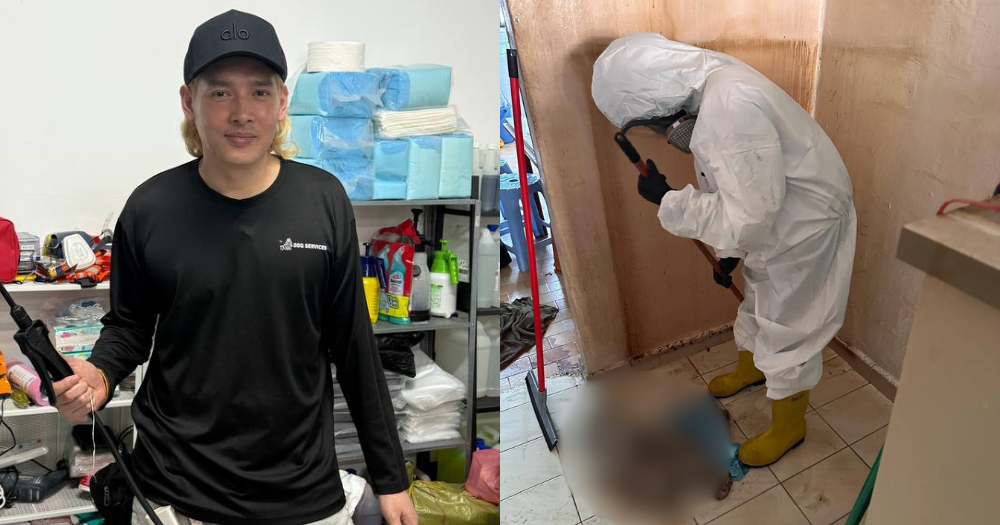
Rahman Razali’s company, DDQ Services, provides trauma cleaning and crime scene cleanup services.
A slim man with bleached blond hair and an easy-going disposition, he looks like he'd be more at ease with a surfboard than a bucket of chemicals.
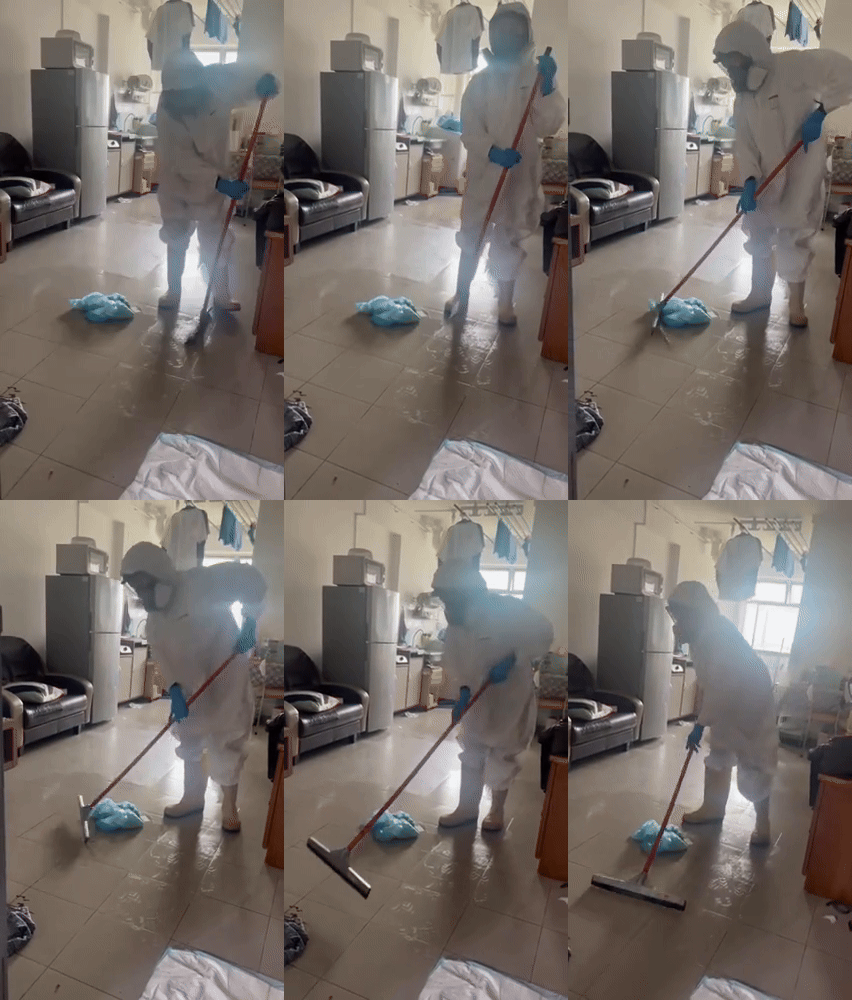 Vid courtesy of DDQ.
But Rahman has been in the business for close to 13 years.
DDQ wasn't initially a trauma cleaning business. When Rahman first started it, it was a disinfection service.
Fogging offices, sanitising kitchens and removing mould from walls were the things that he commonly dealt with.
It was honest grease work, nothing like what he would soon come to encounter.
The business of death
One day, Rahman received a call.
Someone needed help disinfecting their late aunt’s house.
Thinking that this was nothing out of the ordinary, Rahman accepted.
He only realised that this wasn’t the case when he arrived on the scene.
“I still remember, I saw the house, which is at the corner… And then I spotted police tape. So when I saw that, I knew something was wrong already.”
He and his crew arrived in flimsy disposable raincoats, the sort that you could buy for cheap at any supermarket. They lacked the proper equipment, attire, and chemicals for the job.
When he got back home to his wife on that fateful day, with the smell from the scene still lingering on his shirt, he told her, never again.
But he soon received another case. And another. And another.
Even though he wanted to stop each time, he soon realised that there was an opportunity since there weren't many people offering such services in Singapore.
Eventually, his wife told him:
“Maybe this is your calling.”
By the time DDQ’s name started circulating among police contacts and town councils, Rahman had already learnt the rhythms of death — how to recognise the stages of decomposition by smell, how fluids seep through tiles, how the air changes when a room has held a body too long.
He invested in proper suits, respirators, and gloves. He read up on enzyme cleaners and deodorisers.
“If I was going to do this,” he said, “I had to do it right.”
The work itself
Most people think trauma cleaning is just disinfecting, and that all you need are chemicals, gloves, and a strong stomach. Rahman reveals that these weren't all there was to it.
“Just clean, just get rid of the dirt, the grime, the dust, that’s it. It's more than that. It involves, I will say, restoring. It involves your emotions. It involves your spirituality as well.”
Once, he was called to a retired teacher’s home.
The woman had died alone, leaving behind only dozens and dozens of scrawls and notes pasted everywhere on the walls, doors and piano:
"God is watching you."
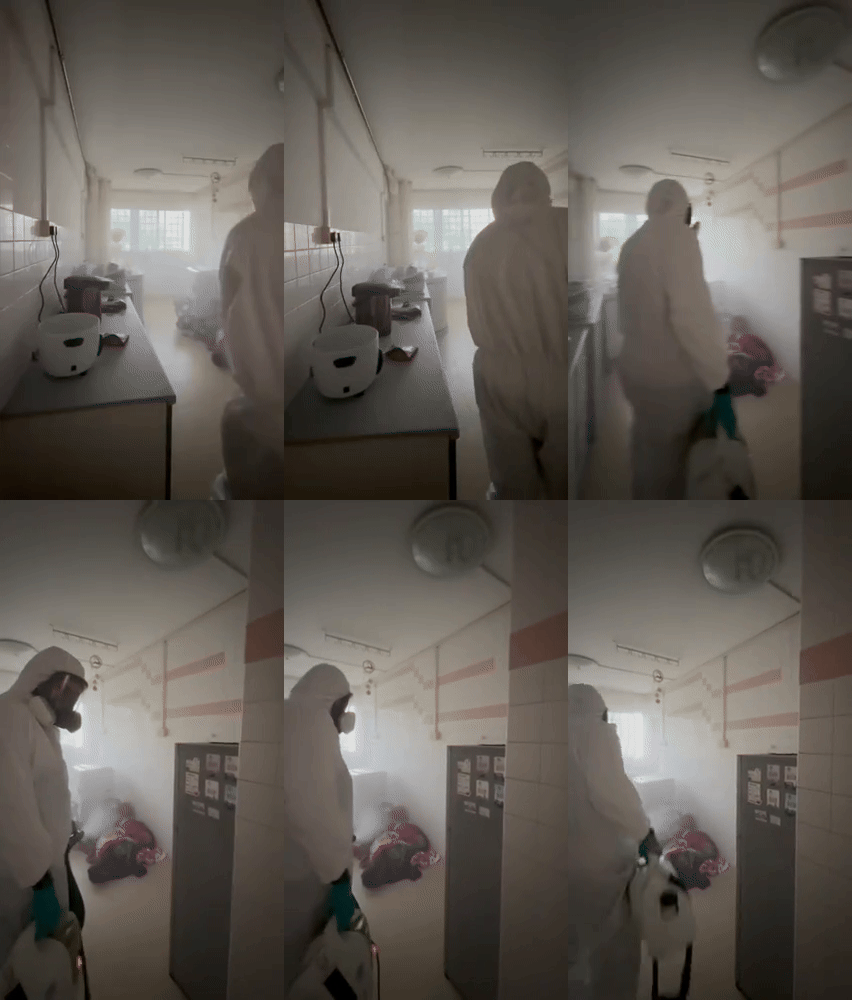 Vid courtesy of DDQ
Another case stays with him even now.
It was the eve of Raya, and Rahman had been called down to a unit that was ankle-deep in water from a kitchen leak.
He recalls that as being one of his more challenging cases.
“(There were) maggots swimming all around, with the bodily fluids, water, everything all mixed together.”
In the corner of the sparse room, with just a single mattress and a little stand to hang clothes on, something else had caught his attention.
“I saw a pair of baju kurung, then I saw a pair of new shoes, then the samping and the songkok.”
At this point, Rahman’s eyes had a bit of a sheen to them.
He said he had briefly conversed with the barber that the deceased was a regular of.
“The barber said that he (the deceased) was looking forward to Hari Raya, but he doesn’t know — he has nowhere to go for visiting.”
“You know that he's really looking forward to Hari Raya, but he’s got no one to meet, no one to visit.”
None had reached out before it was too late.
It had struck Rahman then that death really could happen at any time.
The old saying goes that time is precious, and more than anything, the job has taught him to treasure this.
The Sengkang case
In the Sengkang case, the deaths of father and daughter went unnoticed until a neighbour noticed an odour resembling sambal balacan (fermented shrimp paste), and foul-smelling liquids began to seep into the unit below.
Unlike in the kitchen and bathrooms, living rooms and bedrooms often don't have waterproofing.
So when bodies are left untouched for a long time, "liquid will actually seep through slowly, so that's how the neighbours below will be affected".
As to the balacan-like odour, it's the smell of decomposition, Rahman explains. During his very first trauma cleaning case, he'd misattributed it to somebody cooking.
“It comes nose diving right straight at you. One moment you are breathing normal air — and in the next, it’s something else entirely.”
While Rahman did not handle the Sengkang case, he has seen many like it: cases where death simply goes unnoticed until the signs of decomposition alert the living.
He recounts having come across bloody hands traced along the wall, likely from an elderly person who'd fallen and was trying to pull themselves up.
“What I can see is that, even for your neighbours, you don't really know (them) by name, right?” he says. “So when you don't have the communication, when you don't know your neighbour… This sort of thing happens. They end up dying.”
Neighbours play a "critical role", Rahman emphasises.
“I’m not saying be kaypoh, I'm (just) saying that someone who has a good relationship with their neighbours, when something (is) out of the ordinary, they can just call the police for help."
A sacred job
As Rahman and his workers move methodically through room after room, outside, the city continues to bustle.
What Rahman does remains unknown to most in Singapore, and could even be considered “dirty” by some, but he remains steadfast.
“I keep telling myself, it's not really dirty, it's just that you are helping them to restore or to dignify," he says. “It's actually a very sacred job.”
“You are doing something of a service to help someone that is really in need of (it).”
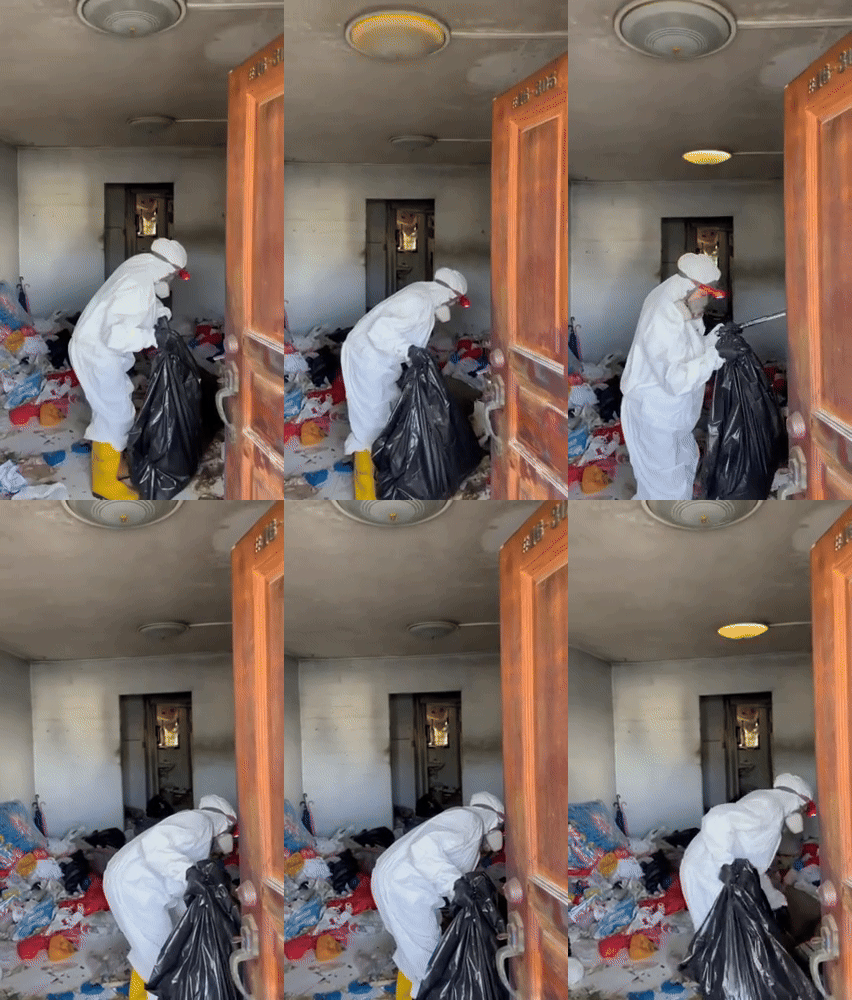 Vid courtesy of DDQ.
There is no glitz or glamour, no applause, but as Rahman’s wife had said all those many years ago, it is a calling.
“(The) one thing that keeps me going is the gratitude that (was) shared with us, knowing that we are able to help (these people) find closure, to help them to restore. I think these are the things that keep us going,” Rahman says.
“It's about giving life, finding closure, that’s trauma cleaning to me.”
Watch more:
@mothershipsg When someone dies alone, Rahman Razali is the one who shows up. This is his story. #tiktoksg #fypsg #sgnews #loneliness ♬ original sound - Mothership
Top photos courtesy of DDQ Services.