News

S’pore has to move beyond just tolerance on race & religion: Eugene Tan
"We have to seek greater understanding of the different races, religions, and cultures, with an appreciation of our diversity."
October 16, 2025, 11:06 AM


Sixty years since its independence, Singapore continues to confront issues of race, religion, and language to build unity amid diversity.
What is Singapore's brand of multiracialism, and how does its people make it work for them?
Eugene Tan, a political analyst and professor of law at Singapore Management University (SMU), seeks to capture the nuances of this ongoing effort in his latest collection of essays, Raising the Nation.
For nearly three decades, Tan has studied how Singapore navigates race, religion, language, and identity, producing about 50 published opinion-editorials and commentaries on these topics now compiled in Raising the Nation.
"I am convinced that Singapore had and has no choice, as a matter of survival and for its prosperity, but to be a truly multiracial nation-state in form and substance," Tan told Mothership.
"It is how we go about living out our multiracial credo has made the difference."
An excerpt from the introduction, "Race, Religion, & Language as Part of Singapore's National Identity", is reproduced here.
By Eugene Tan
Nation-building in Singapore entails that there must be a national civic identity alongside the various ethnic identities.
The former is premised on the commonality of citizenship. That, regardless of how we seek to define ourselves ethnically, citizens of Singapore share a common identity — that of being Singaporeans.
It is as citizens that our rights, interests, and privileges are recognised, given effect to, and protected.
Classifying race
The conventional racial classification of Chinese, Malay, Indian, and Others (CMIO as it is popularly known today) was introduced by the British in their conduct of censuses in the Straits Settlements as early as 1871.
It undoubtedly has impacted the way in which individuals understand their identities. Moreover, culture is regarded by individuals, families, and society as a derivative of race.
Singapore has continued with the classification of the various races. One’s racial affiliation is by virtue of one’s paternal racial ascription and this is recorded in one’s birth certificate as well as the national registration identity card.
Hyphenated identities, the dual combination of the races of one’s parents, are also permitted.
This official designation and organisation of identities serve a myriad of official purposes such as in education, public housing, and national service.
The value of ethnic identity
Although multiracialism is a core value, ethnic identities remain a potent means of political mobilisation and structuring of political life in Singapore.
Removing the CMIO classification is neither feasible nor desirable for Singapore in the foreseeable future.
With the ethnic Chinese comprising about three-quarters of the population, it is not difficult to appreciate why ethnic identities will remain salient and important for many years to come.
Any attempt to reduce the place of ethnic identities will, unsurprisingly, be of grave concern to non-Chinese Singaporeans who would be concerned about whether their identities would be subsumed under the Chinese majority.
Even if that were not the case, another concern is whether their identities would matter less.
Being Singaporean takes precedence
What has defined our multiracialism is the recognition that every citizen has multiple identities — national, racial, religious, linguistic, and cultural, among others.
However, the identity that takes precedence, especially at the governmental and political levels, is that of being a Singapore citizen. The success of our multiracialism must be that even if we have different sub-national (ethnic) identities, we all have one common identity and loyalty as citizens of Singapore.
Ethnicity is a Janus-faced creature in Singapore. It is simultaneously portrayed as a threat and a source of cultural ballast.
On the one hand, its primordial pull with centrifugal tendencies can threaten Singapore’s survival.
On the other hand, ethnicity intrinsically matters, to varying degrees, to every Singaporean, and its importance also evolves through the different life stages. Moreover, its utility lies in its role as a source of socio-cultural and political values.
Multiracialism explicitly accepts pluralism and diversity.
In Singapore, the concern is to ensure a common reflex rather than a differentiated response from each ethnic community in challenging times. This is why nation-building is vital.
A plural society will be torn asunder if the component communities pull in different directions and are at odds with each other, especially during a crisis.
However, this does not mean that uniformity is priced above distinctiveness. An enforced denial of difference does not give due credence that we can be full and equal citizens despite our different ethnic backgrounds and identities.
From tolerance to understanding
Singapore has to move beyond tolerance. As Michael Walzer notes of tolerance in On Toleration (1997): “To tolerate someone is an act of power; to be tolerated is an acceptance of weakness. We should aim at something better than this combination, something beyond toleration, something like mutual respect.”
We have to strive towards an understanding and appreciation of our inherent differences. We have to seek greater understanding of the different races, religions, and cultures, with an appreciation of our diversity.
To be clear, understanding and appreciating our differences do not have to mean acceptance of them.
Only from this can we be confident that the social capital and interracial trust — so vital for multiracialism to thrive — will grow from strength to strength.
In this regard, the knee-jerk reaction of organising cultural bus-tours, wearing each other’s traditional costumes, and consumption of fusion food can only be of limited effect where sustainable multiracialism is concerned.
We must develop within us the commitment to go beyond racial stereotypes and seek a deeper and meaningful understanding of each other’s race, culture, and religion.
We would have attained a higher plane of true multiracialism if our multiracial peace and harmony does not require explanation as though it is an oddity.
Instead, it is when we have fallen short as a society that any dismal state of affairs requires an explanation and soul searching.
A Singaporean-Singapore identity
The development and maturity of a Singaporean-Singapore identity can help reduce the countervailing pulls of race, culture, and religion. Over time, these sub-national identifiers will reduce in importance but will probably not become completely irrelevant.
The ethnic Chinese must also be conscious of their role as the majority ethnic group — their commitment to multiracialism is critical.
Extreme care must also be given to intra-ethnic rivalries, as intra-ethnic outflanking can have negative knock-on effects on the canvassing by other racial groups for their own cultural and political space.
For multiracialism to be a viable conception of managing differences, the imagined boundaries between “us” and “them” have to be reduced. These boundaries may never disappear, but the commonality built in spite of them can provide for sustainable multiracialism.
This is when the Singaporean state has a Singaporean nation where every Singaporean’s multiple identities is grounded on the overarching and defining identity as a citizen of Singapore.
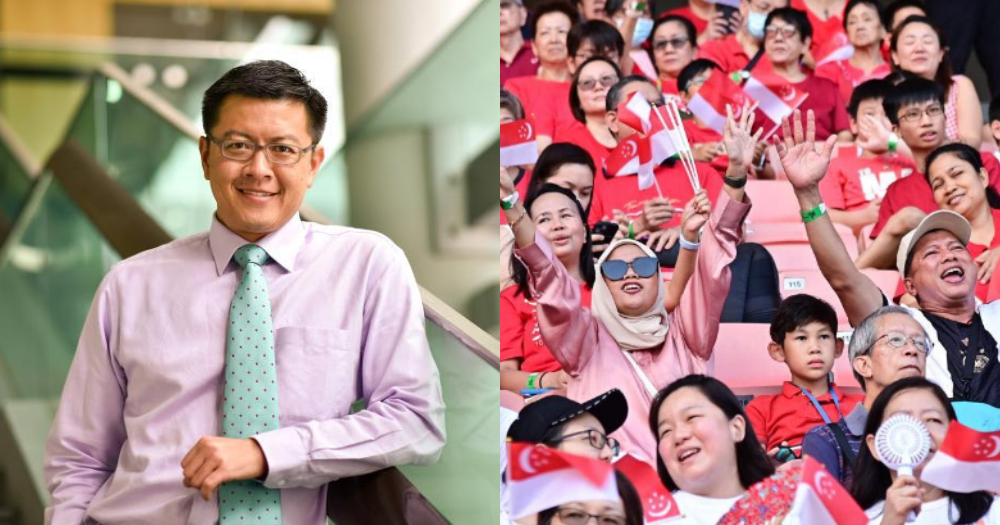
Top images from SMU and People's Association