News

Mandatory jail & caning for etomidate suppliers in S'pore, higher penalties for vaping from Sep. 1
Etomidate will be listed as a Class C drug under the Misuse of Drugs Act on Sep. 1, 2025.
August 28, 2025, 03:00 PM

 From Sep. 1, Kpod substance etomidate will officially be classified as a Class C drug under the Misuse of Drugs Act (MDA), in addition to the Poisons Act (PA) that it is currently listed under.
The new classification, first brought up by Minister for Health Ong Ye Kung on Jul. 20, comes with a slate of enforced penalties for those caught with etomidate-laced e-vaporisers, commercially known as Kpods.
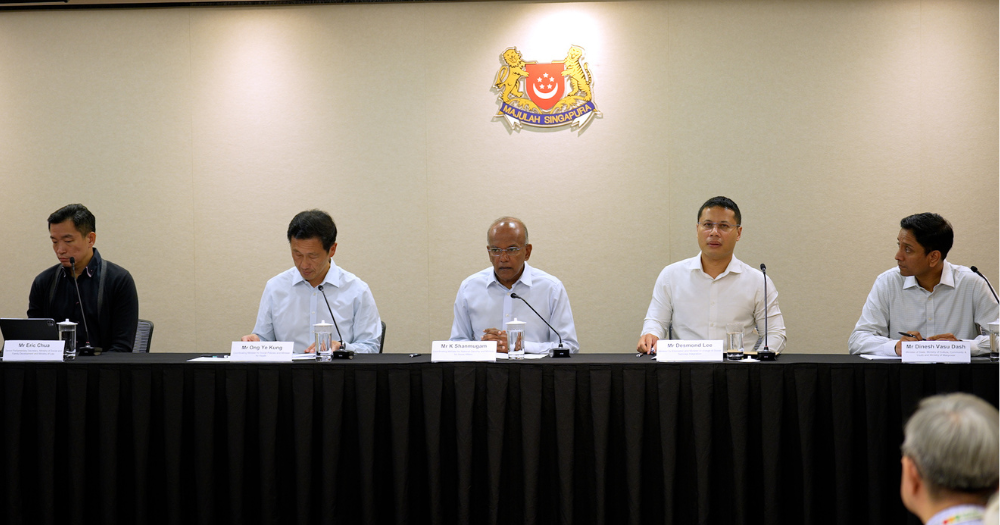
The new measures were announced by a panel of government officials at a press conference on Aug. 28, chaired by Ong, Minister for Home Affairs K Shanmugam, Minister for Education Desmond Lee, Senior Parliamentary Secretary for Social and Family Development Eric Chua and Minister of State for Manpower Dinesh V. Dash.
During the press conference, Ong said the past month and a half was provided to allow sufficient time for vape and etomidate users to give up their habits before the authorities step in.
This comes amidst the government's increased crackdown on the use of vapes and etomidate in recent months.
Penalties for vaping
Individuals caught in possession of vapes from Sep. 1 will face stronger penalties.
First-time offenders will be handed a notice of composition (NOC), or fine without prosecution, of S$500 for individuals under 18, and S$700 for those 18 and above.
Second-time offenders will be required to attend a three-month rehabilitation programme under the Tobacco (Control of Advertisements and Sale) Act (TCASA).
Those who persist in offending after the second strike will face prosecution in court, where they could face a maximum fine of S$2,000.
The new penalties are a step up from the existing NOCs of S$300 for those under 18 and S$500 for those 18 and above, regardless of the number of offences.
Growing prevalence of vaping
One third of individuals who vape in Singapore are under 18 years old, while more than half are under 30, according to MOH.
Vapes have been banned in Singapore since February 2018, as part of the government's longstanding effort to curb tobacco use and nicotine consumption.
However, vapes have more recently become a delivery device via lacing for etomidate and other controlled drugs.
Ong said that there is a worry of vaping becoming a gateway for more serious substance abuse and cigarette use.
Etomidate-laced vapes are known to pose harmful effects on users, including suicidal behaviours, loss of consciousness, disruption of vital bodily functions and the emergence of zombie-like behaviours.
Penalties for etomidate-related offences
Etomidate will be classified a Class C controlled drug from Sep. 1, for an interim period of six months until Feb. 28, 2026, to allow time for the Ministry of Health (MOH) to craft a new legislation against vapes and etomidate.
In the meantime, the PA, TCASA and MDA will be used to penalise etomidate users.
During his announcement on Jul. 20, Ong said that one in three randomly sampled vapes from vape users in Singapore were found to be etomidate-laced.
This figure has since fallen to 12 per cent, he told the media on Aug. 28, giving the government reason to believe that warnings about the incoming severe consequences of vaping have taken root.
About 80 per cent of etomidate abusers in Singapore are under 30 years old, Ong added.
Those found abusing or supplying etomidate will face harsher penalties under the new law.
Rehabilitation & supervision for abusers
Etomidate abuse includes the use of etomidate-laced vapes and those who test positive for etomidate, according to MOH and the Ministry of Home Affairs (MHA).
First-time offenders of etomidate abuse will be handed an NOC of S$500 for those under 18, and S$700 for those 18 and above. They will also be made to attend rehabilitation at the Institute of Mental Health (IMH) and selected social services agencies like the Singapore Anti-Narcotics Association for up to six months under the PA.
Second-time offenders will be arrested and subsequently receive mandatory supervision for six months under the MDA, which includes drug testing and rehabilitation.
Those who fail to complete the rehabilitation programme will be prosecuted in court.
From the third offence, those 16 and above will be admitted to the Drug Rehabilitation Centre and receive detention and rehabilitation.
All offenders, regardless of age, will also receive mandatory supervision, including drug testing for 12 months under the MDA.
This is an increase from the current penalty of a S$300 NOC for those under 18 and S$500 for those 18 and above, or prosecution under the PA and a fine of up to S$10,000, two years' imprisonment, or both.
Ong said rehabilitation has been used in lieu of prosecution to give vape users "a second chance", taking into account the young ages of most of them in Singapore.
Jail & caning for suppliers
On the other hand, suppliers of etomidate will be subjected to much more severe penalties.
Those involved in the import of etomidate will face a mandatory jail term of at least three years and five strokes of the cane. This can go up to 20 years' imprisonment and 15 strokes of the cane.
Offenders involved in the sale and distribution of etomidate will face between two and 10 years' imprisonment, with between two and five strokes of the cane.
Under existing laws, offenders found supplying etomidate can be prosecuted in court under the PA and face a fine of up to S$10,000, two years' jail, or both.
Current first-time offenders may also be prosecuted under the TCASA and be fined up to S$10,000, jailed up to six months or both. Repeat offenders could face a fine of up to S$20,000, imprisonment for up to one year, or both.
Foreigners may face deportation
Foreigners who visit or live in Singapore will be subjected to the same laws.
Those found in possession of vapes will have their vapes seized and be issued an NOC, while repeat offenders may face deportation.
Foreigners on a long-term pass or immigration facility, such as an Employment Pass, S Pass, Work Permit, Student’s Pass, Long-Term Visit Pass or Dependant’s Pass, may have their passes revoked after three strikes.
They may also be banned from future entries into Singapore.
Meanwhile, those caught with etomidate-laced vapes or who test positive for etomidate may have their pass revoked, be deported and banned from re-entering Singapore after the first offence.
Appeals will be considered on a case-by-case basis, Shanmugam added.
Enforcement in specific settings
There will also be increased enforcement against etomidate abuse in specific settings.
Currently, nationwide enforcement patrols have been increased across various public boards, including by the National Parks Board, National Environment Agency (NEA), Singapore Police Force (SPF) and HSA in public spaces and by public transport operators on buses and trains.
The Immigration and Checkpoints Authority (ICA) has also increased checks at air, land and sea checkpoints against smuggling of vapes.
The Singapore Armed Forces (SAF) and Home Team (HT) have also stepped up checks on their personnel.
MOM said that a number of their community and worksite enforcement officers will be seconded to HSA to support enforcement efforts for the interim period of six months, after which they will return to MOM.
Educational institutions
The use of vapes and etomidate in schools, including institutes of higher learning (IHL), will result in individuals being caught and reported to the authorities.
Schools will also increase disciplinary measures against these offences, including detention, suspension, caning for boys, conduct grade adjustment and counselling.
Students in IHLs found with vapes and etomidate will have their privileges withdrawn, including overseas exchange programmes, scholarships, and eviction from university hostels.
Repeat offenders may also face suspension or expulsion.
Addressing recent incidents of school students being exposed to vape sellers outside of their schools, Lee said MOE's aim is to heighten their knowledge on the risks of vaping and consuming etomidate, and to enable them to say no to external influence.
Preventive education on vaping and school regulations is now covered in common and mandatory orientation modules and outreach talks, he added.
There will also be increased outreach to parents of students, he said, through open communication about updates on preventive measures.
Schools may also request drug detection equipment from MOE, including saliva test kits capable of detecting the presence of nicotine.
Public service & uniformed services
Public officers who use, possess or are found supplying and trafficking vapes will be issued fines, demotions and dismissal from service, in line with the national framework.
Those in uniformed services, including Home Team personnel, will also face similar punishments, and National Servicemen may face detention.
SAF personnel will be dealt with under military law, a Mindef spokesperson said.
This may include fines, detention in the Detention Barracks, or even a discharge from service.
SAF personnel found with vapes and etomidate will also have to undergo a mandatory rehabilitation programme.
Programmes to quit
The government has rolled out a number of programmes aimed at helping individuals quit vaping.
Among these is the QuitVape programme, where those using etomidate-laced vapes can seek help from IMH, WE CARE Community Services, the Singapore Anti-Narcotics Association and other community services.
Red vape disposal bins have also been placed in designated areas around Singapore to encourage users to dispose of their vapes voluntarily, with no penalties against them.
The Health Promotion Board (HPB) also rolled out a "Don't Toy With Your Life" campaign in June this year to educate youths on the dangers of vaping, as well as provide support to quit.
Top image by Reuben Nathan/Mothership