News

Nvidia & AMD agree to pay 15% of China AI chip sales revenue to US government
The U.S. government could receive more than US$2 billion with the agreement.
August 11, 2025, 01:37 PM


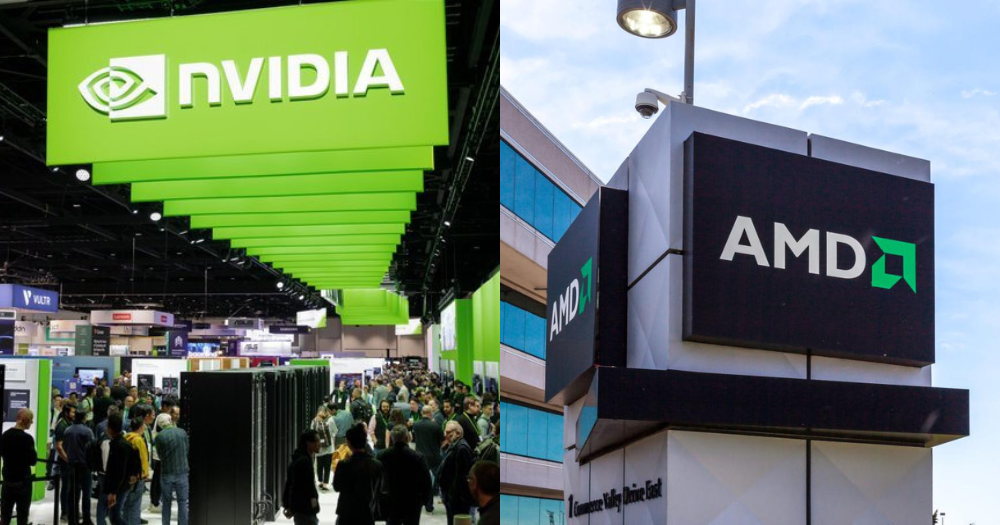
Nvidia and Advanced Micro Devices (AMD) have agreed to pay the United States government 15 per cent of their revenue from advanced computer chip sales in China.
Nvidia and AMD are both American tech companies.
Part of agreement to obtain export licenses
Citing a U.S. official and others familiar with the situation, Financial Times (FT) reported that the two companies were granted export licences for the Chinese market last week, on the condition that they agreed to pay 15 per cent of their revenue from China chip sales to the U.S. government.
Nvidia would pay 15 per cent of their revenue from the sale of their H20 chips, which are used in artificial intelligence (AI) applications, while AMD will pay the same percentage from the sale of their MI308 chips in China.
Trump previously banned the sale of Nvidia's H20 chips
U.S. President Donald Trump's administration previously halted sales of Nvidia's H20 chips in April.
According to The New York Times (NYT), the reason for the ban is concerns that the chips could allow China to catch up with the U.S. in terms of the development of AI.
However, Trump reversed his decision and gave the green light to Nvidia in July after a meeting with Nvidia chief executive Jensen Huang, allowing them to sell the H20 chips to China again.
In spite of Trump's green light, the U.S. Bureau of Industry and Security (BIS), which is the section of the U.S. commerce department that runs export controls, had not issued any export licences to Nvidia, FT reported.
Huang raised the issue to Trump during their recent meeting on Aug. 6.
Following the meeting, the commerce department began issuing H20 export licences on Aug. 8.
The administration has also begun issuing licences for AMD's China chip, said the U.S. official.
Concerns over selling to China
According to FT, Nvidia and Trump have been facing criticism over selling the H20 chip to China.
Matt Pottinger, a China expert who was deputy national security adviser in Trump's first term, along with 19 other security experts, wrote a letter to commerce secretary Howard Lutnick, urging the U.S. not to issue any H20 licences.
They claimed that the H20 chip was a "potent accelerator of China's frontier AI capabilities" and would aid the Chinese military.
Their concerns are also echoed by BIS officials, according to people familiar with the situation.
However, Nvidia dismissed the claims and stated that China could not use the chips for military purposes.
Additionally, Reuters reported that the U.S. official stated that the Trump administration did not believe that the sale of such chips would compromise the country's national security.
It is still unclear as to how or when the agreement will be implemented but the administration would be in compliance with the law, said the U.S. official.
Nvidia made a statement
According to export control experts, as reported in FT, this is the first time U.S. companies have agreed to pay a portion of their revenues to obtain export licences.
When asked if Nvidia had agreed to paying the U.S. government 15 per cent of its China chip sale revenue, a Nvidia spokesperson stated that they "follow rules the U.S. government sets for [their] participation in worldwide markets".
"While we haven't shipped to H20 to China for months, we hope export control rules will let America compete in China and worldwide," he added.
U.S. government could receive more than US$2 billion with the agreement
Citing Bernstein researchers, NYT reported that by the end of 2025, Nvidia was expected to sell more than US$15 billion (around S$19.2 billion) worth of its H20 chip to China, while AMD was expected to sell US$800 million (around S$1 billion).
With the agreement, this would give the U.S. government about US$2 billion (around S$2.5 billion).
According to FT, the Trump administration has yet to determine how they will be using the money.
Top photos via NVIDIA Asia Pacific/Facebook, AMD/Facebook