


News

After separation, many said that S'pore wouldn't make it. How did we survive?
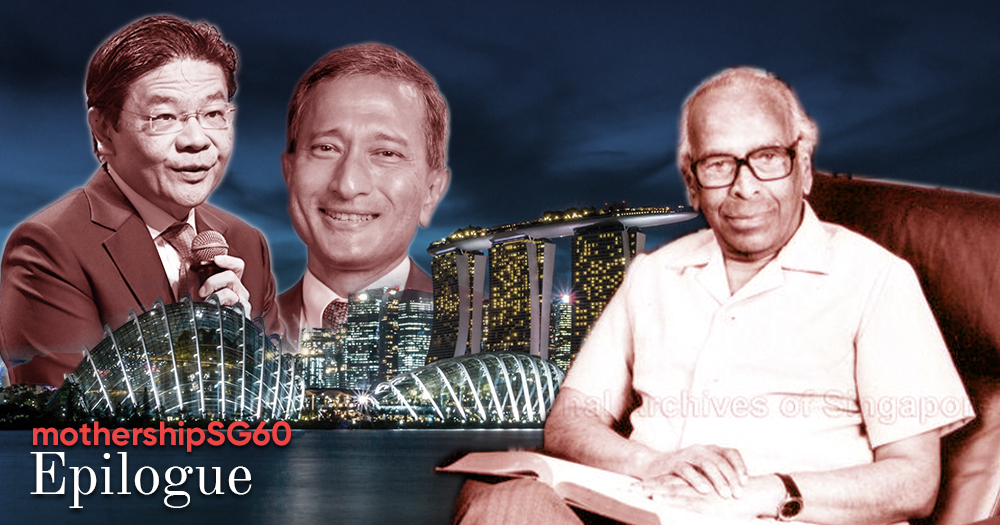
In a speech from 1972, foreign affairs minister S Rajaratnam explained Singapore's strategy for the road ahead.
August 10, 2025, 08:20 PM
Over the past week leading up to National Day, Mothership has taken you back, through the events which led to Singapore’s separation from Malaysia on Aug. 9, 1965. Today, we present a significant moment post-independence.
Epilogue: On February 6, 1972, Minister for Foreign Affairs S. Rajaratnam — then turning 57 — delivered a speech titled “Singapore: Global City” at the Singapore Press Club.
The venue was the new Dragon Palace restaurant in the Cockpit Hotel, an unusual place to deliver to journalists a 40-minute fusion of ideas that continues to be remarkably prescient 50 years on.
A mystery - Why hasn't an independent Singapore collapsed yet?
Rajaratnam's speech, delivered over six years after independence, sought to answer the question of Singapore's survival; many had assumed that the tiny nation would "relapse into economic decay and mounting political turbulence," said the minister.
Instead, life on the island was progressively improving. Was this an illusion — "a cunning arrangement of mirrors" — or just attributable to good luck and happy accidents?
The answer, Rajaratnam revealed, was Singapore's effort to transform itself into a "global city".
He outlined the country's strategy for this, and warned that the traditional role of Singapore as a regional entrepot and as a marketplace in Southeast Asia would become less and less important.
Singapore would, instead, become part of the world and its global economic system.
Rajaratnam believed that the evolution and growth of Singapore into a global city had contributed to its economic success:
“If we view Singapore's future not as a regional city but as a Global City, then the smallness of Singapore, the absence of a hinterland, or raw materials and a large domestic market are not fatal or insurmountable handicaps. It would explain why, since independence, we have been successful economically and, consequently, have ensured political and social stability.
As a global city, Rajaratnam contended, the world would be our hinterland.
This, he said, was borne out in Singapore's shipping statistics, having more than doubled the number of ships coming into Singapore and trebled the cargo they were bringing with them in the 10 years preceding 1970.
"The gist of this possibly lengthy discourse is that an independent Singapore survives and will survive because it has established a relationship of interdependence in the rapidly expanding global economic system," he concluded.
"Singapore's economic future will, as the years go by, become more and more rooted in this global system. It will grow and prosper as this system grows and prospers. It will collapse if this system collapses. But the latter is hardly likely to happen because that would be the end of world civilisation.”
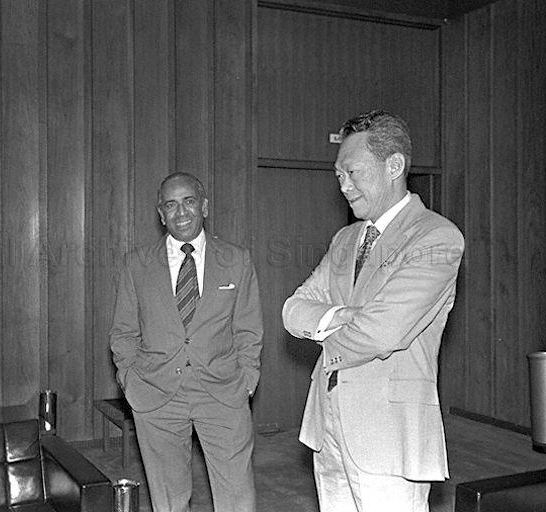 Lee Kuan Yew and S Rajaratnam in 1975. Image from National Archives of Singapore
Significance of Raja’s speech, 53 years on
According to Rajaratnam’s biographer Irene Ng, “the global city construct, articulated for the first time here, provided an entirely new way of viewing the country’s current reality and its distant future”.
The initial local press commentary was lukewarm, focusing on the economic risks if Singapore’s economy were to be dominated by MNCs.
Dissenting politicians would criticise the government, arguing that Singaporeans would lose their livelihoods and their souls to exploitative foreign interests.
But Rajaratnam’s ideas have lived on, and his speech is often cited for its accuracy in predicting the rise of global cities and the emphasis on Singapore’s connectivity and hub status.
The ideas of the speech continue to be referenced by his successors, as recently as this year.
Minister for Foreign Affairs Vivian Balakrishnan said at the Singapore Institute of International Affairs lecture on Jan. 24, 2025:
“In 1972, Singapore’s first Foreign Minister, Mr S Rajaratnam, delivered a speech, which is well worth reading even today. This speech outlined his vision – and he coined the term – a “Global City”. He argued that because Singapore was so small, with no hinterland or natural resources, Singapore had to become a “world embracing city”. Mr Rajaratnam was a wordsmith. He created a word which I had never seen before – “Ecumenopolis”.
This concept of going and leaping beyond our immediate limitations, boundaries, and neighbourhood, was in fact ahead of its time, but one which has served us very well. In other words, Singapore embarked on hyper-connected globalisation before it became conventional wisdom, before it became the standard formula for rising cities and countries throughout Asia”.
Rajaratnam’s speech was also recently mentioned in a dialogue with Prime Minister Lawrence Wong and moderated by IPS Director Janadas Devan.
PM Wong called it “a very good speech” and a “very far-sighted” one.
Excerpt from PM Wong and Janadas Devan's conversation
Janadas Devan (JD): More than 50 years ago, Mr S Rajaratnam, our first Foreign Minister, gave a famous speech on Singapore being a Global City. I read the speech recently.
PM Wong (PM): I read it. It was a very good speech.
JD: It was given in 1970. And it was a speech that was incredibly optimistic.
PM: And very far-sighted.
JD: But he gave the speech and borrowed the concept from Arnold Toynbee’s Study of History. And it was a speech that was optimistic, a sense that the world was going to become more open, and that we should ride that tide and connect with other global cities and our hinterland is, in that speech, no longer Malaya or Southeast Asia. It is the world. If you and your Foreign Minister were to give that speech again in vastly different circumstances, how would you envision Singapore as a Global City in these new circumstances. We have no alternative but to be a Global City. But how would you envision our place in this time?
PM: We have no alternative. That is a fact. So first of all, it is important to acknowledge that there is no other choice, staying open for us is not a matter of luxury, it is an essential lifeline. But what does it mean to be a Global City in this new environment?
I will tell you a story. In 2005. I was working with then Prime Minister Lee Hsien Loong. And we were preparing his National Day Rally in 2005.I had just started in my role as his Principal Private Secretary (PPS), so it was my first National Day Rally as such. And I came to realise at that time that when preparing for a rally speech like that, you do not start with the title of the speech. You start thinking about the content. What are the messages, what is the structure, what are the key things that you would like to say. The title comes last. No one remembers the title of the speech. Frankly, do any of you? There is a title, incidentally, in every rally speech. Who remembers the title ever?
JD: I only remember one - “New Way Forward”.
PM: So one of the tasks I had to do when we were wrapping up, because this is the last thing you think of, was to come up with the title. And I asked around and everyone told me, do not sweat too much about this because no one remembers, no one cares. The media is not going to use your title, so just use something that is functional and then move on; many more other important things to do. But you know, this was my first rally. I was young and enthusiastic, and I was determined to come up with something that had traction. So I thought long and hard and, in 2005 the title was “A Vibrant Global City called Home. The next day, Straits Times (ST)’s coverage of the rally speech, the headline - front page, was “Global City called Home”. So I was vindicated, and I cheered. All my efforts paid off. The ST carried it on the front page - headline. But that phrase always stuck. It has always remained with me. That we do want to be a Global City called “Home”. And what does it mean in today’s circumstance? And I would say again, three things.
First, even in a fragmented world, there will be a global network of cosmopolitan cities that stand out. We want to be one of them. A shiny node where the human spirit thrives, where people want to be here, to do business and to make things happen.
Second, we do not have to copy others. We should have confidence to chart our own way; what it means to be a Global City, to be that shining node in this global network.
We will never be like New York or Paris, and we do not have to be. Here, we are cosmopolitan, but we are Asian, we are multi-cultural. Some say we are boring, and we will never have the same offerings as New York and Paris. We can try to be more exciting, have more lifestyle offerings, but let us be realistic, we will not be the same. But at the same time, we are stable, we are predictable. We are reliable and we are trusted, and these are intangible assets that others would die to have.
So, we should embrace our strengths and our competitive advantage, build on them and add value to the world.
Third and finally, we must always be a home for Singaporeans. Even as we talk about being a Global City, we must set the house rules. That means we stay open, but there will be house rules that apply.
For example, guardrails on housing. Foreigners want to buy a home or property here? Pay the Additional Buyer’s Stamp Duty (ABSD). There will be prudent controls on foreign manpower – it is not just a free for all. We manage the flows so that Singaporeans always remain at the centre of everything we do; Singaporeans benefit.
Being a Global City will eventually translate into better homes, better lives, improved standards of living for Singapore. We want to be a Global City where, at the end of the day, we can still enjoy good food at hawker centres, we have affordable public housing, and there will be a strong kampung spirit in every town. That is a Global City we want to be. A Global City called home.
Previous stories
Top images from the National Archives of Singapore, Jacky Ho, for IPS-SBF Conference: Global-City Singapore: SG60 and Beyond, Vivian Balakrishnan's Facebook page and Mike Enerio via Unsplash