




News

Foreigners caught with etomidate vapes in S'pore may face deportation, reentry ban: Shanmugam
They will also be subject to the same enhanced laws against vaping.
August 28, 2025, 03:03 PM
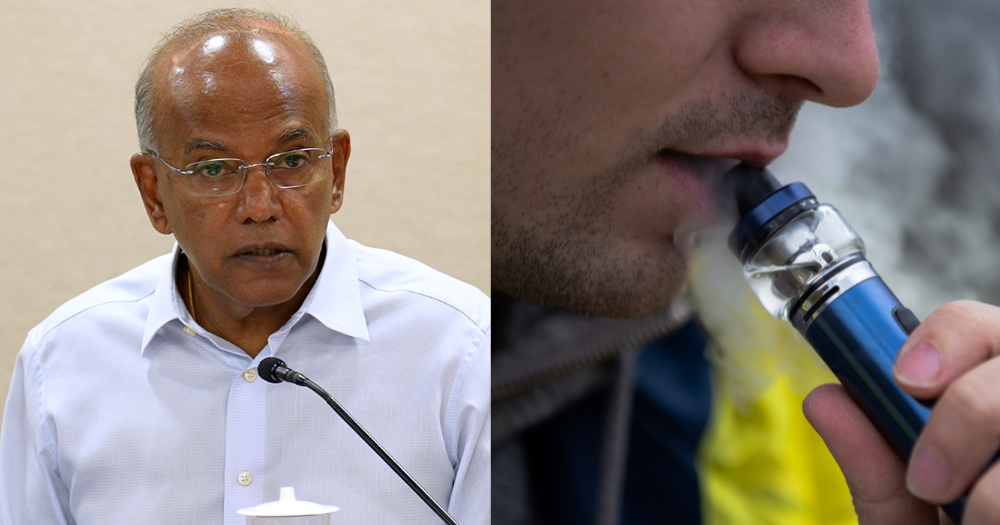


Foreigners in Singapore in possession of etomidate vapes may be deported and barred from reentering the country, Home Affairs Minister K Shanmugam said on Aug. 28.
Speaking at a press conference on the whole-of-government clampdown on vaping and etomidate consumption, he said that foreign nationals who visit or live in Singapore must abide by Singapore's laws and face the same penalties for vaping.
This comes in light of the government's recent announcement that etomidate will be classified as a Class C drug from Sep. 1, which means that those found in possession of or are caught consuming or trafficking the substance will face harsher penalties, including jail and caning.
Work passes revoked
Foreigners in Singapore who are found in possession of vapes will have their vapes seized and be issued a notice of composition (NOC), or a fine without prosecution.
Under the new law, individuals under 18 years old who are caught with vapes will be given a S$500 NOC for the first offence, while those 18 and above will have to pay S$700.
On the second offence, offenders will have to attend a three-month rehabilitation.
Third offences onwards will result in prosecution and a maximum fine of S$2,000.
While the above penalties are likely to also apply to foreigners, repeat foreign offenders will face additional consequences.
Short-term visit pass holders will be banned from re-entering Singapore upon departure.
Those on a long-term pass or immigration facility, such as an Employment Pass, S Pass, Work Permit, Student’s Pass, Long-Term Visit Pass or Dependant’s Pass, may also have their pass or immigration facility revoked on the third offence, and be deported and banned from re-entering Singapore thereafter.
Foreigners caught with etomidate-laced vapes, or who test positive for etomidate, may have their pass revoked, be deported and banned from re-entering Singapore immediately.
Shanmugam added that "leniency will be exercised for young persons" if they are long-term pass holders and have offended for the first time.
He added that the Ministry of Home Affairs (MHA) recognises the impact this may have on family units and will review any appeals on a case-by-case basis.
Migrant workers
Minister of State for Manpower Dinesh V. Dash said during the press conference that vaping incidents among migrant workers in dormitories are currently low.
Nonetheless, he said that MOM will continue to increase spot checks and enforcement patrols "to detect and deter vaping within dormitories".
Similar to all other foreigners, migrant workers found vaping or in possession of vapes will be subject to the local enhanced penalties.
They may also have their work passes revoked and be banned from working in Singapore.
Up to 700 MOM ground officers will also be empowered to take enforcement actions against vape offenders, and a number of them will be seconded to the Health Sciences Authority (HSA) to support enforcement efforts, Dinesh added.
There will also be intensified educational and engagement efforts targeting migrant workers and migrant domestic workers in their native languages, via outreach channels such as the FWMOMCare application and domestic worker WhatsApp channels.
Passengers in transit
In response to a question from the media, Minister for Health Ong Ye Kung, who was also on the panel at the press conference, stated that announcements will be made on aircrafts entering Singapore to warn incoming visitors to dispose of their vapes.
This will be in addition to existing announcements about other prohibited items, including drugs and chewing gums.
Transit commuters at Singapore's Changi Airport will be able to drop their vapes off at red vape disposal bins at airport terminals, the same ones that have been distributed across the island.
Shanmugam added that if individuals are caught, the authorities will first work to determine their motives, especially if "purposes of trafficking" are involved.
However, he said that discussions are still underway to decide on the steps taken against transiting abusers of etomidate.
"If you are an abuser, and you're transiting through Singapore...a question we'll have to assess is, how much resources do we want to expand by arresting you, bringing you into Singapore and then giving you rehabilitation and so on," he said.
"We'll have to take a sensible approach of these things."
Top image by Reuben Nathan/Mothership and Canva