News

M’sia meaningless if S’pore does not benefit: PM Lee on common market negotiation
Singapore’s leaders continue to spar with the Central Government over the common market and federal tax contributions.
August 07, 2025, 07:45 PM
Over the next few days leading up to National Day, follow along as Mothership takes you back, through the events which led to Singapore’s separation from Malaysia on Aug. 9, 1965.
JUL. 22, 1964: Amidst the ongoing row between Singapore and the Central Government over issues of the economy, Prime Minister Lee Kuan Yew showed no signs of backing down.
Speaking at the Jul. 21 opening of an HDB exhibition in Outram, PM Lee criticised the decision to raise Singapore’s federal revenue tax contribution from 40 to 60 percent, arguing that it would do little to solve social problems in the Peninsula.
He also declared that if Singapore “does not benefit economically from Malaysia, and if the common market is not set up as laid down in the Malaysia Agreement, then Malaysia is meaningless.”
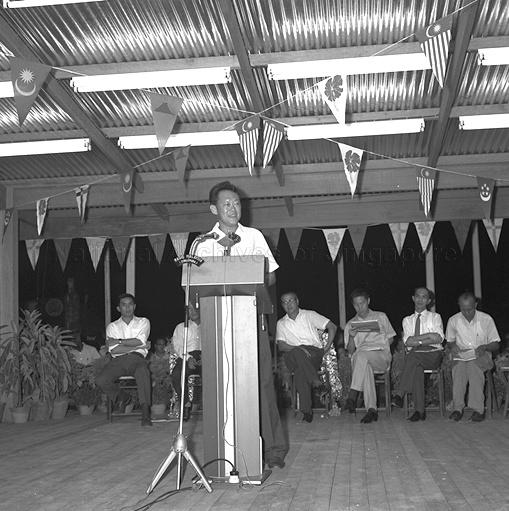 PM Lee speaking at the opening of a HDB exhibition in Outram. Image from National Archives of Singapore
Ongoing sparring
Singapore’s tussle with the Central Government over the establishment of a common market has become entangled with the issue of federal revenue contributions since the latter’s move in December 1964 to raise the island state’s share, along with another dispute over a development loan Singapore had committed to Borneo.
At the time, federal finance minister Tan Siew Sin pointed to Singapore having the lightest tax burden in the whole of Malaysia as well as a higher per capita income than the States of Malaya.
He also said the federal government needed to increase defense spending because of the Confrontation with Indonesia.
“I hope it will not be too much to hope that Singapore will agree to reverse the proportion — in other words, 60 per cent for the Central Government and 40 per cent for Singapore,” he said on Dec. 2, 1964.
More recently, on Jul. 17, Tan cited Singapore’s ‘special position’ of retaining 60 per cent of its revenue when the states of Malaya had to contribute 100 per cent of theirs to the Federal Government; Sarawak and Sabah retain a considerably smaller portion of revenue than Singapore too.
He also referenced the island’s existing advantages over Malaya — namely its attractiveness to investors and having the largest supply of skilled labour.
Implementing a common market would tilt the balance sheet further in Singapore’s favour at the expense of the rest of Malaysia, Tan opined.
This, along with Singapore’s reticence over its commitment to the Borneo development loan, made the common market untenable.
“Singapore stands to gain most from the creation of the Malaysian Common Market,” said Tan.
“But if in spite of this, she insists on maintaining financial arrangements which are clearly unfair… then the dice would be too heavily loaded against the rest of Malaysia.”
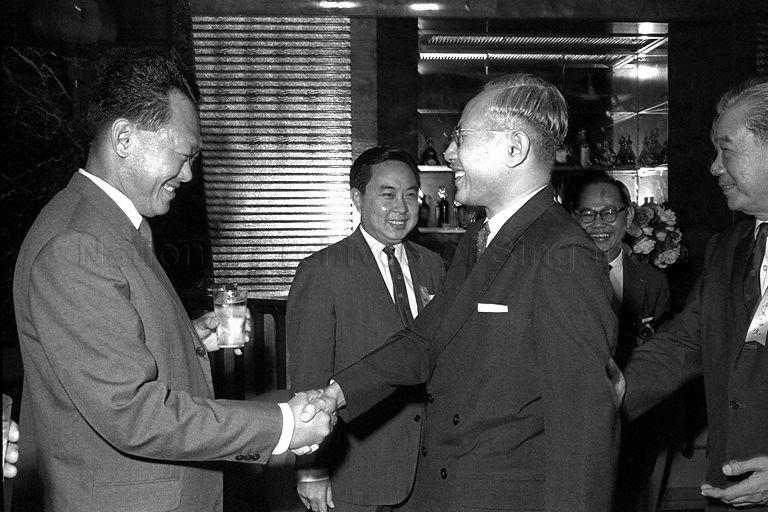 PM Lee (L) shaking hands with Tan Siew Sin. Image from National Archives of Singapore
A firm “no”
PM Lee, along with Singapore’s finance minister Goh Keng Swee, have thus far batted away suggestions that Singapore increase its federal contributions.
On Monday, Jul. 19, Goh replied to Tan’s continued insistence on raising Singapore’s tax burden with a firm “No”.
Goh disclosed that in correspondence from November 1964, Tan had appeared to believe Singapore’s contribution of 40 per cent to be sufficient; Goh on the other hand had asked for the arrangement to be reviewed.
“The Singapore Government’s estimate is that 30 per cent is more than adequate to meet our obligations under the Constitution,” said Goh.
Responding to Tan’s jibe about Singapore’s favourable position vis-à-vis the other Malaysian states, Goh argued the situation had no equivalence.
“1.9 million Malaysians in Singapore are entitled to 15 seats (in the Federal Parliament) compared to 1.2 million Malaysians in Sabah and Sarawak’s 40 seats in parliament.
Further, these states do not have to pay for education, hospitals, social services, roads, road development, nor finally nearly all the development projects going on within their boundaries, including projects of Federal departments.”
PM Lee stated at the HDB event that should wrangling over the federal revenue contributions persists, Singapore was prepared to refer the dispute to the World Bank for arbitration.
Excerpt from The Agreement Related to Malaysia
Article IX: The provisions of Annex J to this Agreement relating to Common Market and financial arrangements shall constitute an Agreement between the Government of the Federation of Malaya and the Government of Singapore
Previous stories
Top image from National Archives of Singapore and Canva