




Environment

S’pore’s 1st public zoo at Botanic Gardens in 1875: ‘Nothing else worth seeing’ here after its closure in 1905, tourists said
At its peak, the zoo was described as "one of the finest collections of living beasts".
July 24, 2025, 07:44 PM


After travelling days on a ship, you step onto the streets of a bustling port city, with its merchant-lined roads, coolies hefting back-breaking loads of cargo, rickshaws and horse-drawn carriages trundling past.
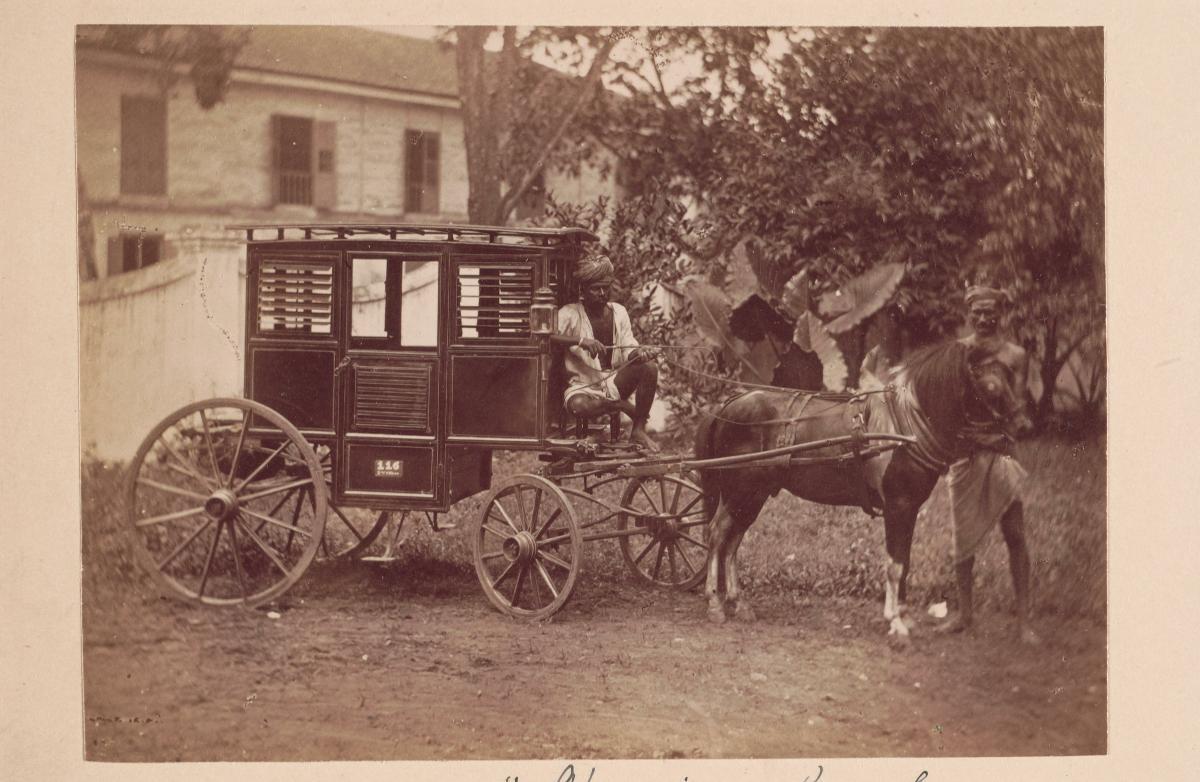 Photo from Root.sg
You've heard tell of the "mysterious" East, and a tiny British settlement with a flourishing port growing amidst the seemingly wild jungles, where "not 20 years ago were grouped a few wretched Malay villages, half fishermen, half pirates, where virgin forest extended to the seashore".
Instead, this now "hospitable shore", as Jules Itier, Head of French commercial mission to China and the Indies described, is home to the focal point of your leisure trip — a captivating menagerie of animals located smack dab in the heart of the island's lush landscapes, the Botanic Gardens.
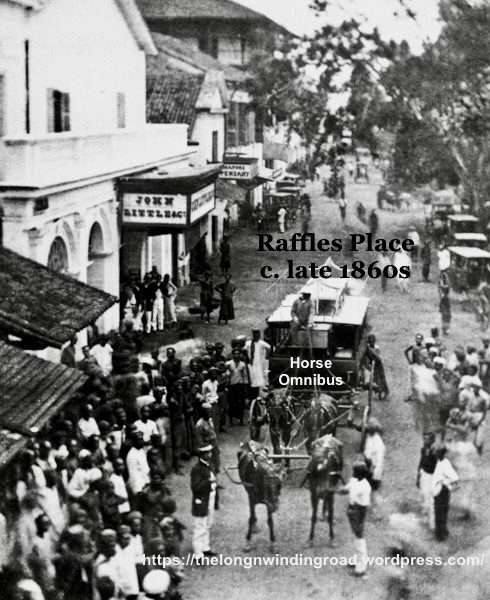 Photo from The Long and Winding Road
New stream of revenue
This is Singapore in the 19th century.
Then, the island's colonial administrators, Stamford Raffles and William Farquhar, were already fascinated by natural history and the teeming biodiversity in this tropical landscape, so different from the temperate ones they were used to back home.
Till the middle of the century, the Botanic Gardens, established in 1859, earned revenue from a sort of "subscription" model, i.e. entering the Gardens was not free like it is today.
However, the Agri-Horticultural Society, which managed the Gardens, fell into debt.
Desperate for revenue, the idea of a public zoological garden was proposed, otherwise "a portion of the Gardens must be allowed to relapse into jungle", The Straits Times reported in 1870.
In addition to the zoo, it was also decided that the government would help defray the costs of the Garden's upkeep with a grant comprising a grand S$100 a month (this was double the previous amount, wow).
This was the start of what would become one of Singapore's most alluring attractions for its time.
Exotic
The menagerie, established in 1875, lent Singapore a certain exoticism for adventure-seeking foreigners, and visitors were captivated by the idea of traipsing through a tamed jungle of sorts, seeing alien-like animals up close but with the assurance of their personal safety.
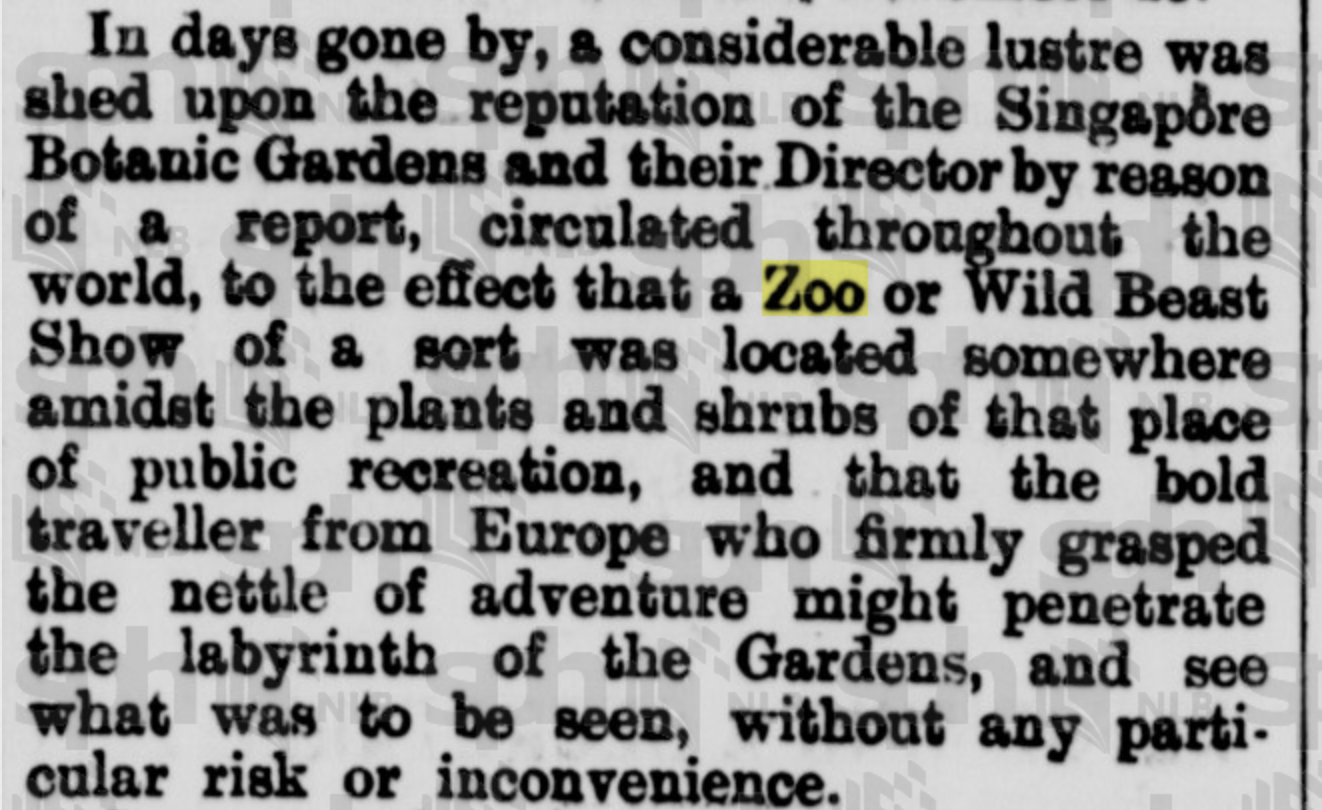
This mysticism was even conveyed in the news back then, with an article describing it as a "Zoo or Wild Beast Show of a sort".
As such, "the bold traveller from Europe" "might penetrate the labyrinth of the Gardens and see what was to be seen, without any particular risk or inconvenience".
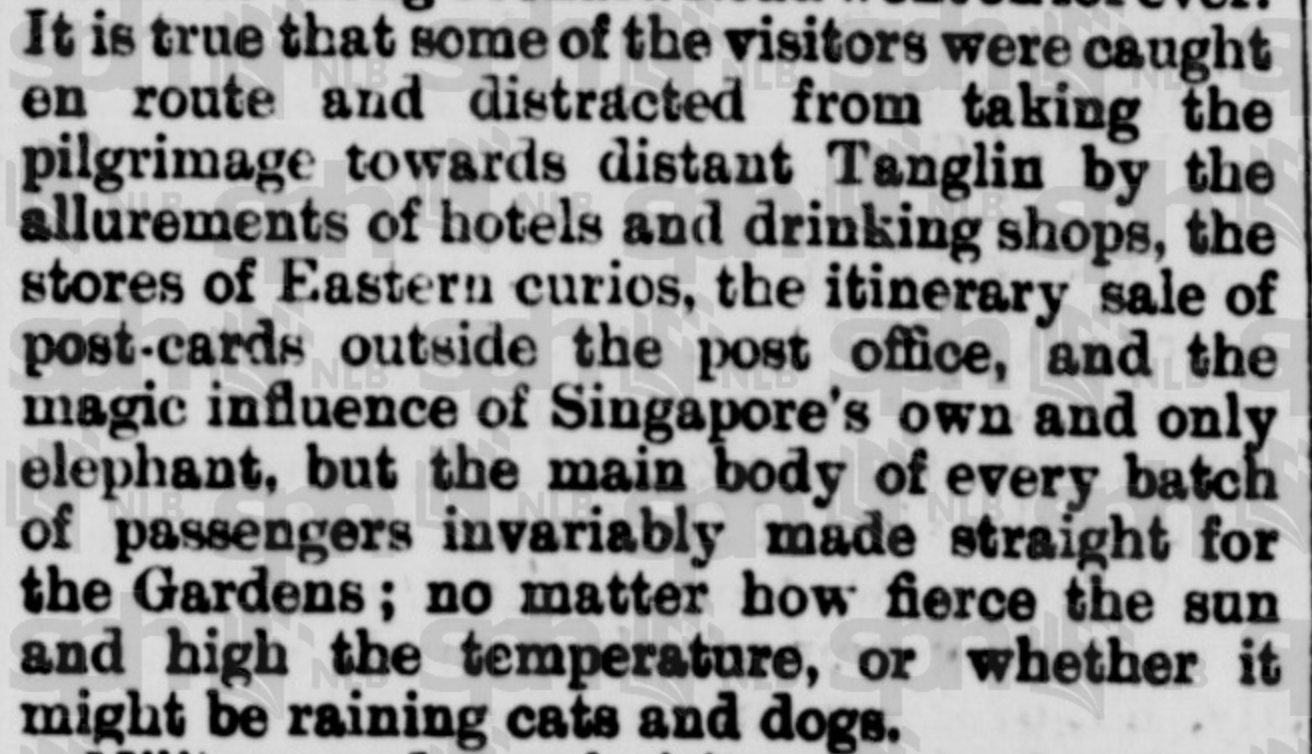
Such was the allure of the Gardens that "the main body of every batch of passengers [to Singapore] invariably made straight [for it]", rain or shine.
Curious creatures
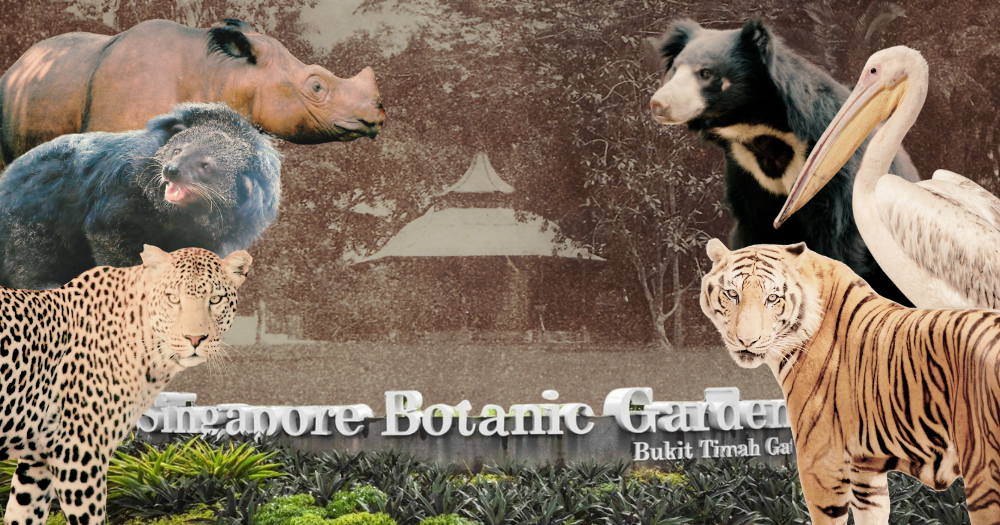
The zoo started off with a humble collection comprising a rhino, sloth-bear, kangaroos and other small animals and birds.
It eventually grew to contain a panoply of creatures like orangutans, monkeys, tigers, leopards, pelicans, dingoes, and foxes, totalling 144 exhibits. Majority of the animals were gifted by state officials.
By 1902, the collection had become rather representative of Southeast Asian fauna, particularly that of the Malay peninsula, according to a journal article by the Gardens' first director, Henry Nicholas Ridley.
Other fauna at the zoo included Sambar deer, wild boars, binturongs, mousedeer and the Malayan tapir.
The latter, interestingly enough, had belonged to Ridley for years, and was first bought by him as a baby. It spent most of its time in the man's office or house.
"On Saturdays it came up to the Director’s house for Sunday, as the office was closed on that day, and went back on Monday morning."
Despite the species being native to the region, it seemed it was still a curiosity to many. Ridley wrote:
"This tapir was very docile and amusing and was a great attraction, very few people even the Malays ever having seen one before."
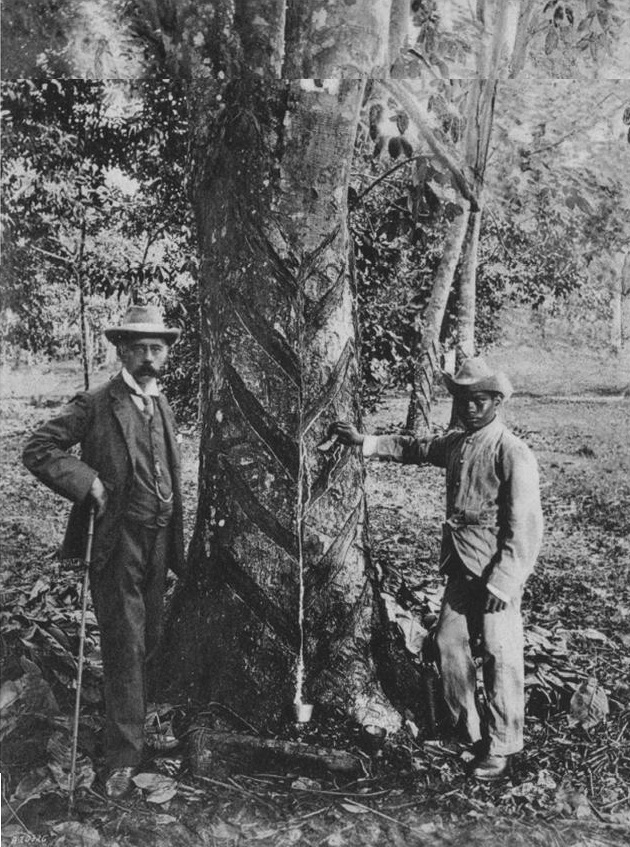 Ridley (left) next to a rubber tree. Unfortunately, no photos with the tapir. Photo from Wikipedia
As was also noted of the zoo's appeal in the book "Nature's Colony":
"More importantly, the animals attracted non-elite visitors to the Gardens, who were fascinated with the range of animals on display.
One visitor in 1875 commented that the newly arrived Australian animals were "sources of endless admiration and amusement to the Malays and Chinese." A young kangaroo was a particular favourite. Whenever it peeped out of its mother's pouch, it "took the popular fancy immediately."
Problems arise
The zoo however, was eventually plagued with problems.
It became apparent that the funds so generously allocated at the start were insufficient for the upkeep of over a hundred animals, and it was noted that most of the monthly grant went towards maintaining the grounds and plant houses.
Despite the large number of creatures, there were only three keepers, two of whom were from a regiment stationed in Singapore.
The third was also "dismissed because he wanted more money".
Following this, two kangaroos and two leopards died.
Once, someone even entered the zoo and single-handedly killed an emu, a bear and a cassowary.
"The decline of the zoo can be attributed to a failure to provide competent attendants and adequate guards," a report stated.
These incidents put a damper on the Gardens Committee's enthusiasm for the zoo — although the report claimed the committee always had a "sickly interest" in the zoological side of the Gardens.
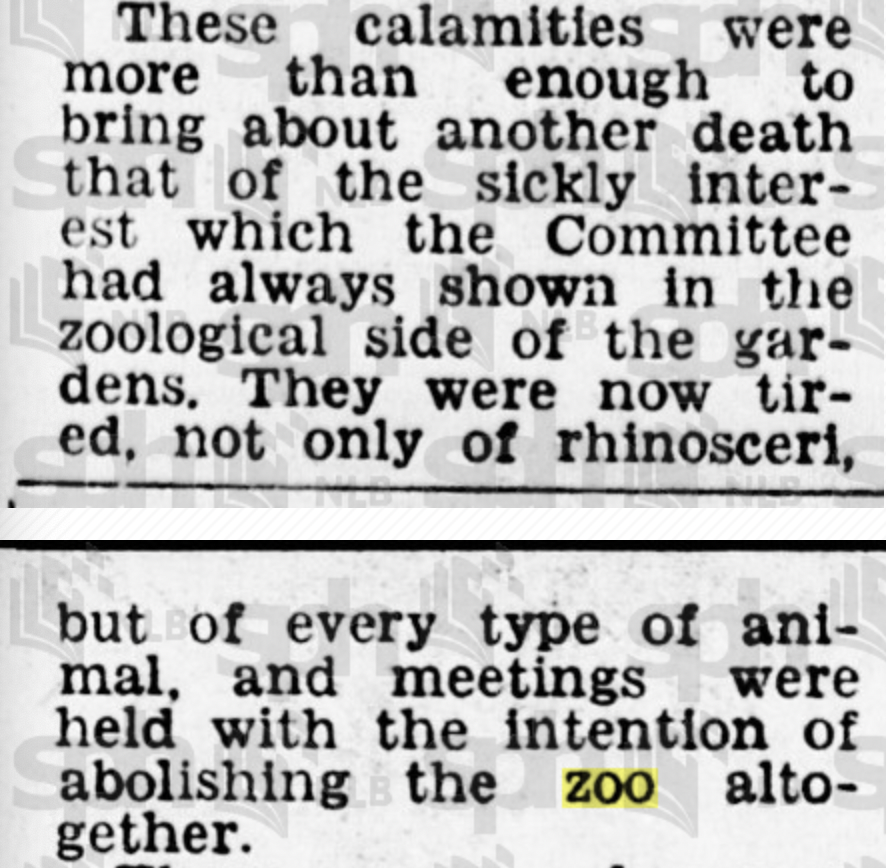
However, further discussions with those who saw value in the zoo eventually led to a compromise.
In 1878, a mere three years after its opening, the zoo was downsized to only include small animals and birds, while larger creatures like the orangutan and tigers were dispatched back to their native countries.
And from then on, the zoo languished.
Death of a zoo
In 1881, the colonial government withdrew all monetary support for the zoo due to "financial constraints", which forced the zoo to rely on private contributions only.
The zoo continued on in this "half-hearted manner", and in 1905, it breathed its last.
At the start, the zoo had drawn its fair share of plaudits, having been described as "one of the finest collections of living beasts", and "the delight of children and visitors at the Botanic Gardens".
But perhaps its slow decline and the way in which it had gradually descended into disrepair led to some bafflement over the apparent clamour it caused when the last of the exhibits was finally sold.
As the Singapore Free Press remarked:
"...And this [closure], strange as it may seem, caused quite an outcry because, for some reason or other, the Singapore Zoo had obtained quite an international reputation, and 2,000 tourists who went to see the animals and found that they were no longer there, left Singapore in disgust, saying that there was nothing else worth seeing on the island."
Soon enough, the three-decade-old establishment faded from existence and memory with nary a whimper.
"In fact, interest in that direction seemed to have altogether vanished..."
Much has changed
Records of the zoo that used to reside in Botanic Gardens are scarce. Photos, even more so.
All that remains is a blurry shot of the Monkey House in the zoo.
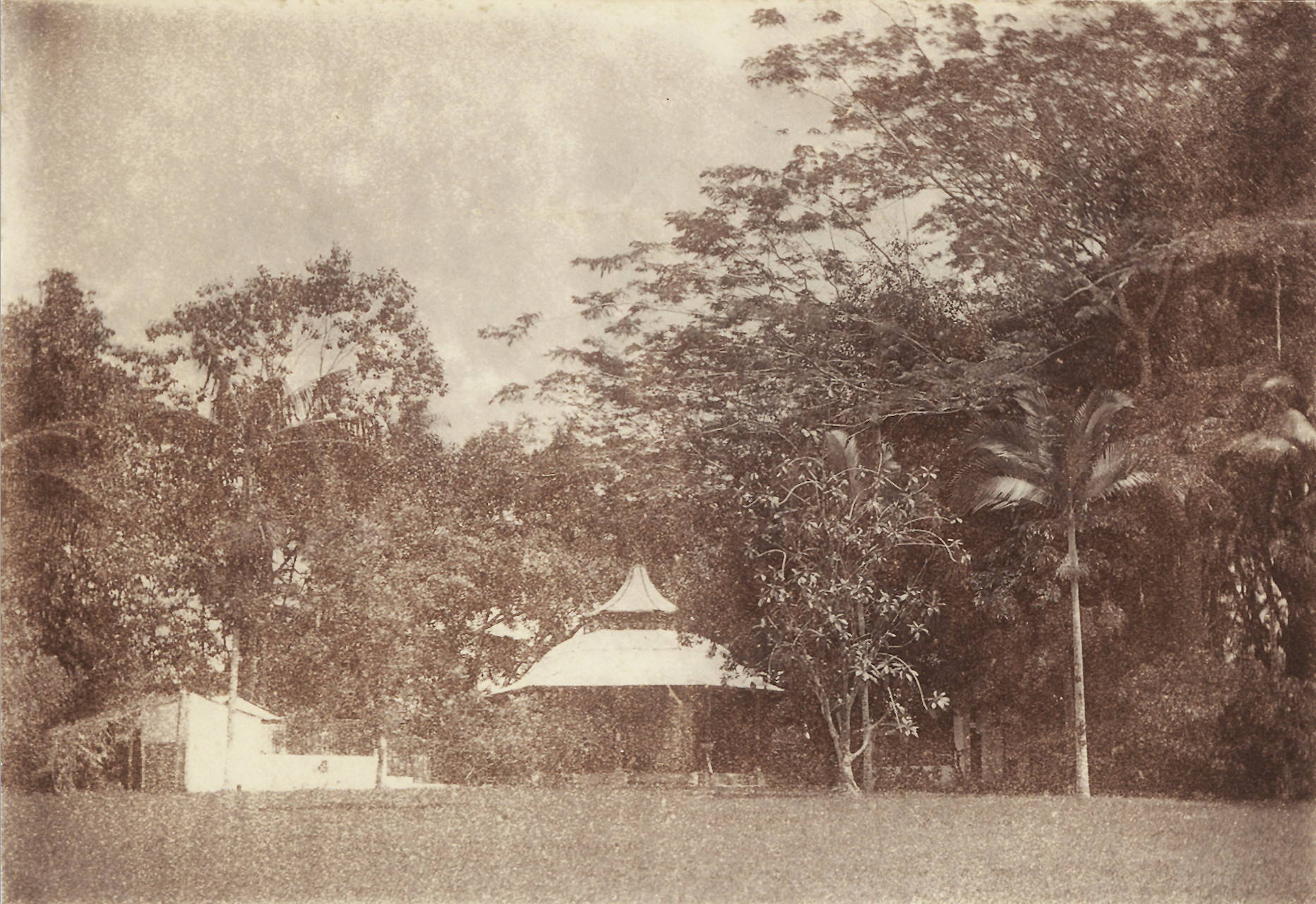 The Monkey House. Photo from Singapore Botanic Gardens Archive
As well as an old map of the Gardens, though lacking greatly in detail, which shows where the rhino, carnivora, deer and kangaroo enclosures were.
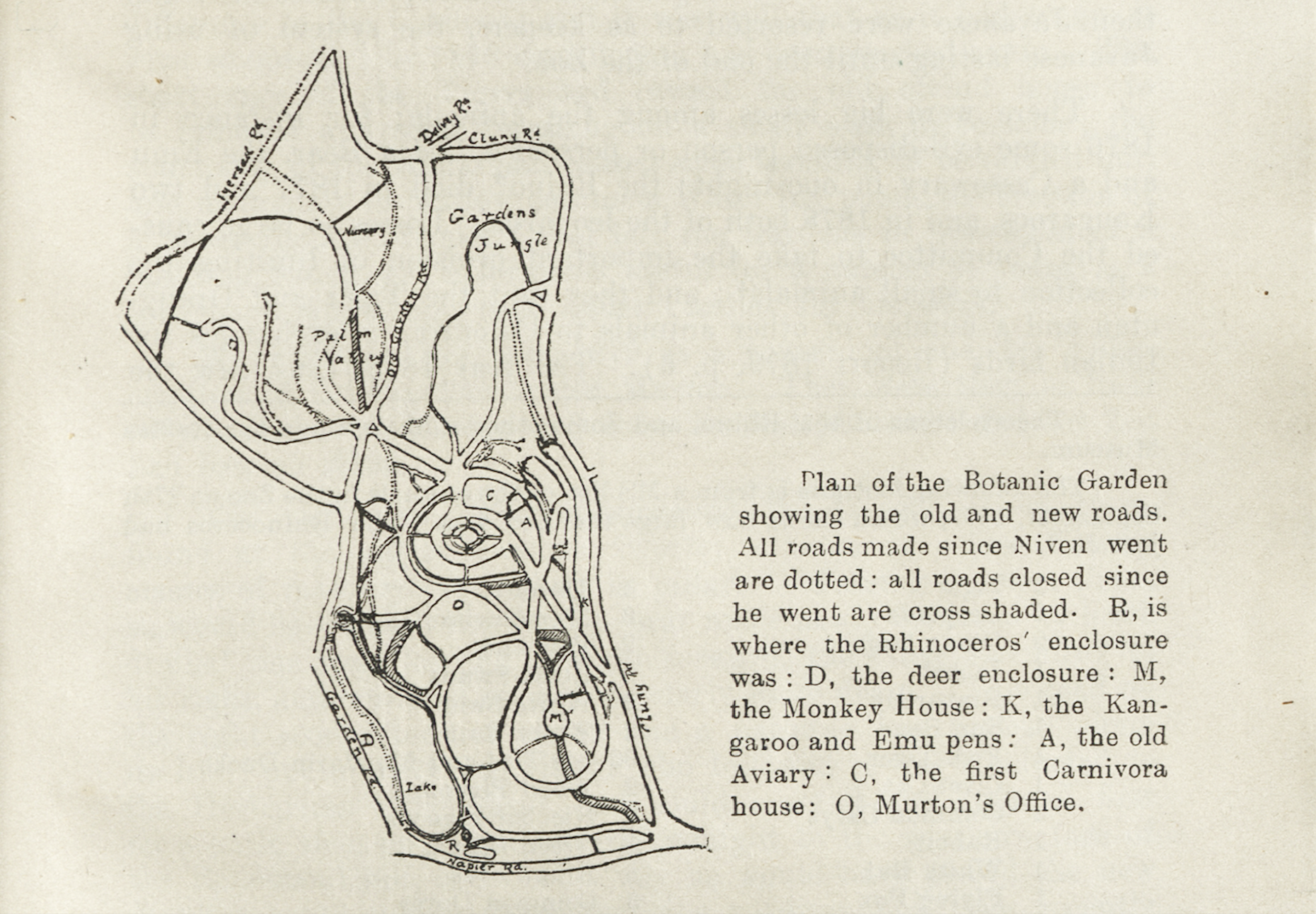 Photo from Singapore Botanic Gardens Archive
Of course, much has changed over a century. Right now, grass patches, trees, and a security guard office stood where these enclosures once were.
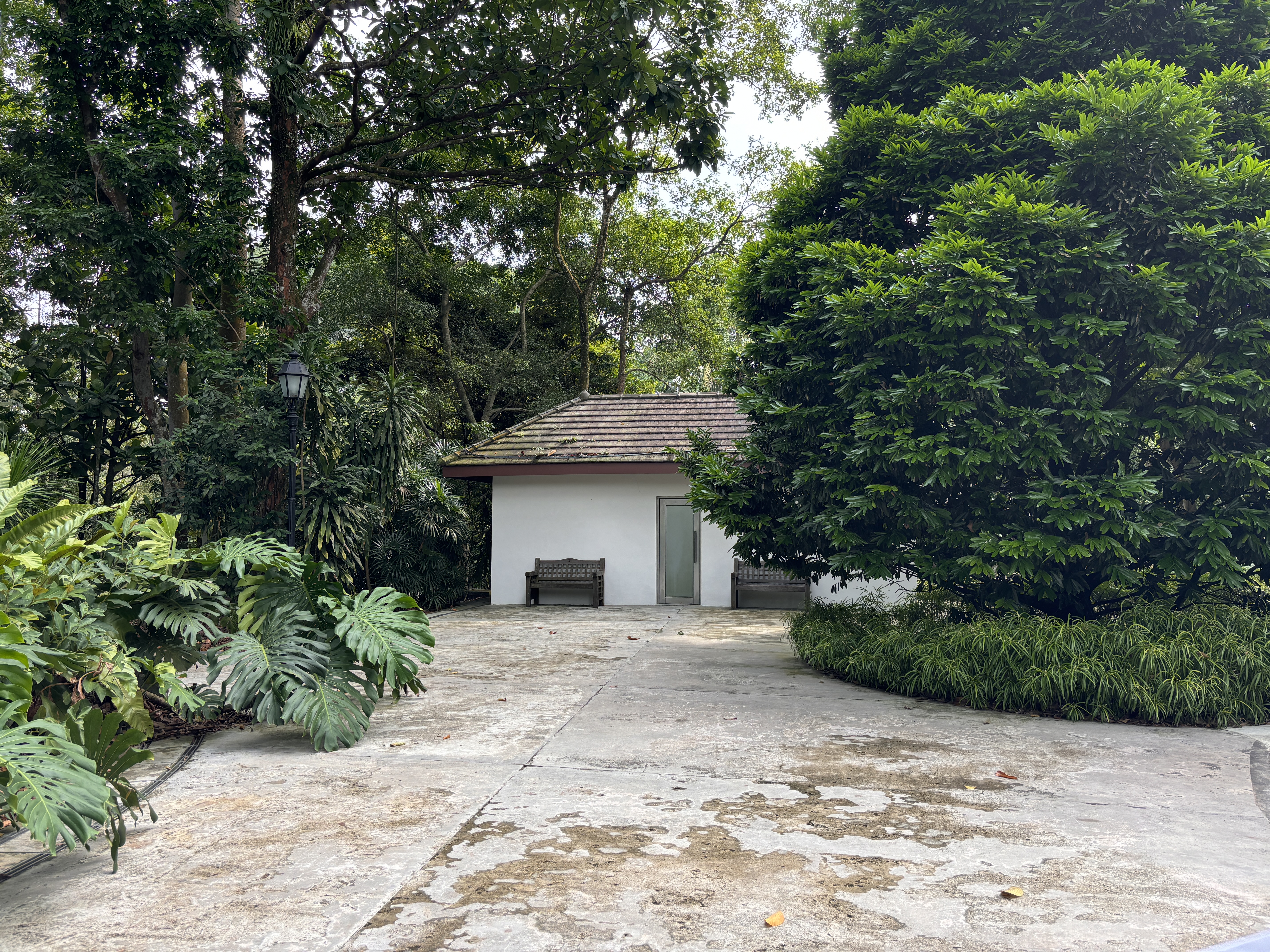 Where this building was exactly where the Monkey House was. Photo by Ashley Tan
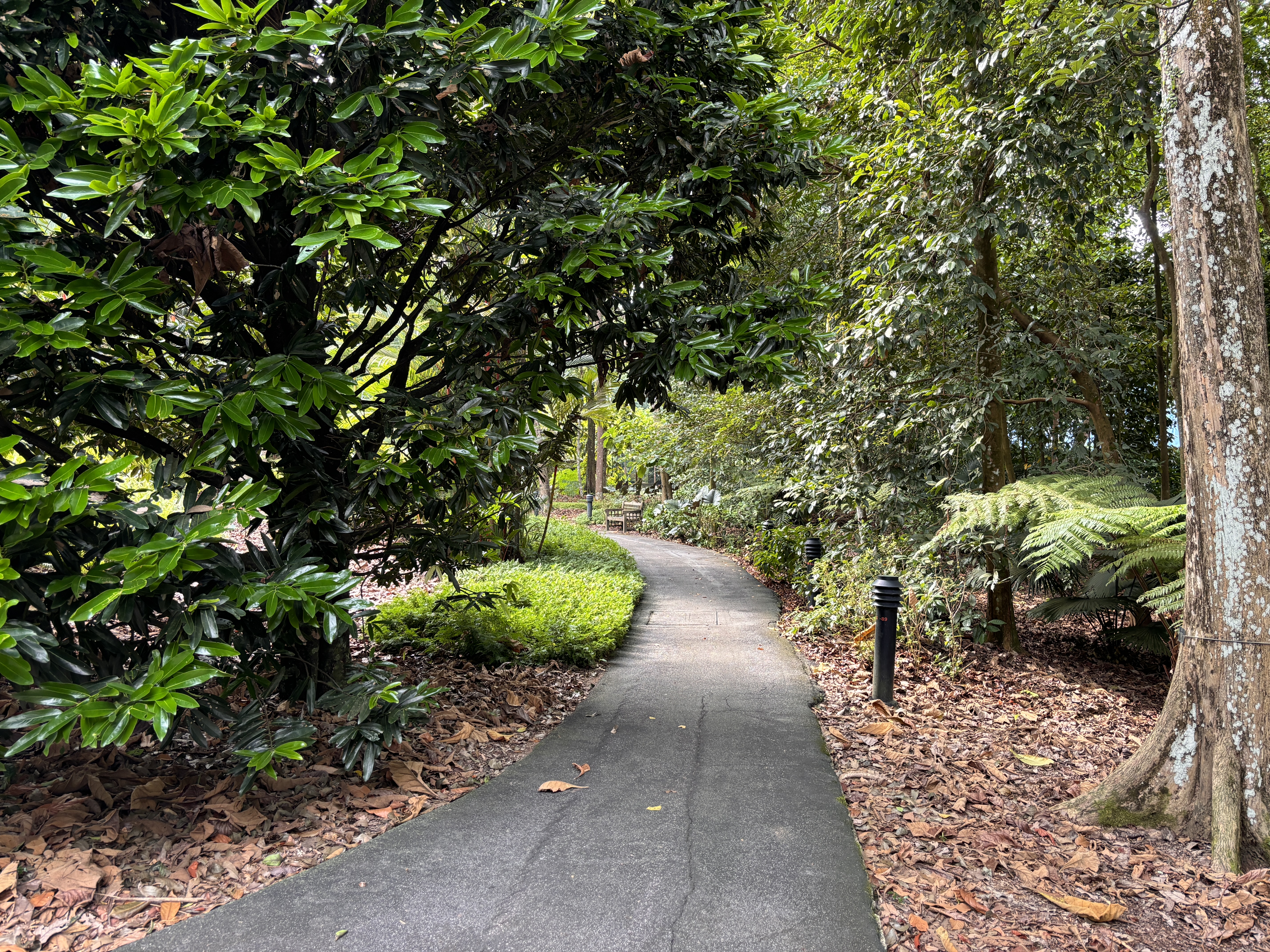 Where the kangaroo enclosure used to be. Photo by Ashley Tan
When asked for his insights into downfall of the zoo, Zongyu Ooi, the current Director for Living Collections in the Singapore Botanic Gardens, opined that another reason was potentially the lack of expertise necessary to manage so many animals.
This was especially so as many of the creatures were gifted or donated, instead of actually acquired by the zoo,
"Animals are not easy to take care of, especially when you have so many different types."
But in hindsight, perhaps the death of the zoo was necessary.
Without the large responsibility of caring for a repository of animals, the Gardens could re-centre itself around its original purpose — a space to carry out botanical and horticultural work, and foster such interests.
After all, the Singapore Zoo that we know now was established much later in 1973 — and perhaps that was for the better, as more thought and consideration was put into its set-up and guaranteeing the welfare of its animals.
To do this, the the team even drew on the opinions and advice of experts and zoo directors from Europe, North America and Australia, something that certainly did not happen with the Botanic Gardens Zoo.
Conservation
Ultimately, the Gardens' main focus is on being a "premium tropical botanical institute", Ooi noted.
"So I think, of course, the Gardens has changed a lot over the years, but the character and heritage and the mission remains very similar from the start."
And right now, the integral question is how the Gardens can contribute more to conservation.
In 1875, the Singapore Botanic Gardens Herbarium was established. It houses 800,000 preserved plant specimens, and around 10,000 of these have been digitised, with plans to digitise the rest by 2027.
This digital database is publicly accessible to anyone from around the world, and will make it easier for researchers to conduct botanical studies.
In another stride towards botanical conservation, a seed bank was opened at the Gardens in 2019, which focuses on conserving plant species in Southeast Asia by preserving their seeds and germplasm.
With all the work its done, the Gardens will actually be celebrating the 150th anniversary of the Singapore Herbarium and the Singapore Botanic Gardens Library of Botany and Horticulture.
It will also be commemorating the 10th anniversary of its inscription as a UNESCO World Heritage Site.
To celebrate these milestones, the Gardens will be holding the Singapore Botanic Gardens Heritage Festival and the Singapore Garden Festival (SGF) Orchid Show from Jul. 19 to 27, 2025.
There will also be daily light shows at Swan Lake and Tanglin Gate from 7:30pm to 10pm, from Jul. 19 to Aug. 10, among other family-friendly events, workshops and performances.
Find out more here.
Top photo from Singapore Botanic Gardens Archive, Canva and Casa Dental