




News

S'pore's overall recycling rate hovers around 50%, NEA to increase recycling efforts
Recycling rates remained relatively stagnant between 2023 and 2024.
July 23, 2025, 11:52 AM
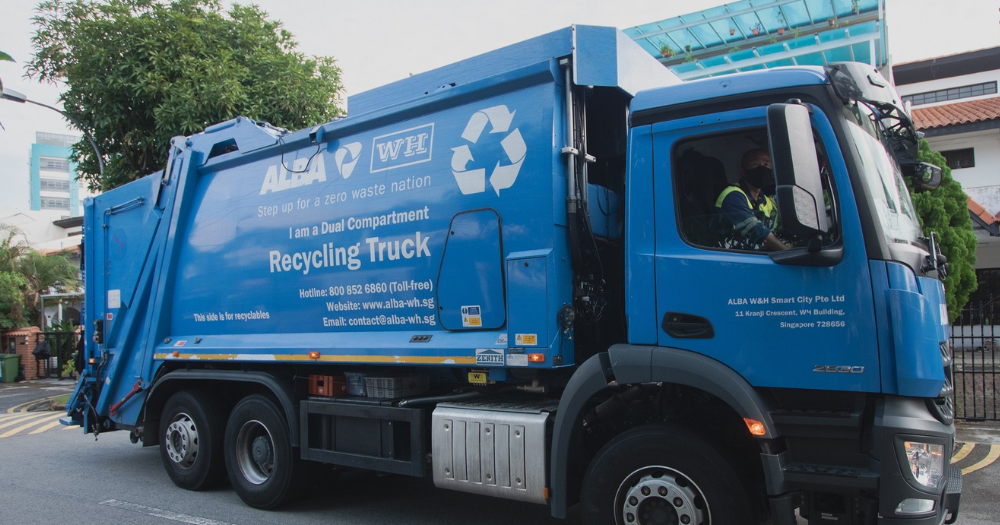


The amount of waste generated in 2024 was lower than in 2023, continuing the downward trend in waste generation in Singapore over the past decade, according to the National Environment Agency (NEA).
This was announced by Senior Minister of State of Sustainability and the Environment Janil Puthucheary at the opening of Mottainai Food Tech’s pilot manufacturing facility and R&D laboratory on Jul. 23.
NEA said in a media release that the decrease in waste generation was reflected in both daily domestic (waste collected from households, hawker centres, educational institutions etc.) and daily non-domestic waste (waste collected from industrial and commercial premises) generated.
Generated waste can either be disposed of through landfills and incineration plants, or recycled through local and overseas recycling facilities.
Decreasing waste generation
Daily domestic waste generated per capita saw a 0.03kg decrease, from 0.88kg in 2023 to 0.85kg in 2024.
Across a 10-year period from 2014 to 2024, daily domestic waste generation also saw a more than 20 per cent decrease.
Meanwhile, daily non-domestic waste generated per billion dollar Gross Domestic Product (GDP) decreased from about 25 tonnes in 2023 to 23 tonnes in 2024.
In the past decade, this figure has fallen by more than 30 per cent.
NEA said that these decreases in waste generation is attributed to "the sustained reduction and reuse efforts" by households and businesses.
Stagnant recycling rates
Overall recycling rates from 2023 to 2024 remained around the same at about 50 per cent, however.
This means that about half of all waste types generated in households and industries are recycled.
The remaining half are disposed of at waste-to-energy plants and Semakau Landfill.
C&D and used slag
According to NEA, the slight decrease in recycling rates from 52 per cent in 2023 to 50 per cent in 2024 is due to a drop in the amount of Construction and Demolition (C&D) waste and used slag generated.
Both forms of waste are almost completely recycled, and therefore contribute significantly to recycling volume.
The same factors also contributed to a 10 per cent drop in recycling rates over a 10-year period from 2014 to 2024.
C&D waste, generated from demolition projects, fell by 122,000 tonnes from 2023 to 2024, while used slag, produced through steel smelting activities, fell by 63,000 tonnes.
Wood waste
The amount of wood waste recycled in 2024 also fell by 49,000 tonnes, adding to the slight overall fall in recycling volume.
NEA said that this is attributed to a short-term reduction in Singapore's wood waste processing capacity due to the closure of one biomass plant and the drawn-out maintenance progress of another.
Biomass plants process woodchips by converting them into energy.
Paper waste
Paper waste generated saw an increase from the post-2019 period during the Covid-19 pandemic.
According to NEA, the increase is driven in part by e-commerce packaging.
However, there was also a steep reduction in paper recycling rates due to factors like the high cost of paper waste collection.
Improving recycling efforts
NEA said that it aims to encourage increased recycling efforts and reducing waste generated, particularly in food, paper and plastic wastes.
A number of practices have been implemented over the years.
Food waste
Recycling rates of food waste saw a slight increase from 13 per cent in 2014 to 18 per cent in 2024.
From Mar. 2024, new large commercial and industrial food waste generators have been required to segregate, treat and report their food waste.
This scheme will be extended to other existing generators when the first phase of NEA's Integrated Waste Management Facility (IWMF), which will see the operation of the Food Water Treatment Facility, is completed in 2027.
Paper waste
In March 2025, NEA supported a set of guidelines implemented by the Singapore Manufacturing Federation (SMF) and Singapore Post (SingPost) to encourage the reduction of and recycling of paper waste.
The guidelines were driven by the "3Rs" principles and offered operating models for e-commerce marketplaces to promote sustainable packaging, including cardboard boxes.
NEA said it is also looking to strengthen support for paper recycling by collaborating with waste collectors, recycling companies and other stakeholders.
Plastic waste
To encourage plastic recycling, NEA will be implementing a beverage container return scheme, where consumers will receive 10 cents for every empty beverage container they return to designated return points, including reverse vending machines.
The scheme, which was postponed several times and is set to begin on Apr. 1, 2026, will repurpose clean and high-quality plastic recyclables collected into new products.
Top image via NEA/Facebook