News

DPM Gan visited US, saw optimism in the economy but foresees uncertainty over tariffs
A lot of uncertainty, some optimism.
July 30, 2025, 12:21 AM


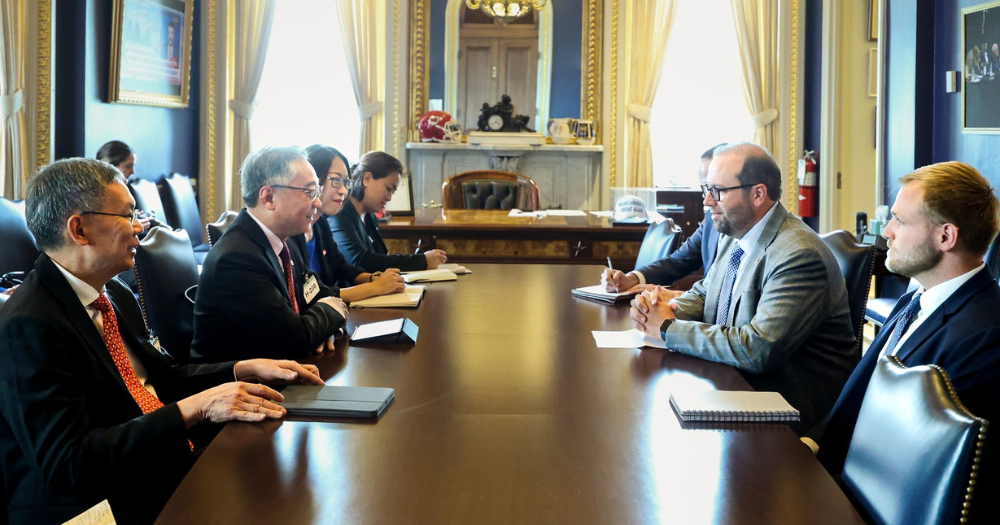
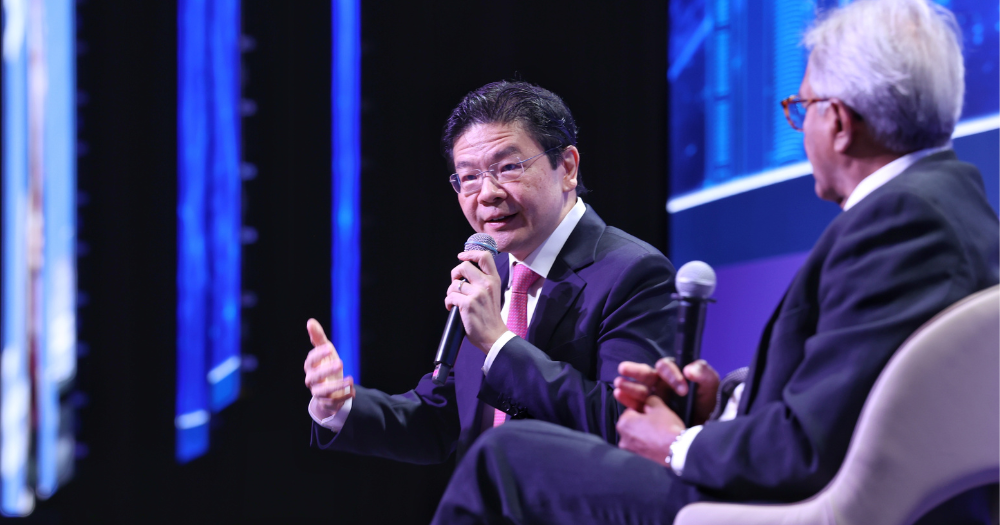
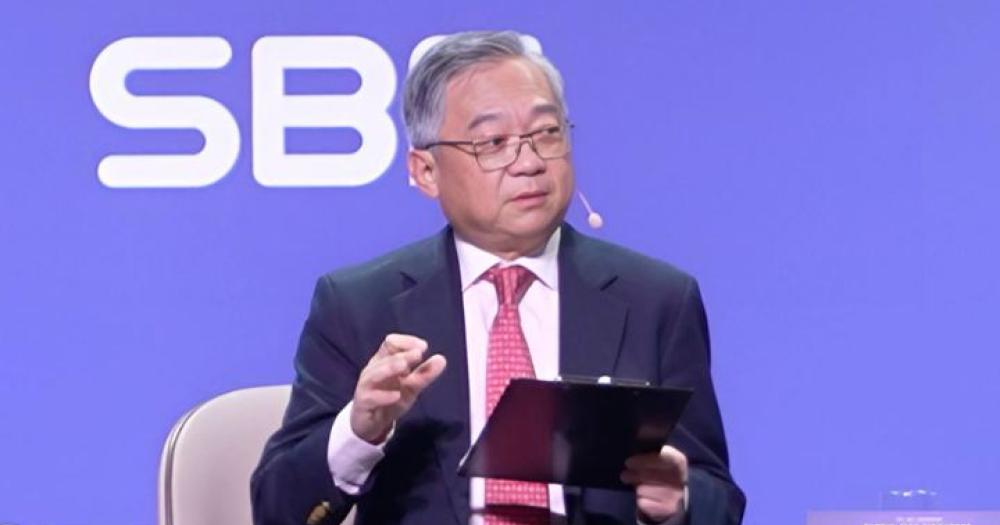
Gan Kim Yong spoke at the Institute of Policy Studies' and Singapore Business Federations' conference, entitled Global City Singapore: SG60 and Beyond on Jul. 29, where he gave a comprehensive rundown of who he had spoken to during his recent working visit to the United States, including his meetings with legislators, administration staff, and business leaders.
Aside from a full throated endorsement of the Singapore Pavilion at the 2025 Osaka Expo (he recommends visiting it, if you can), the following is Gan's opening address to the conference:
Opening address
The Prime Minister spoke this morning, and all of you have heard his speech.
I think he talked about the world that we are facing, that is increasingly becoming uncertain and full of challenges and difficulties moving forward, and a lot of variability.
So I think it is something that we have to confront.
At the same time, we are also strengthening Singapore's value proposition to the world by being a trusted, reliable partner.
We will continue to work with like-minded countries to move forward with our economic agenda.
As I said, I just came back from the U.S.
Four-point update
Just to give you a very quick update of my discussion in the U.S., I went there with four key objectives:
First, is to have first-hand information and assessment of the economy, how it's going, where it's moving towards, what the outlook is like.
Secondly, to meet up with various Congressmen from both parties, to engage them, to share with them about Singapore.
And thirdly, to meet up with the (Trump) Administration, to discuss areas of collaboration, how we can deepen our cooperation to create more opportunities for the U.S.
And lastly, to also discuss issues relating to the tariff.
The economy
On the first issue of the economy, it's surprising that the U.S. economy continues to be relatively resilient.
When I meet many businessmen in the U.S. as well as academicians, the feedback I get is that the economic outlook seems cautiously optimistic, maybe because of the “Big, Beautiful Bill” that President Trump has just passed, that has entrenched the tax cuts, and the benefits, and support for businesses.
So the outlook seems to be quite optimistic, albeit cautiously.
So secondly, at the same time, inflation seems to be muted, and they expect maybe one of the reasons is because the full impact of the tariff hasn't flown through yet, so they are still waiting to see whether costs will go up in the second half of the year.
But so far, inflation seems to [have] moderated.
So I think this is reasonably good news for the economy. The unemployment rate has also been stable and has not spiked up.
So I think overall, most of the American businesses are cautiously optimistic about the future.
A good relationship
Secondly, when I met the Congressmen, several of them from both parties, I tried to impress on them the good relationship that Singapore has with the U.S., the long-term and deep engagement that we have, and particularly that the U.S. has a trade surplus with Singapore, unlike many other countries.
And we are also keen to continue to explore how we can work together with the U.S., and we hope the Congressmen will continue to support Singapore's engagement with the U.S.
Administration
And when I met the U.S. Administration, we also talked about cooperation between the two countries beyond just tariffs and beyond just investment and trade.
We also discussed cooperation in the digital economy, in climate change and sustainability, in the green economy, and how we can continue to work together in many of these areas that have a potential for growth.
And also encourage them to continue to engage Asia, not just Singapore, but the larger Asia, because Asean, for example, is a fast-growing region and a very important economic region for the U.S.
So I encourage them to continue to engage with the U.S. and to find ways to work together within the U.S. and Singapore; the U.S. and Asean.
Tariffs
And lastly, on tariffs. We discussed the tariff that the U.S. has introduced since "Liberation Day" in April, and particularly Singapore is subject to the minimum baseline tariff of 10 per cent.
So my first question to them is, can we negotiate on that 10 per cent? Can we try to reduce it or eliminate the 10 per cent?
I think the answer, for the time being, was quite obvious. They are not in the mood to discuss any discount to the baseline tariff, which I think I shared with many of you earlier.
But we also want to put a place marker to remind the U.S. that at any point in time, in the future, if there's flexibility to discuss the baseline tariff, we are interested in negotiating on the baseline tariffs.
So I think we just want to register our interests at the same time, when we discuss with them, I think that the U.S. has mentioned several times that the baseline tariff may be adjusted going forward.
So we also wanted to know whether the baseline tariff will stay at 10 per cent, or will it be higher or lower.
And the answer was non-committal, and they are still reviewing the tariff, and in time to come, they will make the appropriate announcement.
So we just have to wait and see. I think there are significant uncertainties.
I did not have a chance to meet Secretary Lutnick (Howard Lutnick, U.S. Secretary of Commerce), and therefore, we didn't go into details of negotiation on the pharmaceutical tariffs.
Administration's focus
And I think the administration's focus now is to finish the negotiation of reciprocal tariffs.
So after that, they will start to engage countries on specific sectoral tariffs, like pharmaceuticals or semiconductors.
So I think that, in a nutshell, is what I have engaged the U.S. to discuss.
And generally, I think we continue to have a very good working relationship between the U.S. and Singapore, and we are happy to see that the U.S. has completed negotiations with several countries and several economic groups, including the EU.
And I think this gives the U.S. a sense that there's good progress in tariff negotiations.
Uncertainty
But I also come back with a sense that there remains significant uncertainty. I'm not sure whether the uncertainty has really been eliminated or even reduced.
Say, for example, to start with, despite the fact that they have completed negotiations with several countries, the details are not yet fully discussed or disclosed.
And how, for example, the definition of rules of origin, how do you determine the rules of origin? The details are not out yet.
And how to implement some of these tariffs, because it's very complicated to have different tariffs for different countries, and how do you deal with inter-country transfers, transhipment, re-exports, re-manufacturing, value-added manufacturing and so on.
How do you account for the contribution, the components from different countries?
The details have not been worked out, both in terms of definition as well as implementation.
On top of that, there's also uncertainty as to the sectoral tariffs, which has not been determined.
And the baseline tariff, as I mentioned, whether it will stay at 10 per cent or whether it will be higher, is something that remains yet to be seen.
Beyond the tariffs
And beyond the tariffs discussion, there's also the question of how countries will respond as a result of tariff negotiations.
Let's say, for example, the EU has committed to make an investment of US$550 billion over a period of time.
And whether these investments will be new investments, or whether they will be investments that will be diverted from investments into other countries, is a question that we do not know yet.
Japan has also committed investments into the U.S., and Japan has been a major investor in Singapore.
Whether the Japanese investment in Singapore will be diverted into the U.S. is a second question that is yet to be seen.
So there are uncertainties as to how countries will respond to the outcome of the tariff and negotiation.
Some countries have also committed to purchasing more from the U.S., and they would have been purchasing these products from other countries; now, instead of purchasing from country A or country B, they will now purchase from the U.S.
And therefore exports from these countries to the affected countries will be changed.
So I think these second derivative uncertainties that no one is paying much attention [to] yet, because we need to have the tariffs settled, then we'll work out [what] the secondary impact will be.
Supply chain restructuring
And then in the medium to longer term, there's also an issue of how the supply chain will be restructured.
If countries that have investments in high-tariff countries decide to move their investments, to relocate their manufacturing plant to a lower-tariff country, so as to benefit from the lower tariffs imposed by the U.S..
So this will result in shifts in the supply chain, and these shifts are another uncertainty that we have yet to see.
The economics will have to be worked out based on the relative tariffs from different countries.
Agreement today, rate change tomorrow
But in the medium and longer term, the concern and uncertainty that we are facing really is, how would this impact the overall global trading system, what we call the rules-based multilateral trading system, that we depend on rules respecting trade agreements with one another, and not to change at will.
It's something that has been challenged.
Today, we may agree with one another on certain tariffs, but tomorrow, something happens, I will decide to change my tariff rate that I impose on you.
And that is something that is very uncertain, and that has been seen over the last few months.
As you see tariffs being negotiated, we have a minimum baseline tariff of 10 per cent, and it is at the risk of being adjusted going forward, and whether that will be the final tariff, no one can tell.
So the uncertainty, in fact, over the last few months, has been raised.
It is something that we will need to recognise, adjust ourselves, and respond to it.
Related story:
Top image via Mothership